









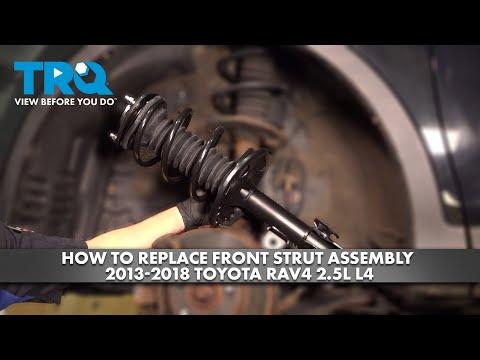






How to Replace the Front Struts on a 2013-2018 Toyota RAV4 (Trim: LE)
Step-by-step instructions with tools, parts, torque specs, and alignment tips
How to Replace the Front Struts on a 2013-2018 Toyota RAV4 (Trim: LE)
Step-by-step instructions with tools, parts, torque specs, and alignment tips for 2013, 2014


🔧 Front Strut Assembly - Replacement
Your RAV4 uses front struts, not rear struts. This job replaces the complete front strut assembly on one side or both sides. Since the strut is part of the suspension and steering geometry, it must be torqued correctly and aligned after the repair.
Difficulty Level: Intermediate | Estimated Time: 3-5 hours
⚠️ Safety & Precautions
- Support the vehicle with jack stands before removing any suspension parts.
- Do not rely on a floor jack alone.
- The coil spring is under high tension. Replace the complete strut assembly only if possible. If you are not using a complete assembly, a spring compressor is required and can be dangerous.
- Mark the position of the strut-to-knuckle bolts before removal if possible to help preserve alignment.
- Get a wheel alignment immediately after the repair.
- Battery disconnect is not required for this repair.
🔧 Required Tools
You'll need the following tools for this repair:
- Floor jack (rated 3-ton minimum)
- Jack stands (rated 3-ton minimum)
- Wheel chocks
- 21mm lug wrench or socket
- 14mm socket
- 17mm socket
- 19mm socket
- 21mm socket
- Ratchet
- Breaker bar
- Torque wrench
- Penetrating oil
- Trim clip tool
- Rubber mallet
- Paint marker
- Safety glasses
- Work gloves
🔩 Required Parts
HowToo sells all the parts you need for this repair:
- Front strut assembly - Qty: 2
- Front strut mount hardware - Qty: 2 sets
- Front stabilizer link nuts - Qty: 2
- Front strut-to-knuckle bolts and nuts - Qty: 2 sets
📋 Before You Begin
- Park on level ground.
- Set the parking brake.
- Chock the rear wheels.
- Break the front lug nuts loose before lifting the vehicle.
- If you are replacing both sides, do one side at a time so the sway bar and knuckle stay supported.
🔨 Step-by-Step Instructions
Follow these steps in order:
Step 1: Loosen the wheel nuts
- Use a 21mm lug wrench or socket to loosen the front wheel nuts about one turn.
- Do this before lifting the vehicle.
Step 2: Raise and support the vehicle
- Use a floor jack to lift the front of the vehicle at the proper lift point.
- Set the vehicle on jack stands and make sure it is stable before continuing.
- Remove the wheel nuts and wheel.
Step 3: Free the attached lines and links
- Use a 14mm socket to remove the brake hose bracket bolt from the strut.
- Use a 17mm socket to remove the stabilizer link nut from the strut.
- If the link stud spins, hold it with the correct wrench while loosening the nut.
- Spray penetrating oil first if parts are rusty.
Step 4: Mark the strut position
- Use a paint marker to mark the relationship between the strut and steering knuckle.
- This helps keep alignment as close as possible until the final alignment.
Step 5: Remove the lower strut bolts
- Use a 19mm socket and breaker bar to remove the two strut-to-knuckle bolts and nuts.
- Support the knuckle while removing the last bolt so the axle and brake hose are not stressed.
- Torque on installation: 177 Nm (131 ft-lbs)
Step 6: Remove the upper strut nuts
- Open the hood and locate the top of the strut tower.
- Use a 14mm socket to remove the three upper strut mount nuts.
- Leave one nut loosely threaded until you are ready to remove the strut so it does not drop unexpectedly.
- Torque on installation: 49 Nm (36 ft-lbs)
Step 7: Remove the strut assembly
- Remove the last upper nut while holding the strut assembly with one hand.
- Work the strut out of the wheel well.
- Use a rubber mallet gently if the knuckle is stuck to the strut.
Step 8: Install the new strut assembly
- Position the new strut in the tower first.
- Start the upper nuts by hand with a 14mm socket, but do not fully tighten yet.
- Line up the lower strut body with the steering knuckle.
Step 9: Reconnect the lower strut and suspension parts
- Use the 19mm socket to install the lower strut bolts and nuts.
- Tighten the bolts evenly.
- Torque to 177 Nm (131 ft-lbs)
- Reinstall the stabilizer link using a 17mm socket.
- Torque to 74 Nm (55 ft-lbs)
- Reinstall the brake hose bracket with a 14mm socket.
- Torque to 29 Nm (21 ft-lbs)
Step 10: Tighten the upper mount nuts
- Use a 14mm socket to fully tighten the upper mount nuts.
- Torque to 49 Nm (36 ft-lbs)
Step 11: Reinstall the wheel
- Put the wheel back on and hand-tighten the lug nuts.
- Lower the vehicle with the floor jack.
- Use a 21mm lug wrench or torque wrench to tighten the wheel nuts in a star pattern.
- Torque to 103 Nm (76 ft-lbs)
✅ After Repair
- Bounce the front of the vehicle a few times and listen for clunks.
- Check that the brake hose and ABS wire are routed correctly.
- Test drive slowly at first and listen for unusual noises.
- Get a professional wheel alignment as soon as possible.
- If you replaced both sides, make sure both front ride heights look even.
💰 DIY vs Shop Cost
Shop Cost: $650-$1,100 (parts + labor)
DIY Cost: $220-$500 (parts only)
You Save: $430-$600 by doing it yourself!
Shop labor rates vary but typically run $100-$150/hour. This repair takes a shop approximately 2-3 hours.
🎯 Ready to get started?
HowToo makes it easy: same-day/2-day shipping on every part, plus all the tools and specialty tools you need! Check out the parts and tools sections below to add everything to your cart.
Guide for Suspension Strut Assembly replace for these Toyota vehicles
| Year Make Model | Sub Model | Engine | Body Style |
|---|---|---|---|
| 2018 Toyota RAV4 | LE | - | - |
| 2018 Toyota RAV4 | Limited | - | - |
| 2018 Toyota RAV4 | XLE | - | - |
| 2018 Toyota RAV4 | Hybrid Limited | - | - |
| 2018 Toyota RAV4 | Hybrid XLE | - | - |
| 2018 Toyota RAV4 | SE | - | - |
| 2018 Toyota RAV4 | Hybrid SE | - | - |
| 2018 Toyota RAV4 | Platinum | - | - |
| 2018 Toyota RAV4 | Adventure | - | - |
| 2017 Toyota RAV4 | LE | - | - |
| 2017 Toyota RAV4 | Limited | - | - |
| 2017 Toyota RAV4 | XLE | - | - |
| 2017 Toyota RAV4 | Hybrid Limited | - | - |
| 2017 Toyota RAV4 | Hybrid XLE | - | - |
| 2017 Toyota RAV4 | SE | - | - |
| 2017 Toyota RAV4 | Hybrid SE | - | - |
| 2017 Toyota RAV4 | Platinum | - | - |
| 2016 Toyota RAV4 | LE | - | - |
| 2016 Toyota RAV4 | Limited | - | - |
| 2016 Toyota RAV4 | XLE | - | - |
| 2016 Toyota RAV4 | Hybrid Limited | - | - |
| 2016 Toyota RAV4 | Hybrid XLE | - | - |
| 2016 Toyota RAV4 | SE | - | - |
| 2015 Toyota RAV4 | LE | - | - |
| 2015 Toyota RAV4 | Limited | - | - |
| 2015 Toyota RAV4 | XLE | - | - |
| 2014 Toyota RAV4 | EV | - | - |
| 2014 Toyota RAV4 | LE | - | - |
| 2014 Toyota RAV4 | Limited | - | - |
| 2014 Toyota RAV4 | XLE | - | - |
| 2013 Toyota RAV4 | EV | - | - |
| 2013 Toyota RAV4 | LE | - | - |
| 2013 Toyota RAV4 | Limited | - | - |
| 2013 Toyota RAV4 | XLE | - | - |