









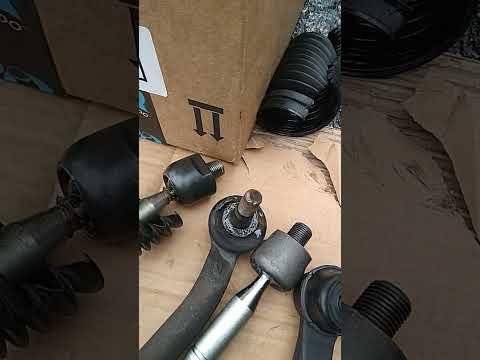







How to Replace the Front Outer Tie Rod Ends on a 2013 Toyota Camry
Step-by-step DIY tie rod end replacement with tools, parts list, torque specs, safety tips, and cost savings
How to Replace the Front Outer Tie Rod Ends on a 2013 Toyota Camry
Step-by-step DIY tie rod end replacement with tools, parts list, torque specs, safety tips, and cost savings


🔧 Camry - Front Outer Tie Rod End Replacement
You’ll be replacing the front outer tie rod ends on your Camry. These connect the steering rack to the wheel and are critical for safe, accurate steering.
Difficulty Level: Intermediate | Estimated Time: 2–3 hours (both sides)
⚠️ Safety & Precautions
- ⚠️ Always support the car with jack stands, never rely on the floor jack alone.
- ⚠️ Wear eye protection when using a pickle fork or puller; joints can release suddenly.
- ⚠️ Work on cool components and on solid, level ground to avoid the car shifting.
- ⚠️ After this repair, a professional wheel alignment is strongly recommended for safe driving.
- ⚠️ Turn the ignition OFF and keep the key out of the ignition while working near the steering.
🔧 Required Tools
You'll need the following tools for this repair:
- 🛠️ Floor jack (rated 3-ton minimum)
- 🛠️ Jack stands (rated 3-ton minimum, Qty: 2)
- 🛠️ Wheel chocks
- 🛠️ Lug wrench (21mm)
- 🛠️ Ratchet handle 3/8"
- 🛠️ Ratchet handle 1/2"
- 🛠️ Socket 10mm
- 🛠️ Socket 17mm
- 🛠️ Socket 19mm
- 🛠️ Open-end wrench 19mm
- 🛠️ Open-end wrench 22mm
- 🛠️ Torque wrench 3/8" drive (5–80 ft-lbs range)
- 🛠️ Torque wrench 1/2" drive (30–150 ft-lbs range)
- 🛠️ Breaker bar 1/2"
- 🛠️ Needle-nose pliers
- 🛠️ Hammer 16oz
- 🛠️ Tie rod end puller (specialty)
- 🛠️ Pickle fork ball joint separator (specialty)
- 🛠️ Wire brush small
- 🛠️ Paint marker or white correction pen
- 🛠️ Measuring tape (metric and inch)
- 🛠️ Penetrating oil spray
- 🛠️ Shop rags
- 🛠️ Safety glasses
- 🛠️ Mechanic gloves
🔩 Required Parts
HowToo sells all the parts you need for this repair:
- 🔩 Front outer tie rod end - left side - Qty: 1
- 🔩 Front outer tie rod end - right side - Qty: 1
- 🔩 New tie rod end nuts (included with tie rod ends) - Qty: 2
- 🔩 New cotter pins (if supplied with parts) - Qty: 2
- 🔩 Anti-seize compound - Qty: small tube
- 🔩 Rust penetrant spray - Qty: 1 can
- 🔩 Shop towels - Qty: 1 pack
📋 Before You Begin
- Park your Camry on level ground, engage the parking brake, and place wheel chocks behind the rear wheels.
- Loosen (but do not remove) the front wheel lug nuts with the 21mm lug wrench before lifting the car.
- Raise the front of the car using the floor jack at the front center jacking point, then support both sides with jack stands under the pinch welds.
- Turn the steering wheel (with engine off) to point the side you’re working on slightly outward so the tie rod is easier to access.
- Spray penetrating oil on the outer tie rod end threads and the nut at the steering knuckle and let it soak for at least 5–10 minutes.
🔨 Step-by-Step Instructions
Follow these steps in order:
Step 1: Remove the front wheel
- Use the 21mm lug wrench to remove the front wheel lug nuts completely.
- Remove the wheel and set it aside, flat, under the car as an extra safety layer.
- Keep lug nuts together so none get lost.
Step 2: Identify the outer tie rod end
- The outer tie rod end is the small joint connecting the steering arm (knuckle) to the long rod coming from the steering rack.
- Find the lock nut on the inner tie rod (the nut just behind the outer tie rod end on the threaded shaft).
- Look for the small joint with a stud through the knuckle.
Step 3: Mark the current position for alignment reference
- Use the paint marker to draw a line across the outer tie rod end and the inner tie rod threads where they meet at the lock nut.
- This helps you install the new tie rod end in a similar position to keep the alignment close.
- Measure from a fixed point (for example, the center of the tie rod joint) to the center of the strut or another repeatable point with the measuring tape and note it down.
- These marks do not replace a real alignment.
Step 4: Loosen the lock nut on the inner tie rod
- Use a 22mm open-end wrench on the lock nut behind the outer tie rod end.
- Hold the outer tie rod end body with the 19mm open-end wrench so it does not turn while you break the lock nut free.
- Turn the lock nut about 1–2 turns only (do not remove yet) so you keep the reference position.
- If very tight, apply more penetrant and wait.
Step 5: Remove the cotter pin and castle nut
- If your Camry’s tie rod end uses a cotter pin, straighten its bent ends with needle-nose pliers and pull it out.
- Use a 17mm socket and 3/8" ratchet to loosen and remove the nut holding the tie rod stud to the steering knuckle.
- If the stud spins while loosening, press down on the joint with your hand while turning the nut, or use a jack under the arm to apply pressure.
Step 6: Separate the tie rod end from the steering knuckle
- Position the tie rod end puller (specialty) over the joint and tighten it with a 17mm socket or appropriate tool until the joint “pops” loose.
- If you use a pickle fork ball joint separator (specialty), place it between the tie rod end and the knuckle and tap it with the hammer until the joint separates.
- Avoid hitting the threaded stud directly with the hammer to prevent damage.
- Expect a loud pop when it releases.
Step 7: Unscrew and count turns of the old tie rod end
- Once the stud is free from the knuckle, hold the inner tie rod steady with the 22mm open-end wrench on the lock nut area if needed.
- Turn the outer tie rod end by hand to unscrew it from the inner tie rod threads.
- Count each full turn as you remove it (example: 14 full turns) and write this number down.
- Same turn count will help keep toe close.
Step 8: Prepare the inner tie rod threads
- Use a wire brush to clean the exposed threads on the inner tie rod.
- Wipe with a shop rag and apply a very thin coat of anti-seize compound to the threads (optional but helpful in future).
- Make sure the lock nut is still on the inner tie rod and close to your paint mark.
Step 9: Install the new outer tie rod end
- Compare the new tie rod end to the old one: same length, same stud size, and same thread direction.
- Screw the new outer tie rod end onto the inner tie rod by hand, turning it the exact number of turns you counted when removing the old one.
- Line up the new tie rod end so the joint points correctly into the steering knuckle.
- Hand-thread first to avoid cross-threading.
Step 10: Attach the tie rod stud to the steering knuckle
- Insert the stud of the new tie rod end into the hole in the steering knuckle.
- Install the new nut by hand until it is snug.
- Use a 17mm socket and 3/8" torque wrench to tighten the nut to 49 Nm (36 ft-lbs).
- If the nut has castle slots and a cotter pin hole, align the slots by tightening slightly further (never loosen to align), then install a new cotter pin with needle-nose pliers.
Step 11: Tighten the lock nut
- Hold the new outer tie rod end body with the 19mm open-end wrench.
- Use the 22mm open-end wrench to tighten the lock nut against the back of the outer tie rod end.
- Tighten the lock nut to approximately 74 Nm (55 ft-lbs) using a 22mm crowfoot on the torque wrench if available, or snug firmly with the wrench.
- Ensure the outer tie rod end does not twist as you tighten the lock nut.
Step 12: Repeat for the other side (if replacing both)
- Repeat Steps 1–11 on the other front wheel.
- Try to match the same number of turns and similar measurements to keep the steering centered.
Step 13: Reinstall the wheels
- Mount the wheel back on the hub.
- Hand-tighten the lug nuts with the 21mm lug wrench in a star pattern.
- Lower the car off the jack stands using the floor jack, then fully down to the ground.
- Use the 21mm socket and 1/2" torque wrench to torque the lug nuts to 103 Nm (76 ft-lbs) in a star pattern.
Step 14: Basic toe check (quick DIY check only)
- Roll the car forward and backward a meter or so to settle the suspension.
- Use the measuring tape to compare distances between front edges and rear edges of the front tires (at hub height). They should be close to equal.
- If something looks far off (visibly toe-in or toe-out), do not drive fast. Go slowly to the alignment shop.
- This check does not replace a shop alignment.
✅ After Repair
- Start the engine and gently turn the steering wheel from lock to lock. Listen for any clunks and make sure the steering feels smooth.
- Test drive slowly in a safe area. Check that the steering wheel is roughly centered and the car does not pull strongly to one side.
- Schedule a professional four-wheel alignment as soon as possible; tell them you replaced both front outer tie rod ends.
- After the alignment, recheck the front lug nut torque to 103 Nm (76 ft-lbs).
💰 DIY vs Shop Cost
Shop Cost: $300–$500 (parts + labor, both sides, plus alignment)
DIY Cost: $80–$150 (parts) + $60–$100 (alignment)
You Save: About $150–$250 by doing the tie rod ends yourself!
Shop labor rates vary but typically run $100–$150/hour. This repair takes a shop approximately 1.0–1.5 hours plus alignment time.
🎯 Ready to get started?
HowToo makes it easy: same-day/2-day shipping on every part, plus all the tools and specialty tools you need! Check out the parts and tools sections above to add everything to your cart.