









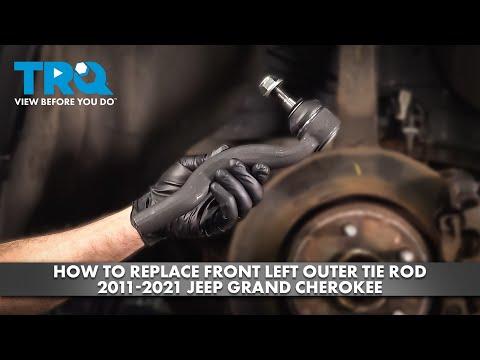







How to Replace the Front Outer Tie Rod End on a 2019 Jeep Grand Cherokee
Step-by-step DIY repair guide with tools, parts list, torque specs, safety tips, and cost savings breakdown for 2016, 2017, 2018, 2019, 2020, 2021
How to Replace the Front Outer Tie Rod End on a 2019 Jeep Grand Cherokee
Step-by-step DIY repair guide with tools, parts list, torque specs, safety tips, and cost savings breakdown for 2016, 2017, 2018, 2019, 2020, 2021


🔧 Grand Cherokee - Front Outer Tie Rod End Replacement
This guide walks you through replacing a front outer tie rod end on your Grand Cherokee. The outer tie rod connects the steering rack to the wheel hub and a worn one can cause looseness, uneven tire wear, or clunking while steering.
Difficulty Level: Intermediate (first-timer friendly) | Estimated Time: 2–3 hours
⚠️ Safety & Precautions
- 🛑 Always support the vehicle with jack stands, never rely on the floor jack alone.
- 🛑 Work on a flat, solid surface and chock the rear wheels so the vehicle cannot roll.
- 🛑 Wear safety glasses; separating the tie rod can release stored energy suddenly.
- 🛑 Do not place your hands between the tire and fender while the vehicle is lifted.
- 🛑 After this repair, a professional wheel alignment is mandatory to avoid rapid tire wear.
- 🛑 No battery disconnection is required for this repair.
🔧 Required Tools
You'll need the following tools for this repair:
- 🛠️ Floor jack (rated 3-ton minimum)
- 🛠️ Jack stands (rated 3-ton minimum)
- 🛠️ Wheel chocks
- 🛠️ Lug wrench (21mm)
- 🛠️ Ratchet (3/8" drive)
- 🛠️ Ratchet (1/2" drive)
- 🛠️ Socket set metric (8mm–21mm)
- 🛠️ Open-end/box wrench set metric (10mm–24mm)
- 🛠️ Adjustable wrench (10–30mm capacity)
- 🛠️ Tie rod end puller (specialty)
- 🛠️ Ball joint separator "pickle fork" (specialty)
- 🛠️ Hammer (16–24 oz)
- 🛠️ Torque wrench (10–150 ft-lbs range)
- 🛠️ Needle-nose pliers
- 🛠️ Marker or paint pen
- 🛠️ Penetrating oil spray
- 🛠️ Wire brush small
- 🛠️ Shop rags
- 🛠️ Gloves
- 🛠️ Safety glasses
🔩 Required Parts
HowToo sells all the parts you need for this repair:
- 🔩 Front outer tie rod end (left or right, as needed) - Qty: 1 per side
- 🔩 New tie rod end nut - Qty: 1 per side
- 🔩 New jam nut (lock nut) for outer tie rod - Qty: 1 per side
- 🔩 Cotter pin (if your new tie rod nut uses one) - Qty: 1 per side
- 🔩 Anti-seize compound - Qty: small tube
- 🔩 Penetrating oil - Qty: 1 can
- 🔩 Brake cleaner spray - Qty: 1 can
📋 Before You Begin
- 🔧 Park the Grand Cherokee on level ground, set the parking brake, and place wheel chocks behind the rear tires.
- 🔧 Loosen the front wheel lug nuts slightly with the 21mm lug wrench before lifting the vehicle.
- 🔧 Decide which side you are replacing (left, right, or both). Best to replace both fronts together.
- 🔧 Spray penetrating oil on the outer tie rod end nut and the jam nut where the tie rod threads into the inner rod; let it soak for 5–10 minutes.
- 🔧 No scan tool setup is needed for this job, but schedule a wheel alignment as soon as possible after the repair.
🔨 Step-by-Step Instructions
Follow these steps in order:
Step 1: Lift and support the front of the vehicle
- Use the 21mm lug wrench to loosen (but not remove) the front wheel lug nuts about one turn.
- Position the floor jack under the front crossmember or approved jacking point and raise the front until the wheel is off the ground.
- Place jack stands under the front frame rails at the factory support points and slowly lower the vehicle onto the stands using the floor jack.
- Once supported, remove the lug nuts fully with the 21mm socket and 1/2" ratchet and pull the wheel off.
- Shake the vehicle on stands to confirm stability.
Step 2: Identify the outer tie rod and clean threads
- Locate the outer tie rod end; it is the small arm that connects the steering linkage to the steering knuckle behind the brake rotor.
- Use the wire brush to clean the exposed threads between the inner tie rod and outer tie rod, and around the jam nut.
- Spray more penetrating oil on the jam nut and the tie rod stud nut and let it soak a couple of minutes.
- Clean threads make removal much easier.
Step 3: Mark the tie rod position for basic alignment
- With the wheel still off, take a marker or paint pen and mark a line across the inner tie rod and the outer tie rod to show their relative position.
- Also, count how many threads are visible between the jam nut and the outer tie rod and note it down, or take a photo.
- This helps keep toe close before alignment.
Step 4: Loosen the jam nut
- Use an appropriately sized open-end wrench (usually 21–22mm) on the jam nut that locks the outer tie rod to the inner tie rod.
- Hold the inner tie rod with another open-end wrench if there are flats provided, to avoid twisting it.
- Turn the jam nut counterclockwise about 1–2 turns to free the outer tie rod. Do not remove it completely yet.
- If stuck, apply more penetrating oil and tap lightly.
Step 5: Remove the tie rod end nut from the steering knuckle
- Remove any cotter pin (small locking pin) from the tie rod stud using needle-nose pliers.
- Use the appropriate socket (commonly 21mm) and 1/2" ratchet to remove the castle nut or standard nut holding the tie rod stud to the steering knuckle.
- If the stud spins while you try to remove the nut, press up on the tie rod end with a floor jack under the joint to add friction, then remove the nut.
Step 6: Separate the tie rod end from the steering knuckle
- Position the tie rod end puller over the joint as designed and tighten it with a socket and ratchet until the stud pops free from the steering knuckle.
- If you do not have a puller, place the pickle fork between the tie rod end and the steering knuckle and tap the fork with the hammer until the joint separates.
- Do not hit the threaded part of the stud directly with the hammer.
- Loud “pop” is normal when it separates.
Step 7: Unscrew and remove the old outer tie rod end
- With the joint free from the knuckle, turn the outer tie rod end by hand or with an adjustable wrench counterclockwise to unthread it from the inner tie rod.
- Count the number of full turns it takes to remove the outer tie rod and write this number down (for example: 17 full turns).
- Remove the old jam nut if you are replacing it, using an open-end wrench.
- Counting turns helps keep the toe close.
Step 8: Prepare the new outer tie rod end
- Compare the new tie rod end to the old one on a bench; the length, stud size, and shape of the taper should closely match.
- Apply a small amount of anti-seize compound to the inner threads of the new outer tie rod and the outer threads of the inner tie rod using a shop rag.
- Thread the new jam nut onto the inner tie rod by hand until it is several turns on but not near its final position.
Step 9: Install the new outer tie rod end onto the inner tie rod
- Thread the new outer tie rod end onto the inner tie rod by hand, turning it clockwise.
- Turn it the same number of full turns you counted during removal (for example: 17 full turns).
- Align your paint mark as close as possible to the original position using an adjustable wrench if needed for the final fraction of turn.
- Snug the jam nut up to the new outer tie rod by hand for now.
Step 10: Install the tie rod stud into the steering knuckle
- Insert the threaded stud of the new tie rod end into the hole in the steering knuckle.
- Thread the new nut (supplied with the tie rod) onto the stud by hand.
- Use the appropriate socket (often 21mm) and 1/2" ratchet to tighten the nut securely.
- Then use a torque wrench and socket to tighten the nut to 75 Nm (55 ft-lbs).
- If it is a castle nut and the slots do not line up with the cotter pin hole, tighten slightly more (never loosen) until they align, then install the new cotter pin and bend its ends with needle-nose pliers.
Step 11: Tighten the jam nut
- Hold the flat section of the new outer tie rod end with an open-end wrench to prevent it from turning.
- Use another appropriately sized open-end wrench on the jam nut and tighten it firmly against the outer tie rod.
- Using a torque wrench and crowfoot or suitable adapter, torque the jam nut to 75 Nm (55 ft-lbs).
- Do not over-tighten; you can damage the threads.
Step 12: Reinstall the wheel
- Place the wheel back onto the hub and hand-thread all lug nuts.
- Use the 21mm socket and 1/2" ratchet to snug the lug nuts in a star pattern while the vehicle is still on jack stands.
- Raise the vehicle slightly with the floor jack, remove the jack stands, and then slowly lower the vehicle to the ground.
- With the vehicle on the ground, use a torque wrench and 21mm socket to torque the lug nuts in a star pattern to 135 Nm (100 ft-lbs).
Step 13: Repeat on the other side (if needed)
- If you are replacing the outer tie rod end on the other front side, repeat Steps 1–12 for that side.
- Replacing both sides helps even steering feel.
Step 14: Basic steering check
- With the vehicle on the ground, turn the steering wheel full left and full right to make sure there is no binding and that the tie rods move smoothly.
- Visually check that both tie rods look similar in length compared to each side.
- Use brake cleaner spray and shop rags to clean any grease or anti-seize from brake components and wheel surfaces.
✅ After Repair
- 🚗 Take a short, careful test drive at low speed first. Listen for clunks and feel for any strange steering behavior.
- 🚗 The steering wheel may be slightly off-center, and the vehicle may pull a bit; this is normal until a proper alignment is done.
- 🚗 Schedule a four-wheel alignment as soon as possible; tell the shop you replaced the outer tie rod end(s).
- 🚗 After the alignment, check the tie rod nuts and lug nuts again at home with your torque wrench to ensure everything is still tight.
💰 DIY vs Shop Cost
Shop Cost: $300–$500 (parts + labor for one side, including alignment)
DIY Cost: $70–$160 (parts only, alignment extra)
You Save: $130–$250 by doing the tie rod yourself!
Shop labor rates vary but typically run $100–$150/hour. This repair takes a shop approximately 1.0–1.5 hours plus alignment time.
🎯 Ready to get started?
HowToo makes it easy: same-day/2-day shipping on every part, plus all the tools and specialty tools you need! Check out the parts and tools sections above to add everything to your cart.