















How to Replace the Front Lower Control Arms on a 2017 Toyota Corolla
Step-by-step DIY suspension repair with required tools, parts list, torque specs, safety tips, and cost savings
How to Replace the Front Lower Control Arms on a 2017 Toyota Corolla
Step-by-step DIY suspension repair with required tools, parts list, torque specs, safety tips, and cost savings


🔧 Corolla - Control Arm Replacement
Replacing the control arms on your Corolla restores proper steering feel, alignment, and tire wear. Worn control arm bushings or ball joints can cause clunks, vibration, and loose steering. You’ll be unbolting the arm from the chassis and steering knuckle, then installing a new one.
Difficulty Level: Intermediate | Estimated Time: 2–3 hours per side
⚠️ Safety & Precautions
- ⚠️ Always support the car with jack stands, never rely only on a floor jack.
- ⚠️ Work on a flat, solid surface and keep the transmission in Park with the parking brake fully set.
- ⚠️ You will be close to suspension springs; do not loosen any spring or strut top nut.
- ⚠️ Wear safety glasses; rust or debris can fall in your eyes when loosening bolts.
- ⚠️ Torque all suspension fasteners correctly; loose bolts can cause loss of control.
- ⚠️ An alignment is required after control arm replacement to avoid rapid tire wear.
🔧 Required Tools
You'll need the following tools for this repair:
- 🛠️ Floor jack (rated 2-ton or higher)
- 🛠️ Jack stands (rated 2-ton or higher, Qty: 2–4)
- 🛠️ Wheel chocks
- 🛠️ 21mm lug nut socket
- 🛠️ 1/2" drive breaker bar
- 🛠️ 1/2" drive ratchet
- 🛠️ 3/8" drive ratchet
- 🛠️ Socket set (10mm–22mm, metric)
- 🛠️ 17mm socket
- 🛠️ 18mm socket
- 🛠️ 19mm socket
- 🛠️ 17mm combination wrench
- 🛠️ 19mm combination wrench
- 🛠️ Torque wrench (10–150 ft-lbs range)
- 🛠️ Ball joint separator (pickle fork or press type) (specialty)
- 🛠️ Pry bar (18"–24")
- 🛠️ Hammer (2–3 lb)
- 🛠️ Flathead screwdriver (medium)
- 🛠️ Needle-nose pliers
- 🛠️ Penetrating oil spray
- 🛠️ Paint marker or white correction pen
- 🛠️ Wire brush (hand)
- 🛠️ Shop rags
- 🛠️ Mechanic’s gloves
- 🛠️ Safety glasses
🔩 Required Parts
HowToo sells all the parts you need for this repair:
- 🔩 Front lower control arm assembly, left side (with bushings and ball joint) - Qty: 1
- 🔩 Front lower control arm assembly, right side (with bushings and ball joint) - Qty: 1
- 🔩 Front lower control arm bolts and nuts kit - Qty: 1 set
- 🔩 Ball joint nut (self-locking) - Qty: 2
- 🔩 Subframe/control arm mounting bolts (optional, recommended) - Qty: 1 set
- 🔩 Anti-seize compound - Qty: small tube
- 🔩 Rust penetrant spray - Qty: 1
📋 Before You Begin
- 📝 Park the Corolla on level ground, shift to Park, and set the parking brake.
- 📝 Place wheel chocks behind the rear tires.
- 📝 Loosen front wheel lug nuts slightly before lifting the car.
- 📝 You do not need to disconnect the battery for this job.
- 📝 Spray penetrating oil on control arm bolts and ball joint nuts 10–15 minutes before starting.
🔨 Step-by-Step Instructions
Follow these steps in order:
Step 1: Lift and support the front of the car
- Use the 21mm lug nut socket and breaker bar to loosen both front wheels’ lug nuts one turn while the car is still on the ground.
- Position the floor jack under the front center jacking point (under the subframe crossmember).
- Raise the front of the car high enough to place jack stands under the reinforced pinch welds behind each front wheel.
- Lower the car gently onto the jack stands and give the car a firm shake to confirm it is stable.
- Remove both front wheels using the 21mm socket and ratchet.
Step 2: Identify the control arm and fasteners
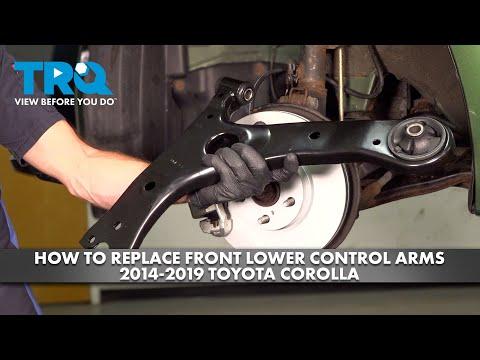
- Locate the front lower control arm: a roughly triangular metal piece running from the front subframe to the steering knuckle.
- Note the three main attachment points:
- Inner front bushing to subframe (front bolt).
- Inner rear bushing to subframe (rear bolt or bracket bolts).
- Ball joint stud to the steering knuckle (outer end).
- Use the paint marker to mark around the rear bushing bracket and subframe edges to help re-position it in the same place. This helps keep alignment close.
Step 3: Remove the ball joint nut from the steering knuckle
- Locate the ball joint stud at the outer end of the control arm where it passes through the steering knuckle.
- Use a wire brush to clean the exposed threads and apply penetrating oil.
- Use the appropriate 17mm or 19mm socket and ratchet to remove the ball joint nut. If it spins, use needle-nose pliers to hold the stud if there is a hex, or apply more penetrating oil.
- Leave the nut threaded on a couple of turns to catch the arm when you separate the joint.
Step 4: Separate the ball joint from the knuckle
- Position the ball joint separator (specialty) between the control arm ball joint and the steering knuckle.
- Tighten the tool using the appropriate socket from your set until the joint “pops” free from the knuckle. This pop is normal.
- If using a pickle fork type, insert the fork and tap it with the hammer until the joint separates. Avoid hitting the rubber boot on new parts.
- Remove the loose ball joint nut fully with the socket and move the control arm downward away from the knuckle.
Step 5: Remove the front inner control arm bolt
- Locate the front bushing where the control arm bolts to the subframe (toward the front of the car).
- Use a 17mm or 19mm socket on a breaker bar and a wrench on the nut (if present) to break the bolt loose.
- Once loose, use the ratchet and socket to remove the bolt fully. Remember its orientation.
Step 6: Remove the rear bushing bolts / bracket
- Find the rear of the control arm where it attaches to the subframe through a larger bushing and bracket.
- Use the socket set (often 17mm–19mm) and ratchet to remove the bolts securing the rear bushing bracket to the subframe.
- You may need the breaker bar if bolts are very tight or rusty.
- Support the control arm with one hand as you remove the last bolt so it doesn’t drop suddenly.
Step 7: Remove the old control arm
- Wiggle and pull the control arm out from the subframe and steering knuckle area.
- Use the pry bar gently if it is stuck in the subframe bushings.
- Compare the old arm to the new arm on the ground. Make sure shape, length, and bushing/ball joint locations match. Never install if parts look different.
Step 8: Install the new control arm in the subframe
- Apply a light coat of anti-seize compound on the shank of the bolts (not on threads if using locking nuts).
- Position the new control arm into the subframe: first slide the rear bushing into its place, then align the front bushing mount.
- Install the rear bracket and bolts by hand using the socket, but do not fully tighten yet.
- Install the front bolt through the front bushing and thread the nut by hand if used. Do not fully tighten yet.
Step 9: Attach the ball joint to the steering knuckle
- Lift the outer end of the control arm and guide the ball joint stud into the steering knuckle hole.
- You may need to jack up the lower control arm slightly using the floor jack under the ball joint area to align it.
- Install the new ball joint nut by hand, then tighten using the socket (17mm or 19mm) and ratchet.
- Tighten the ball joint nut to 49 Nm (36 ft-lbs). If a cotter pin is used, align the slots and install a new pin using needle-nose pliers.
Step 10: Pre-tighten inner bolts, then torque at normal ride height
- Snug the front and rear control arm bolts with the ratchet and appropriate sockets, but do not fully torque while the suspension is hanging.
- Place the floor jack under the control arm near the ball joint and raise it until the car just begins to lift off the jack stand a little. This simulates normal ride height to avoid twisting the rubber bushings.
- Now torque the inner bolts:
- Front control arm bolt to subframe: 125 Nm (92 ft-lbs).
- Rear bushing bracket bolts to subframe: 125 Nm (92 ft-lbs).
- Use the torque wrench with the appropriate socket to tighten to these values.
Step 11: Reinstall wheels
- Lower the jack under the control arm and ensure the car is fully on the jack stands.
- Reinstall the front wheels and hand-tighten lug nuts using the 21mm socket.
- Use the floor jack to raise the car slightly, remove the jack stands, and lower the car completely to the ground.
- Torque the lug nuts in a star pattern to 103 Nm (76 ft-lbs) using the torque wrench and 21mm socket.
Step 12: Repeat for the other side
- Repeat Steps 1–11 for the other front control arm if you are replacing both. Always replace suspension components in pairs.
✅ After Repair
- ✅ Start the engine and slowly turn the steering wheel lock-to-lock while parked. Listen for any clunks or binding.
- ✅ Take a short, gentle test drive on a smooth road. Check for improved stability and no unusual noises.
- ✅ Schedule a professional four-wheel alignment as soon as possible. Tell them the front lower control arms were replaced.
- ✅ After 50–100 km, recheck the control arm bolts and lug nuts for tightness using your torque wrench.
💰 DIY vs Shop Cost
Shop Cost: $450–$750 (parts + labor for both front arms)
DIY Cost: $180–$320 (parts only, both front arms)
You Save: $270–$430 by doing it yourself!
Shop labor rates vary but typically run $100–$150/hour. This repair takes a shop approximately 1.5–2.0 hours per side.
🎯 Ready to get started?
HowToo makes it easy: same-day/2-day shipping on every part, plus all the tools and specialty tools you need! Check out the parts and tools sections above to add everything to your cart.