









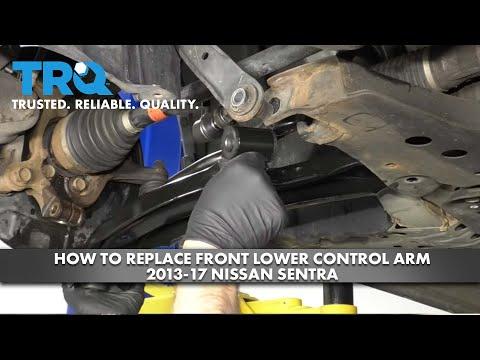







How to Replace the Front Lower Ball Joints on a 2013-2019 Nissan Sentra
Step-by-step instructions with tools, parts, torque specs, safety tips, and alignment guidance
How to Replace the Front Lower Ball Joints on a 2013-2019 Nissan Sentra
Step-by-step instructions with tools, parts, torque specs, safety tips, and alignment guidance for 2013, 2014, 2015, 2016, 2017, 2018, 2019


🔧 Front Lower Ball Joint - Replacement
The front lower ball joints on your Sentra connect the steering knuckle to the lower control arm and allow the front wheels to turn and move smoothly. If they are loose, noisy, or torn, they must be replaced to keep steering safe and accurate.
Difficulty Level: Advanced | Estimated Time: 3-5 hours
⚠️ Safety & Precautions
- Support the car securely with jack stands; never work under a car held up only by a jack.
- Keep the steering knuckle supported when the ball joint is disconnected so the axle and brake hose are not damaged.
- Use caution around the front springs and suspension parts; they can move suddenly under load.
- If the vehicle has a seized or press-fit joint, removal may require a ball joint press (specialty).
- No battery disconnect is required for this repair.
🔧 Required Tools
You'll need the following tools for this repair:
- Floor jack (rated 3-ton minimum)
- Jack stands
- Wheel chocks
- Safety glasses
- Mechanic gloves
- 21mm socket
- 19mm socket
- 18mm socket
- 17mm socket
- 14mm socket
- Ratchet
- Breaker bar
- Torque wrench
- Ball joint separator (specialty)
- Ball joint press (specialty)
- Bungee cord
- Penetrating oil
- Hammer
- Flat screwdriver
🔩 Required Parts
HowToo sells all the parts you need for this repair:
- Front lower ball joint - Qty: 2
- Ball joint mounting nuts and bolts - Qty: 1 set
- New cotter pins - Qty: 2
- Front wheel alignment - Qty: 1
📋 Before You Begin
- Park on level ground and set the parking brake.
- Place wheel chocks behind the rear wheels.
- Loosen the front lug nuts before lifting the car.
- Raise the front and support it securely on jack stands.
- For best results, plan on getting a front-end alignment after the repair.
🔨 Step-by-Step Instructions
Follow these steps in order:
Step 1: Remove the front wheel
- Use a 21mm socket to remove the lug nuts.
- Take off the front wheel and set it aside.
Step 2: Expose the ball joint area
- Turn the steering wheel for better access if needed.
- Spray penetrating oil on the ball joint nut, knuckle hardware, and mounting bolts.
- Let the oil soak before loosening.
Step 3: Disconnect the ball joint from the steering knuckle
- Use a 17mm socket or 19mm socket for the castle nut, depending on the hardware installed.
- Remove the cotter pin first with pliers or a flat screwdriver if equipped.
- Back off the nut, but leave it threaded on a few turns to protect the threads.
- Use a ball joint separator (specialty) to pop the stud out of the knuckle.
- If the stud is stuck, tap the knuckle near the taper with a hammer.
Step 4: Remove the ball joint from the lower control arm
- Use a 14mm socket, 17mm socket, or 18mm socket to remove the ball joint mounting hardware.
- If the joint is riveted or pressed in, use a ball joint press (specialty) to remove it.
- Support the knuckle with a bungee cord so the brake hose and axle are not pulled tight.
Step 5: Install the new ball joint
- Position the new ball joint in the control arm.
- Use the original-style mounting hardware or the supplied hardware from the new part.
- Snug the fasteners with a ratchet, then torque them with a torque wrench.
- Torque the ball joint mounting bolts to 49 Nm (36 ft-lbs).
Step 6: Reconnect the ball joint to the knuckle
- Raise or lower the knuckle by hand until the stud lines up with the steering knuckle.
- Install the nut and tighten it with a 17mm socket or 19mm socket.
- Torque the ball joint nut to 59 Nm (44 ft-lbs).
- If the nut uses a cotter pin, continue tightening only until the slot lines up with the hole, then install a new cotter pin.
Step 7: Reinstall the wheel
- Put the wheel back on and install the lug nuts by hand.
- Lower the car and torque the lug nuts with a torque wrench and 21mm socket.
- Torque the lug nuts to 113 Nm (83 ft-lbs).
✅ After Repair
- Start the car and turn the steering wheel lock-to-lock to check for binding or noise.
- Inspect the ball joint area for any looseness or unusual movement.
- Drive slowly first, then listen for clunks over bumps.
- Get a front-end alignment as soon as possible.
💰 DIY vs Shop Cost
Shop Cost: $350-$700 (parts + labor)
DIY Cost: $80-$220 (parts only)
You Save: $270-$480 by doing it yourself!
Shop labor rates vary but typically run $100-$150/hour. This repair takes a shop approximately 2.5-4 hours.
🎯 Ready to get started?
HowToo makes it easy: same-day/2-day shipping on every part, plus all the tools and specialty tools you need! Check out the parts and tools sections below to add everything to your cart.