














How to Replace the Battery on a 1991-2019 Ford Explorer (Group 65 12V) (Engine: V6 4.0L)
Step-by-step instructions with tools, parts list, safety tips, and terminal/hold-down torque specs
How to Replace the Battery on a 1991-2019 Ford Explorer (Group 65 12V) (Engine: V6 4.0L)
Step-by-step instructions with tools, parts list, safety tips, and terminal/hold-down torque specs for 1991, 1992, 1993, 1994, 1995, 1996, 1997, 1998, 1999, 2000, 2001, 2002, 2003, 2004, 2005, 2006, 2007, 2008, 2009, 2010


🔧 Explorer - Battery Replacement
You’ll remove the old 12V battery from the engine bay and install a new one. The main goals are to keep you safe (batteries can spark) and to make sure the connections are clean and tight so your Explorer starts reliably.
Difficulty Level: Beginner | Estimated Time: 0.5-1.0 hours
⚠️ Safety & Precautions
- Wear eye protection and gloves—battery acid is corrosive.
- Keep sparks/flames away; battery gas can ignite.
- Always disconnect the negative (-) terminal first and reconnect it last.
- Do not let a tool touch the positive (+) terminal and any metal body/engine part at the same time.
- Battery is heavy—lift with both hands and keep it upright.
- Battery disconnect is not required for this job (you’ll be disconnecting it as part of the job).
🔧 Required Tools
You'll need the following tools for this repair:
- 8mm socket
- 10mm socket
- 1/4" ratchet
- 6" socket extension
- Torque wrench (inch-pound)
- Battery terminal brush
- Battery terminal puller (specialty)
- Shop rags
- Nitrile gloves
- Safety glasses
🔩 Required Parts
HowToo sells all the parts you need for this repair:
- 12V battery (Group 65) - Qty: 1
- Battery terminal anti-corrosion spray - Qty: 1
- Battery terminal felt washers - Qty: 1 kit
📋 Before You Begin
- Park on level ground, shift to Park, and set the parking brake.
- Turn the ignition completely OFF and remove the key.
- Open the hood and let the engine bay cool if it’s hot.
- Have your radio presets/clock in mind—some settings may reset when the battery is disconnected.
🔨 Step-by-Step Instructions
Follow these steps in order:
Step 1: Locate the battery and inspect the cables
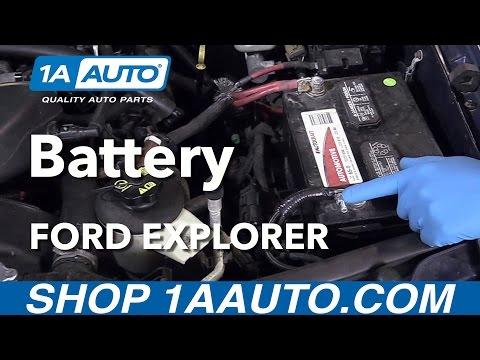
- The battery is in the engine bay. Identify the negative terminal (marked “-”, usually black) and the positive terminal (marked “+”, usually red).
- Use safety glasses and nitrile gloves before touching the terminals.
Step 2: Disconnect the negative (-) battery terminal
- Use an 8mm socket with a 1/4" ratchet to loosen the negative terminal clamp nut.
- Twist the clamp gently and lift it off the battery post.
- If it’s stuck, use a battery terminal puller (specialty) (a small puller that lifts the clamp off without prying).
- Tuck the cable aside so it can’t spring back.
- When reinstalling later: Torque to 44 lb-in (5 N·m)
Step 3: Disconnect the positive (+) battery terminal
- Use an 8mm socket with a 1/4" ratchet to loosen the positive terminal clamp nut.
- Lift the clamp off the battery post and position it so it cannot touch metal.
- When reinstalling later: Torque to 44 lb-in (5 N·m)
Step 4: Remove the battery hold-down
- Use a 10mm socket, 1/4" ratchet, and 6" socket extension to remove the battery hold-down bolt/fastener at the base of the battery.
- Set the hold-down hardware aside where it won’t get lost.
- When reinstalling later: Torque to 80 lb-in (9 N·m)
Step 5: Remove the old battery
- Lift the battery straight up and out using both hands.
- Place it on the ground upright (not on its side).
- Wipe any debris from the tray using shop rags.
Step 6: Clean the terminals and cable clamps
- Use a battery terminal brush to clean the inside of the cable clamps and the battery posts (on the new battery if needed).
- Wipe the residue with shop rags.
- Clean metal-to-metal contact prevents no-start issues.
Step 7: Install the new battery
- Set the new 12V battery (Group 65) into the tray in the same orientation as the old one (posts in the same direction as before).
- Reinstall the hold-down using the 10mm socket, 1/4" ratchet, and 6" socket extension.
- Use a torque wrench (inch-pound): Torque to 80 lb-in (9 N·m)
Step 8: Reconnect the positive (+) terminal first
- Install optional battery terminal felt washers if you’re using them.
- Push the positive clamp fully down onto the positive post.
- Use the 8mm socket and 1/4" ratchet to tighten, then use a torque wrench (inch-pound): Torque to 44 lb-in (5 N·m)
- Apply battery terminal anti-corrosion spray after tightening.
Step 9: Reconnect the negative (-) terminal last
- Push the negative clamp fully down onto the negative post.
- Use the 8mm socket and 1/4" ratchet to tighten, then use a torque wrench (inch-pound): Torque to 44 lb-in (5 N·m)
- Apply battery terminal anti-corrosion spray after tightening.
✅ After Repair
- Start your Explorer and confirm it cranks normally.
- Turn on headlights and blower motor to confirm electrical power is stable.
- Set the clock and re-save radio presets if they reset.
- Check that the battery is secure and the cables can’t move by hand.
💰 DIY vs Shop Cost
Shop Cost: $250-$450 (parts + labor)
DIY Cost: $140-$250 (parts only)
You Save: $110-$200 by doing it yourself!
Shop labor rates vary but typically run $100-$150/hour. This repair takes a shop approximately 0.5-1.0 hours.
🎯 Ready to get started?
HowToo makes it easy: same-day/2-day shipping on every part, plus all the tools and specialty tools you need! Check out the parts and tools sections below to add everything to your cart.
Guide for Vehicle Battery replace for these Ford vehicles
| Year Make Model | Sub Model | Engine | Body Style |
|---|---|---|---|
| 2019 Ford Explorer | - | V6 3.5L | - |
| 2019 Ford Explorer | - | Inline 4 2.3L | - |
| 2018 Ford Explorer | - | V6 3.5L | - |
| 2018 Ford Explorer | - | Inline 4 2.3L | - |
| 2017 Ford Explorer | - | V6 3.5L | - |
| 2017 Ford Explorer | - | Inline 4 2.3L | - |
| 2016 Ford Explorer | - | V6 3.5L | - |
| 2016 Ford Explorer | - | Inline 4 2.3L | - |
| 2015 Ford Explorer | - | V6 3.5L | - |
| 2015 Ford Explorer | - | Inline 4 2.0L | - |
| 2014 Ford Explorer | - | V6 3.5L | - |
| 2014 Ford Explorer | - | Inline 4 2.0L | - |
| 2013 Ford Explorer | - | V6 3.5L | - |
| 2013 Ford Explorer | - | Inline 4 2.0L | - |
| 2012 Ford Explorer | - | V6 3.5L | - |
| 2012 Ford Explorer | - | Inline 4 2.0L | - |
| 2011 Ford Explorer | - | V6 3.5L | - |
| 2010 Ford Explorer | - | V6 4.0L | - |
| 2010 Ford Explorer | - | V8 4.6L | - |
| 2009 Ford Explorer | - | V6 4.0L | - |
| 2009 Ford Explorer | - | V8 4.6L | - |
| 2008 Ford Explorer | - | V6 4.0L | - |
| 2008 Ford Explorer | - | V8 4.6L | - |
| 2007 Ford Explorer | - | V6 4.0L | - |
| 2007 Ford Explorer | - | V8 4.6L | - |
| 2006 Ford Explorer | - | V6 4.0L | - |
| 2006 Ford Explorer | - | V8 4.6L | - |
| 2005 Ford Explorer | - | V6 4.0L | - |
| 2005 Ford Explorer | - | V8 4.6L | - |
| 2004 Ford Explorer | - | V6 4.0L | - |
| 2004 Ford Explorer | - | V8 4.6L | - |
| 2003 Ford Explorer | - | V6 4.0L | - |
| 2003 Ford Explorer | - | V8 4.6L | - |
| 2002 Ford Explorer | - | V6 4.0L | - |
| 2002 Ford Explorer | - | V8 4.6L | - |
| 2001 Ford Explorer | - | V6 4.0L | - |
| 2001 Ford Explorer | - | V8 5.0L | - |
| 2000 Ford Explorer | - | V6 4.0L | - |
| 2000 Ford Explorer | - | V8 5.0L | - |
| 1999 Ford Explorer | - | V6 4.0L | - |
| 1999 Ford Explorer | - | V8 5.0L | - |
| 1998 Ford Explorer | - | V6 4.0L | - |
| 1998 Ford Explorer | - | V8 5.0L | - |
| 1997 Ford Explorer | - | V6 4.0L | - |
| 1997 Ford Explorer | - | V8 5.0L | - |
| 1996 Ford Explorer | - | V6 4.0L | - |
| 1996 Ford Explorer | - | V8 5.0L | - |
| 1995 Ford Explorer | - | V6 4.0L | - |
| 1994 Ford Explorer | - | V6 4.0L | - |
| 1993 Ford Explorer | - | V6 4.0L | - |
| 1992 Ford Explorer | - | V6 4.0L | - |
| 1991 Ford Explorer | - | V6 4.0L | - |