









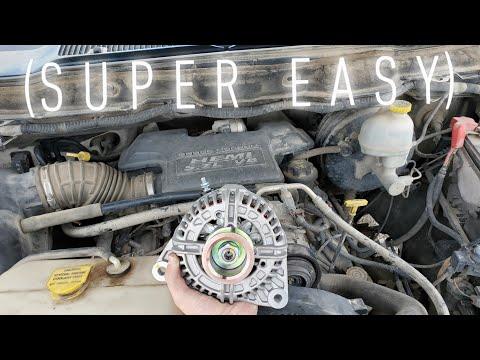





How to Replace the Alternator on a 2022 Ram 1500 Classic 3.6L V6
Step-by-step DIY alternator replacement with tools, parts list, belt routing, torque specs, and safety tips for 2019, 2020, 2021, 2022
How to Replace the Alternator on a 2022 Ram 1500 Classic 3.6L V6
Step-by-step DIY alternator replacement with tools, parts list, belt routing, torque specs, and safety tips for 2019, 2020, 2021, 2022


1500 Classic - Alternator Replacement 🔧
Got it—you want to replace the alternator on your 3.6L V6 4WD SLT. I’ll walk you through it step by step.
Quick check first: Is your truck equipped with Start/Stop (an “A” in a circle button and it shuts off at stoplights)? This can change the alternator style and wiring slightly, but the basic procedure is the same, so I’ll give the standard 3.6L layout that works for both.
Safety First ⚠️
- 🛑 Disconnect the battery before touching the alternator. This prevents sparks and damage to electronics.
- 🧤 Let the engine cool completely. The front of the engine and belt area can get very hot.
- 🧱 Always use jack stands if you raise the truck. A jack alone can fail.
Parts & Specs 📦
- 🔧 Replacement alternator (3.6L V6, correct for your 2022 1500 Classic)
- 🔧 Serpentine belt (optional but recommended if old or cracked)
- 🔧 Alternator mounting bolts torque: about 40–45 ft-lb (54–61 N·m)
- 🔧 B+ (main power) nut torque: about 80–90 in-lb (9–10 N·m)
Exact torque can vary slightly by alternator supplier; if it comes with a spec sheet, follow that.
Tools You’ll Need 🧰
- 🛠️ Socket set (metric): 10mm, 13mm, 15mm, 16mm sockets
- 🛠️ Ratchets: 3/8" drive and 1/2" drive
- 🛠️ Long ratchet or breaker bar (for belt tensioner)
- 🛠️ Serpentine belt tool (optional but helpful; a thin, long bar with special ends)
- 🛠️ Torque wrench (one that can read 10–50 ft-lb)
- 🛠️ Flat trim tool or flat screwdriver (for plastic clips)
- 🛠️ Needle-nose pliers (for clips if needed)
- 🛠️ Work light so you can see the belt routing clearly
A serpentine belt tool is a very slim, long bar that makes it easier to move the belt tensioner in tight spaces.
Access Overview 🧭
On the 3.6L in your 1500 Classic, the alternator is mounted at the front of the engine, upper passenger side. You’ll work mostly from the top, with some access from the front.
Step 1 – Prepare the Truck 🧱
- 🧰 Park on a flat surface, set the parking brake, and put the transmission in PARK.
- 🔌 Open the hood and remove the negative battery cable:
- Use a 10mm socket on the negative (-) terminal.
- Lift the cable off and tuck it aside so it cannot spring back.
Step 2 – Remove Engine Cover & Get Access 🧩
- 🧰 If your 3.6L has a plastic engine cover:
- Grab it at the corners and pull straight up; it’s held by rubber grommets.
- Set it aside.
- 🧰 If any intake ducting or plastic shrouds block access to the front of the engine:
- Loosen the hose clamps (usually 8mm or flat screwdriver).
- Unclip any plastic push-pins with a trim tool.
- Move the ducting aside enough to see the belt and alternator clearly.
Step 3 – Note the Belt Routing 🧵
- 📸 Look for the belt routing diagram sticker under the hood (usually on the radiator support or fan shroud).
- 📸 If you don’t see one, take a clear photo of the belt path around all pulleys before removing it.
Step 4 – Release Belt Tension & Remove Belt from Alternator 🔄
- 🛠️ Locate the belt tensioner:
- It’s a spring-loaded pulley that keeps the belt tight.
- On the 3.6L, it usually has a 15mm or 16mm bolt head in the center.
- 🛠️ Place your long ratchet or serpentine belt tool on the tensioner bolt.
- 🔄 Rotate the tensioner in the direction that loosens the belt (usually clockwise when viewed from the front on this engine).
- ✋ While holding the tensioner, slip the belt off the alternator pulley only.
- 🔁 Slowly release the tensioner back to its rest position.
- 📌 You can leave the belt on the other pulleys if you’re careful, but if it slips off, you’ll just re-route it later using your photo/diagram.
Step 5 – Disconnect Alternator Wiring 🔌
- 🛠️ On the back of the alternator you’ll see:
- A large cable with a nut (this is the B+ power cable).
- A small plug (this is the field/connector plug).
- 🔋 Make sure the negative battery cable is still disconnected.
- 🔧 Remove the B+ cable:
- Use a 13mm socket to remove the nut.
- Lift the cable eyelet off and tuck it aside.
- 🔌 Unplug the small connector:
- Press the locking tab with your thumb or a small flat screwdriver.
- Pull the connector straight off; don’t pry on the wires.
Step 6 – Remove Alternator Mounting Bolts & Alternator 🪛
- 🛠️ Locate the alternator mounting bolts (usually 2–3 bolts, front side into the bracket):
- Common sizes: 15mm or 16mm.
- 🔧 Remove the upper bolts first with a ratchet.
- 🔧 Remove the lower bolt(s) next. Support the alternator with your hand as you remove the last bolt so it doesn’t drop.
- 🧱 Wiggle the alternator out of its bracket:
- It may be snug in the mounting ears; gently rock it side to side.
- If needed, use a small pry bar between the alternator and bracket, but do not pry on thin aluminum parts.
- 📦 Lift the alternator out of the engine bay.
Step 7 – Compare Old and New Alternator 🔍
- 🧰 Set the new alternator next to the old one:
- Check that the mounting ears are in the same positions.
- Check the pulley diameter and number of grooves match.
- Check the electrical connections (same plug style and B+ stud location).
Step 8 – Install the New Alternator 🔩
- 🧱 Place the new alternator into the bracket, lining up the bolt holes.
- 🔧 Install the lower bolt(s) by hand first. Do not tighten fully yet.
- 🔧 Install the upper bolt(s) by hand.
- 🔧 Once all bolts are started, tighten them snug with a ratchet.
- 🔧 Use a torque wrench to tighten the mounting bolts to about 40–45 ft-lb (54–61 N·m).
Step 9 – Reconnect Alternator Wiring 🔌
- 🔧 Reinstall the B+ cable:
- Place the cable eyelet on the stud.
- Install the nut and tighten to about 80–90 in-lb (9–10 N·m) (snug plus a small turn; do not over-tighten).
- 🔌 Plug in the small connector until it clicks.
Step 10 – Reinstall the Belt 🧵
- 🧰 Route the belt around all pulleys according to the diagram/photo, leaving the alternator pulley for last.
- 🔧 Put your ratchet or belt tool on the tensioner again and rotate to release tension.
- 🔁 Slip the belt over the alternator pulley.
- 👀 Double-check:
- The belt is seated in all grooves on every pulley.
- No ribs are hanging off the edge of any pulley.
- 🔁 Slowly release the tensioner.
Step 11 – Reassemble Covers & Reconnect Battery 🔋
- 🧩 Reinstall any intake ducting or plastic covers you removed:
- Push the engine cover back onto its rubber mounts if equipped.
- Tighten hose clamps and reinstall any clips.
- 🔌 Reconnect the negative battery cable:
- Place it on the negative terminal.
- Tighten the 10mm nut snugly (do not over-tighten).
Step 12 – Start-Up & Check ✅
- 🚗 Start the engine.
- 👂 Listen for any belt squeal or unusual noises from the front of the engine.
- 💡 Make sure the battery/charging warning light on the dash turns off after starting.
- 🔍 If you have a multimeter:
- Measure voltage at the battery with the engine running.
- You should see around 13.5–14.8 volts. That means the alternator is charging.
Tips & Common Beginner Mistakes 💡
- 🧠 Don’t skip the battery disconnect. Alternator B+ is always “hot” and can spark badly if grounded.
- 🧠 Take photos as you go, especially of belt routing and wiring.
- 🧠 If the belt squeals after install, re-check that it’s fully seated in all pulley grooves.
If you tell me whether your truck has Start/Stop, I can confirm the exact alternator amperage rating and any small connector differences to double-check your part choice.
HowToo makes it easy: below this answer you’ll see the correct alternator, serpentine belt, and any specialty tools you might need. You can add them to your cart right from the parts section for fast shipping. 🚚