









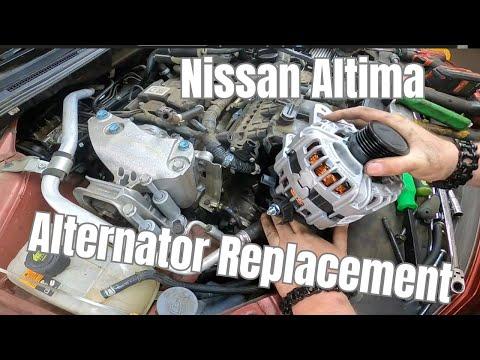






How to Replace the Alternator on a 2019-2022 Nissan Altima 2.5L AWD (Engine: Inline 4 2.0L)
Step-by-step DIY alternator replacement with tools, parts list, safety tips, and detailed instructions
How to Replace the Alternator on a 2019-2022 Nissan Altima 2.5L AWD (Engine: Inline 4 2.0L)
Step-by-step DIY alternator replacement with tools, parts list, safety tips, and detailed instructions for 2019, 2020, 2021, 2022


🔧 Altima - Alternator Replacement
You’ll be removing the old alternator from the front of the engine, swapping it for a new unit, and reinstalling the drive belt. This restores proper battery charging and prevents stalling or no-start issues.
Difficulty Level: Intermediate | Estimated Time: 2–3 hours
⚠️ Safety & Precautions
- ⚠️ Always disconnect the negative battery cable before working; the alternator has live power and can cause dangerous sparks.
- ⚠️ Let the engine cool completely; you’ll be working near hot metal and the exhaust.
- ⚠️ Use jack stands anytime the car is lifted; never rely only on a floor jack.
- ⚠️ Keep metal tools away from the battery positive terminal and alternator B+ stud to avoid short circuits.
- ⚠️ Wear safety glasses and gloves; you’ll work under the car and around tight spaces.
- ⚠️ Do not pry on the serpentine belt tensioner with a screwdriver; only use the proper wrench or serpentine belt tool.
🔧 Required Tools
You'll need the following tools for this repair:
- 🔧 Floor jack (rated 3-ton minimum)
- 🔧 Jack stands (rated 3-ton minimum)
- 🔧 Wheel chocks
- 🔧 Ratchet 3/8" drive
- 🔧 Ratchet 1/2" drive
- 🔧 Metric socket set (8mm–19mm)
- 🔧 Metric combination wrench set (8mm–19mm)
- 🔧 Serpentine belt tool or long-handle 3/8" drive breaker bar (specialty)
- 🔧 Torque wrench 3/8" drive (inch-lb and ft-lb range)
- 🔧 Small flathead screwdriver
- 🔧 Trim clip removal tool or panel popper
- 🔧 Pry bar small
- 🔧 Work light
- 🔧 Fender cover
- 🔧 Safety glasses
- 🔧 Mechanic gloves
🔩 Required Parts
HowToo sells all the parts you need for this repair:
- 🔩 Alternator (for 2.5L engine with AWD) - Qty: 1
- 🔩 Serpentine drive belt - Qty: 1
- 🔩 Alternator mounting bolts (hardware kit, if corroded) - Qty: 1 set
- 🔩 Battery terminal cleaning brush - Qty: 1
- 🔩 Dielectric grease - Qty: 1 small tube
- 🔩 Anti-seize compound - Qty: 1 small tube
- 🔩 Disposable shop towels - Qty: 1 pack
📋 Before You Begin
- Park your Altima on level ground, set the parking brake, and place wheel chocks behind the rear wheels.
- Open the hood and remove any loose items from the engine bay area.
- Turn ignition OFF and remove the key; make sure all lights and accessories are off.
- Disconnect the negative battery terminal using a 10mm wrench, and tuck the cable so it cannot spring back.
- Have your new alternator and belt laid out and compare the pulley size, mounting points, and connectors to your old ones before starting.
🔨 Step-by-Step Instructions
Follow these steps in order:
Step 1: Lift and secure the front of the car
- Use the floor jack at the front jacking point to raise the front of your Altima.
- Place jack stands under the factory pinch welds on both sides and slowly lower the car onto the stands.
- Leave the floor jack just touching the support point as backup, but do not rely on it alone.
- Always shake the car lightly to confirm stability.
Step 2: Remove the right front wheel and splash shield
- Use a 19mm socket and 1/2" ratchet to loosen the right front wheel lug nuts and remove the wheel.
- Turn the steering fully to the left for better access to the inner fender.
- Use a trim clip removal tool or flathead screwdriver to remove plastic clips from the right front inner fender splash shield.
- Use a 10mm socket to remove any small bolts securing the splash shield, then remove the shield to expose the side of the engine and belt area.
Step 3: Remove upper engine cover and air intake ducting
- Under the hood, lift off the plastic engine cover (it pulls straight up off rubber grommets).
- Use a flathead screwdriver to loosen the hose clamp at the air intake tube (near the air filter box or throttle body).
- Unclip any electrical connectors or small hoses on the intake duct gently by hand or with the flathead screwdriver.
- Remove the intake duct so you can see and reach the alternator from above.
Step 4: Relieve serpentine belt tension and remove belt from alternator
- The serpentine belt is the long rubber belt that drives the alternator and other accessories.
- Locate the belt tensioner from the wheel well opening; it is a spring-loaded pulley.
- Use a serpentine belt tool or long 3/8" breaker bar in the tensioner square hole or on the tensioner bolt head (usually 14mm) and rotate it to relieve belt tension.
- While holding tension off with the tool, slip the belt off the alternator pulley using your other hand.
- Slowly release the tensioner back to its resting position.
- Take a picture of the belt routing before removing it.
Step 5: Disconnect wiring from the alternator
- From above and/or through the wheel well, locate the back of the alternator.
- Use a 10mm socket to remove the nut on the large main power cable (B+ terminal) on the back of the alternator, then lift the cable off and set it aside.
- Use a flathead screwdriver to gently lift the locking tab for the small electrical plug (field/LIN connector), then unplug it by hand.
- Inspect the connectors for corrosion and clean lightly with a towel if needed.
Step 6: Remove alternator mounting bolts
- Locate the alternator mounting bolts (usually one upper and one or two lower bolts).
- Use a 14mm socket and 3/8" ratchet to remove the upper mounting bolt.
- From the wheel well, use the same 14mm socket to remove the lower mounting bolt(s). You may need a short extension for access.
- Support the alternator with one hand as you remove the last bolt so it does not drop suddenly.
- When reinstalling later, tighten these bolts to manufacturer specification (refer to service data; do not overtighten).
Step 7: Remove the alternator from the engine bay
- Once the bolts are out, the alternator may still be snug in its bracket.
- Use a small pry bar carefully between the alternator and bracket to break it loose if needed. Do not pry on thin aluminum parts.
- Work the alternator out either upward from the top or downward through the wheel well opening, whichever gives more space.
- Rotate the alternator as needed to snake it out.
Step 8: Prepare and install the new alternator
- Compare the new alternator to the old one: mounting ears, pulley, and plugs must match.
- Apply a light film of anti-seize compound on the alternator mounting ears where they contact the bracket.
- Position the new alternator into the bracket by feeding it in the same way the old one came out.
- Install the upper mounting bolt by hand first (no tools yet), then the lower bolt(s) by hand to avoid cross-threading.
- Use a 14mm socket and ratchet to snug all bolts, then use a torque wrench to tighten each to manufacturer specification.
Step 9: Reconnect alternator wiring
- Push the small electrical connector into the new alternator until it clicks.
- Place the main power cable onto the B+ stud.
- Install the B+ nut using a 10mm socket and gently snug it; then use a torque wrench to tighten to manufacturer specification (do not overtighten; you can strip the stud).
- Apply a small dab of dielectric grease on the external connection if desired to help prevent corrosion.
Step 10: Install the new serpentine belt
- Route the new belt according to the belt routing diagram sticker under the hood, or your photo from earlier.
- Make sure the belt sits fully in the grooves on each pulley and is not twisted.
- Use the serpentine belt tool or breaker bar again to rotate the tensioner and create slack.
- Slip the belt over the alternator pulley last, then slowly release the tensioner.
- Double-check from both top and wheel well that the belt is centered on every pulley.
Step 11: Reinstall intake ducting and engine cover
- Reinstall the air intake duct into position.
- Reconnect any hoses and electrical connectors you removed.
- Use a flathead screwdriver to tighten the intake hose clamp.
- Press the engine cover back down onto its mounting grommets until it clicks into place.
Step 12: Reinstall splash shield and wheel
- Reinstall the inner fender splash shield using the original plastic clips and any 10mm bolts with a 10mm socket.
- Reinstall the right front wheel and hand-thread the lug nuts.
- Use a 19mm socket and ratchet to snug the lug nuts in a star pattern.
- Raise the car slightly with the floor jack, remove the jack stands, then lower the car to the ground.
- Use a torque wrench with 19mm socket to tighten lug nuts to manufacturer specification in a star pattern.
Step 13: Reconnect the battery
- Clean the battery terminals with a battery terminal brush if corroded.
- Reconnect the negative battery cable and tighten the nut with a 10mm wrench to snug plus a little more (do not overtighten).
- Apply a thin coat of dielectric grease on the terminals if available.
✅ After Repair
- Start your Altima and watch the instrument cluster; confirm the battery/charging warning light turns off after starting.
- Listen for any unusual belt squeals or grinding; if you hear noise, shut off the engine and recheck belt routing and bolt tightness.
- Use a multimeter (if you have one) to check voltage at the battery with the engine running; it should typically be around 13.5–14.5 volts.
- Turn on headlights, rear defogger, and blower fan; verify the engine runs smoothly and lights do not dim significantly.
- Your Altima’s ECU should adapt automatically; no special scan-tool coding is typically required for the alternator.
💰 DIY vs Shop Cost
Shop Cost: $650–$950 (parts + labor)
DIY Cost: $250–$450 (parts only)
You Save: $400–$500 by doing it yourself!
Shop labor rates vary but typically run $100–$150/hour. This repair takes a shop approximately 1.5–2.0 hours.
🎯 Ready to get started?
HowToo makes it easy: same-day/2-day shipping on every part, plus all the tools and specialty tools you need! Check out the parts and tools sections below to add everything to your cart.
Guide for Alternator replace for these Nissan vehicles
| Year Make Model | Sub Model | Engine | Body Style |
|---|---|---|---|
| 2022 Nissan Altima | - | Inline 4 2.5L | - |
| 2021 Nissan Altima | - | Inline 4 2.5L | - |
| 2020 Nissan Altima | - | Inline 4 2.5L | - |
| 2019 Nissan Altima | - | Inline 4 2.5L | - |