









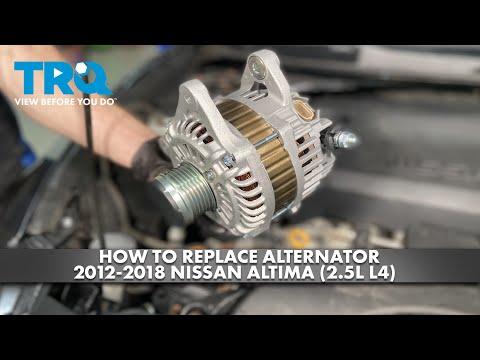







How to Replace the Alternator on a 2016 Nissan Altima (2.5L)
Step-by-step wheel-well access instructions with tools, parts list, safety tips, and torque specs
How to Replace the Alternator on a 2016 Nissan Altima (2.5L)
Step-by-step wheel-well access instructions with tools, parts list, safety tips, and torque specs


🔧 Altima - Alternator Replacement
Your alternator charges the battery and powers the electrical system while the engine runs. Replacing it on your Altima mainly involves disconnecting the battery, removing the serpentine belt, unbolting the alternator, and swapping the electrical connections.
Difficulty Level: Intermediate | Estimated Time: 1.5-3.0 hours
Assumption: 2.5L layout with alternator accessed from passenger wheel well.
⚠️ Safety & Precautions
- ⚠️ Disconnect the battery negative cable first to prevent shorts.
- ⚠️ Support the car on jack stands; never rely on a floor jack alone.
- ⚠️ Keep fingers/tools away from the belt path and pulleys.
- ⚠️ Let the engine cool; the radiator and engine parts can be hot.
🔧 Required Tools
You'll need the following tools for this repair:
- Safety glasses
- Mechanic gloves
- Wheel chocks
- Floor jack (rated 2-ton minimum)
- Jack stands (rated 2-ton minimum)
- Torque wrench (10-150 ft-lbs range)
- 3/8" drive ratchet
- 3/8" drive extension set
- 10mm socket
- 12mm socket
- 14mm socket
- 21mm socket
- Flat trim clip removal tool
- Flathead screwdriver
- Shop light
- Digital multimeter
🔩 Required Parts
HowToo sells all the parts you need for this repair:
- Alternator - Qty: 1
- Serpentine drive belt - Qty: 1
- Plastic splash shield clips - Qty: 1 set
📋 Before You Begin
- Park on level ground, shift to Park, and set the parking brake.
- Place wheel chocks behind the rear wheels.
- Open the hood and disconnect the battery: use a 10mm socket to remove the negative (−) terminal first, then position it so it can’t spring back.
- If you’re new: the serpentine belt is the single long belt that drives multiple accessories.
🔨 Step-by-Step Instructions
Follow these steps in order:
Step 1: Raise the front-right corner and remove the wheel
- Use a 21mm socket to loosen the passenger-front lug nuts 1/2 turn while the tire is on the ground.
- Lift the passenger-front jacking point using a floor jack (rated 2-ton minimum), then set the car down onto jack stands (rated 2-ton minimum).
- Remove the lug nuts with the 21mm socket and take the wheel off.
- Reinstall later: Torque to 113 Nm (83 ft-lbs)
Step 2: Remove the right-side splash shield (inner fender/splash cover)
- Use a flat trim clip removal tool and flathead screwdriver to remove the plastic clips/screws holding the splash shield.
- Pull the shield back to open access to the belt and alternator area.
- Tip: Keep clips in a small cup.
Step 3: Release serpentine belt tension and remove the belt
- From the wheel-well opening, locate the belt tensioner pulley.
- Use a 14mm socket on the tensioner pulley bolt and rotate to relieve tension (you’re “loading” the spring).
- While holding the tension released, slide the belt off the alternator pulley.
- Slowly let the tensioner return to its rest position.
- Tip: Take a quick belt routing photo.
Step 4: Disconnect the alternator electrical connections
- On the back of the alternator, remove the rubber boot covering the main power stud.
- Use a 10mm socket to remove the main power cable nut, then set the cable aside where it can’t touch metal.
- Unplug the alternator electrical connector by pressing the tab and pulling straight out (don’t yank the wires).
- Reinstall later: main power stud nut Torque to 9.8 Nm (87 in-lbs)
Step 5: Unbolt and remove the alternator
- Support the alternator with one hand while loosening bolts.
- Use a 14mm socket and 3/8" drive ratchet with 3/8" drive extensions to remove the alternator mounting bolts (typically upper and lower).
- Work the alternator out through the wheel-well opening.
- Reinstall later: alternator mounting bolts Torque to 49 Nm (36 ft-lbs)
Step 6: Install the new alternator
- Position the new alternator in place.
- Hand-thread the mounting bolts first (this prevents cross-threading).
- Tighten the mounting bolts with a