









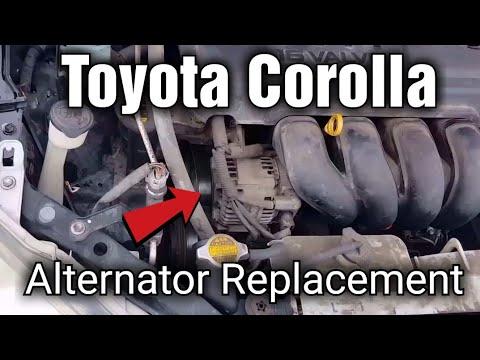







How to Replace the Alternator on a 2007 Toyota Corolla (Step-by-Step Guide)
Tools, parts list, belt tensioner procedures, wiring steps, safety tips, and charging-voltage checks
How to Replace the Alternator on a 2007 Toyota Corolla (Step-by-Step Guide)
Tools, parts list, belt tensioner procedures, wiring steps, safety tips, and charging-voltage checks


🔧 Corolla - Alternator Replacement
Replacing the alternator restores proper battery charging and prevents stalling/no-start issues from a dead battery. On your Corolla, the alternator is belt-driven and mounted high on the engine, so access is straightforward once the belt is relieved.
Difficulty Level: Intermediate | Estimated Time: 1.5-3 hours
⚠️ Safety & Precautions
- 🧯 Disconnect the negative battery cable before touching alternator wiring.
- 🔥 Let the engine cool; the radiator and exhaust area can burn you.
- 🧤 Keep fingers/clothes clear of the belt path and pulleys.
- 🔌 Never short the alternator output stud to ground; it can spark hard.
🔧 Required Tools
You'll need the following tools for this repair:
- Safety glasses
- Mechanic gloves
- Floor jack (rated 2-ton minimum)
- Jack stands (rated 2-ton minimum)
- Wheel chocks
- 3/8" drive ratchet
- 3/8" drive torque wrench (10–100 ft-lbs range)
- 10mm socket
- 12mm socket
- 14mm socket
- 19mm socket
- 6" extension (3/8" drive)
- Serpentine belt tool (specialty)
- Flat trim tool
- Needle-nose pliers
- Multimeter
🔩 Required Parts
HowToo sells all the parts you need for this repair:
- Alternator - Qty: 1
- Serpentine drive belt - Qty: 1
- Battery terminal anti-corrosion pads - Qty: 1
📋 Before You Begin
- Park on level ground, set the parking brake, and chock the rear wheels.
- Disconnect the negative battery cable using a 10mm socket.
- Important: there are 2 belt-tensioner setups on Corollas around this era. Answer these so I can give the exact steps and factory torque specs:
- ❓ Do you have a spring-loaded automatic tensioner (you rotate it with a 19mm socket) or a manual adjuster bolt style?
- ❓ Does your Corolla have A/C (yes/no)?
🔨 Step-by-Step Instructions
Follow these steps in order:
Step 1: Verify charging issue (quick check)
- Use a multimeter at the battery terminals.
- Engine OFF: you typically want around 12.4–12.7V on a healthy battery.
- Engine ON: you typically want charging voltage around 13.5–14.7V.
- If voltage stays near 12V running, alternator likely failed.
Step 2: Get access (top-side)
- Remove the plastic engine cover (if equipped) using a 10mm socket.
- Locate the alternator at the front/top of the engine.
Step 3: Relieve belt tension (procedure depends on your setup)
- If you have an automatic tensioner: place a 19mm socket on the tensioner pulley arm bolt and rotate to relieve tension, then slip the belt off the alternator pulley.
- If you have a manual adjuster: loosen the alternator pivot/lock hardware with a 12mm socket and 14mm socket, then back off the adjuster to loosen the belt.
- Take a photo of belt routing first.
Step 4: Disconnect alternator wiring
- Unplug the alternator electrical connector by pressing the tab (use a flat trim tool if it’s stuck).
- Remove the rubber boot on the alternator output stud.
- Remove the output nut using a 10mm socket and lift the ring terminal off.
Step 5: Remove alternator mounting bolts
- Support the alternator by hand.
- Remove the upper/lower mounting bolts using a 12mm socket and 14mm socket with a 6" extension as needed.
- Lift the alternator out of the engine bay.
Step 6: Install the new alternator
- Set the new alternator in place and start all bolts by hand to prevent cross-threading.
- Tighten mounting bolts with a 3/8" drive ratchet, then final-tighten using a torque wrench.
- Torque specs: I’ll provide the exact factory numbers once you answer the 2 questions in “Before You Begin,” because they differ by belt/tensioner setup and accessory configuration.
Step 7: Reconnect wiring
- Install the main output cable and nut using a 10mm socket.
- Reinstall the rubber boot.
- Plug in the alternator connector until it clicks.
Step 8: Reinstall belt and set tension
- Route the belt correctly (use your photo) and slip it onto the alternator pulley last.
- Automatic tensioner: use a 19mm socket to rotate the tensioner and release it slowly.
- Manual adjuster: use the adjuster to set belt tension, then lock bolts with a 12mm socket and 14mm socket, and final-tighten with a torque wrench once I provide the correct specs.
Step 9: Reconnect battery
- Reconnect the negative battery terminal using a 10mm socket.
- Install battery terminal anti-corrosion pads if you’re using them.
✅ After Repair
- Start the engine and confirm the battery/charge light turns off.
- Use a multimeter at the battery with engine running and confirm charging voltage is in the normal range.
- Listen for belt squeal; if present, re-check routing and tension.
- Recheck for loose tools and that the alternator connector is fully seated.
💰 DIY vs Shop Cost
Shop Cost: $450-$850 (parts + labor)
DIY Cost: $180-$450 (parts only)
You Save: $270-$400 by doing it yourself!
Shop labor rates vary but typically run $100-$150/hour. This repair takes a shop approximately 1.5-2.5 hours.
🎯 Ready to get started?
HowToo makes it easy: same-day/2-day shipping on every part, plus all the tools and specialty tools you need! Check out the parts and tools sections below to add everything to your cart.