









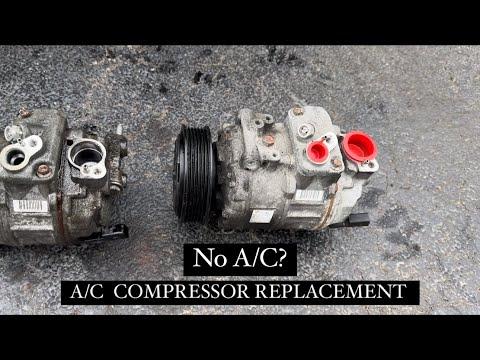







How to Replace the A/C Compressor on a 2018 Volkswagen Tiguan (DIY Guide)
Step-by-step instructions with required tools, parts, safety tips, evacuation, and recharge overview for 2018, 2019, 2020
How to Replace the A/C Compressor on a 2018 Volkswagen Tiguan (DIY Guide)
Step-by-step instructions with required tools, parts, safety tips, evacuation, and recharge overview for 2018, 2019, 2020


🔧 Tiguan - A/C Compressor Replacement
Replacing the A/C compressor on your Tiguan requires safely recovering the refrigerant, removing the drive belt and compressor, then installing the new unit with new seals before evacuating and recharging the system. The most important part is doing the refrigerant recovery/evacuation correctly—if air or moisture stays in the system, cooling will be poor and parts can be damaged.
Difficulty Level: Advanced | Estimated Time: 3-6 hours
Two quick questions before I give the exact step-by-step for your setup:
- ❓ Do you have access to an A/C refrigerant recovery machine and vacuum pump, or will a shop recover/evacuate/recharge it for you?
- ❓ Are you replacing only the compressor, or the compressor + receiver/drier (desiccant) as well?
⚠️ Safety & Precautions
- ⚠️ Refrigerant can cause severe frostbite and eye injury—use safety glasses and nitrile gloves.
- ⚠️ Do not vent refrigerant to the air—recover it with proper equipment.
- ⚠️ Keep hands/tools clear of the belt path; the belt system can pinch badly.
- ⚠️ Let the engine cool fully; the turbo and exhaust area can burn you.
- ⚠️ If you unplug compressor electrical connectors, switch ignition OFF and keep the key away.
🔧 Required Tools
You'll need the following tools for this repair:
- Floor jack (rated 3-ton minimum)
- Jack stands (rated 3-ton minimum)
- Wheel chocks
- Safety glasses
- Nitrile gloves
- Metric socket set (8mm-18mm)
- Metric wrench set (8mm-18mm)
- Torx bit set (T20-T30)
- Triple-square bit set (M10-M12)
- 1/4" ratchet
- 3/8" ratchet
- Extensions (3" and 6")
- Torque wrench (5-60 Nm range)
- Torque wrench (40-200 Nm range)
- Trim clip removal tool
- Flat-blade screwdriver
- Serpentine belt tool (16mm)
- A/C manifold gauge set (specialty)
- Vacuum pump (specialty)
- Refrigerant recovery machine (specialty)
- Refrigerant charging scale (specialty)
- UV leak flashlight (specialty)
🔩 Required Parts
HowToo sells all the parts you need for this repair:
- A/C compressor - Qty: 1
- A/C compressor O-ring seal set - Qty: 1
- Refrigerant (R-1234yf or R-134a as labeled under hood) - Qty: As specified on underhood label
- PAG compressor oil (VW-spec compatible) - Qty: As required
- Serpentine belt - Qty: 1
- Receiver/drier (desiccant) - Qty: 1 If system was open or compressor failed
📋 Before You Begin
- Park on level ground, set the parking brake, and place wheel chocks behind the rear wheels.
- Plan refrigerant handling first: recover refrigerant with a recovery machine before any line is loosened.
- Read the under-hood A/C sticker for the exact refrigerant type and charge amount. You must recharge by weight using a charging scale.
- If your compressor failed noisily or seized, plan to replace the receiver/drier and inspect for metal debris.
🔨 Step-by-Step Instructions
Follow these steps in order:
Step 1: Recover the refrigerant
- Connect your A/C manifold gauge set (specialty) to the high and low service ports.
- Use an A/C refrigerant recovery machine (specialty) to fully recover refrigerant per the machine prompts.
- Never loosen A/C lines before recovery.
Step 2: Raise and support the vehicle
- Lift the front of the vehicle with a floor jack (rated 3-ton minimum).
- Support securely on jack stands (rated 3-ton minimum).
Step 3: Remove lower splash shields to access the compressor
- Remove underbody fasteners using a Torx T25 bit and 10mm socket (fasteners vary by shield location).
- Use a trim clip removal tool for push-clips to avoid breaking them.
Step 4: Release serpentine belt tension
- Rotate the belt tensioner with a serpentine belt tool (16mm) and slide the belt off the A/C compressor pulley.
- Inspect the belt; if cracked or glazed, replace it.
Step 5: Unplug the compressor electrical connector
- Press the lock tab and disconnect using a flat-blade screwdriver carefully if needed.
Step 6: Disconnect the A/C refrigerant lines from the compressor
- Place rags under the connection to catch any residual oil.
- Remove the line retaining fasteners using the appropriate Torx bit or metric socket (varies by fitting style).
- Immediately cap/cover the open lines to reduce moisture entry.
- Remove and discard old O-rings; install new ones during reassembly.
Step 7: Remove the A/C compressor
- Support the compressor by hand and remove mounting bolts using a metric socket and ratchet.
- Lower and remove the compressor from below.
- Torque to factory specification for your compressor mounting bolts using a torque wrench (5-60 Nm range).
Step 8: Prepare the new compressor (oil handling)
- If the new compressor is pre-filled, confirm oil amount/type; if not, add the correct PAG compressor oil amount.
- Rotate the compressor hub by hand several turns to distribute oil evenly.
- Too much oil reduces cooling.
Step 9: Install the new compressor
- Position the compressor and start bolts by hand to avoid cross-threading.
- Tighten with a metric socket and finish with a torque wrench (5-60 Nm range).
- Torque to factory specification for your compressor mounting bolts.
Step 10: Reconnect A/C lines with new O-rings
- Lightly lubricate new O-rings with clean PAG compressor oil.
- Install lines squarely (do not force), then tighten fasteners with the correct Torx bit or metric socket.
- Torque to factory specification for your line retaining fasteners using a torque wrench (5-60 Nm range).
Step 11: Reinstall the serpentine belt
- Route the belt exactly as shown on the under-hood belt diagram.
- Rotate tensioner with the serpentine belt tool (16mm) and slip the belt fully onto the compressor pulley.
Step 12: Reinstall splash shields
- Reinstall shields using a Torx T25 bit, 10mm socket, and trim clip removal tool as needed.
Step 13: Evacuate (vacuum) the system
- Connect the A/C manifold gauge set (specialty) and vacuum pump (specialty).
- Pull vacuum for at least 30–45 minutes, then close valves and verify it holds vacuum.
- If vacuum rises, there is a leak that must be fixed before charging.
Step 14: Recharge by weight and verify operation
- Charge the exact amount listed on the under-hood label using a refrigerant charging scale (specialty).
- Start the engine and turn A/C on MAX; verify pressures are stable on the A/C manifold gauge set (specialty).
- Check fittings for leaks with a UV leak flashlight (specialty) if dye is present.
✅ After Repair
- Confirm cold air at the center vents and that the compressor cycles/controls smoothly (no loud clicking or belt chirp).
- Recheck for any oil residue or bubbling at the line connections after a short drive.
- If cooling is weak, verify charge amount by weight—“topping off” is not accurate.
💰 DIY vs Shop Cost
Shop Cost: $1,200-$2,200 (parts + labor)
DIY Cost: $450-$1,200 (parts only)
You Save: $750-$1,000 by doing it yourself!
Shop labor rates vary but typically run $100-$150/hour. This repair takes a shop approximately 3-6 hours.
🎯 Ready to get started?
HowToo makes it easy: same-day/2-day shipping on every part, plus all the tools and specialty tools you need! Check out the parts and tools sections below to add everything to your cart.