









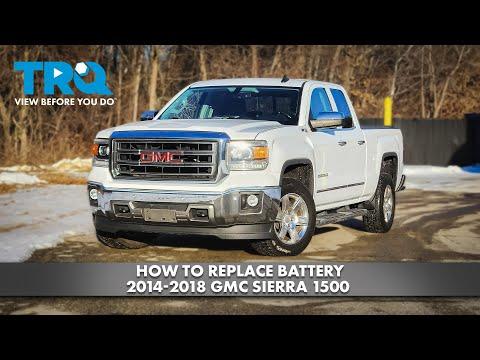






How to Replace the 12V Battery on a 2017 GMC Sierra 1500 (Group 48/H6 AGM)
Step-by-step under-hood battery swap with tools, parts list, torque specs, and safety tips for eAssist models for 2014, 2015, 2016, 2017, 2018, 2019, 2020, 2021, 2022, 2023, 2024, 2025
How to Replace the 12V Battery on a 2017 GMC Sierra 1500 (Group 48/H6 AGM)
Step-by-step under-hood battery swap with tools, parts list, torque specs, and safety tips for eAssist models for 2014, 2015, 2016, 2017, 2018, 2019, 2020, 2021, 2022, 2023, 2024, 2025


🔧 Sierra 1500 - Battery Replacement
On your Sierra 1500, there’s a normal 12V battery under the hood, and because your truck is Mild Hybrid (eAssist/MHEV), it may also have a high-voltage battery pack. The steps below cover the under-hood 12V battery (the one that starts and powers the truck’s 12V system).
Quick question (so I don’t steer you wrong): Are you replacing the 12V battery under the hood, or the hybrid/eAssist battery pack (high voltage)?
Difficulty Level: Beginner | Estimated Time: 0.5-1.0 hours
⚠️ Safety & Precautions
- ⚠️ If you mean the hybrid/eAssist battery pack: don’t DIY—high voltage can cause severe injury; that job should be done by a trained technician.
- ⚠️ For the 12V battery: turn the truck fully OFF, keep keys away from the truck, and wait 2-3 minutes before disconnecting cables.
- ⚠️ Disconnect negative (-) first and reconnect it last to reduce the chance of a short.
- ⚠️ Batteries are heavy and contain acid; wear gloves and safety glasses.
- ⚠️ Do not allow your tool to touch the battery terminal and any metal body part at the same time.
🔧 Required Tools
You'll need the following tools for this repair:
- 8mm socket
- 13mm socket
- 3/8" ratchet
- 6" socket extension
- Torque wrench (10-30 ft-lbs range)
- Battery terminal brush
- Trim tool
- Safety glasses
- Nitrile gloves
- Fender cover
🔩 Required Parts
HowToo sells all the parts you need for this repair:
- 12V AGM battery (Group 48/H6) - Qty: 1
- Battery terminal anti-corrosion washers - Qty: 2
- Battery terminal protectant spray - Qty: 1
📋 Before You Begin
- Park on level ground, shift to Park, and set the parking brake.
- Turn everything off (headlights, HVAC, radio) and remove the key/fob from the truck area.
- If you want to preserve radio presets: use a “memory saver” (a small device that keeps power while the battery is out). If you don’t have one, it’s okay—your truck will relearn settings.
- Open the hood and place a fender cover (a protective mat) over the fender edge to avoid scratches.
🔨 Step-by-Step Instructions
Follow these steps in order:
Step 1: Locate the 12V battery
- Open the hood and find the battery on the passenger-side front of the engine bay.
- If a plastic cover is in the way, pop it off carefully using a trim tool.
Step 2: Disconnect the negative (-) cable first
- Use an 8mm socket with a 3/8" ratchet to loosen the negative (-) side-terminal bolt.
- Pull the negative cable straight out of the battery. Tuck it aside so it can’t spring back and touch the battery.
- If it’s tight, wiggle—don’t pry hard.
Step 3: Disconnect the positive (+) cable
- Use an 8mm socket with a 3/8" ratchet to loosen the positive (+) side-terminal bolt.
- Remove the positive cable and keep it from touching metal parts.
Step 4: Remove the battery hold-down
- At the base of the battery, remove the hold-down bolt using a 13mm socket, 6" extension, and 3/8" ratchet.
- Lift out the hold-down bracket and set it aside.
Step 5: Remove the old battery
- Grab the battery by the handle and lift it straight up and out.
- Lift with legs—batteries are heavy.
Step 6: Clean and prep the cables and tray
- Use a battery terminal brush to clean the inside of both cable ends (where they contact the battery terminals).
- If you’re installing them, place anti-corrosion washers onto the battery terminals.
Step 7: Install the new battery
- Set the new 12V AGM battery (Group 48/H6) into the tray in the same orientation as the old one.
- Reinstall the hold-down bracket and bolt using a 13mm socket, 6" extension, and 3/8" ratchet.
- Torque to 20 Nm (15 ft-lbs).
Step 8: Reconnect cables (positive first, negative last)
- Install the positive (+) cable first using an 8mm socket and 3/8" ratchet.
- Torque to 17 Nm (13 ft-lbs).
- Install the negative (-) cable last using an 8mm socket and 3/8" ratchet.
- Torque to 17 Nm (13 ft-lbs).
Step 9: Protect terminals and reinstall covers
- Spray both terminals lightly with battery terminal protectant spray.
- Reinstall any plastic battery/terminal covers by hand; use a trim tool only if needed.
✅ After Repair
- Start the truck and confirm it cranks normally.
- Check for warning messages on the dash; some may clear after a short drive.
- Reset clock/radio presets if needed.
- If the power windows lose “one-touch/auto” function: hold the window switch all the way down for 5 seconds, then all the way up for 5 seconds.
- Do a quick charging check: with the engine running, electrical system voltage should typically be around 13.5-14.8V.
💰 DIY vs Shop Cost
Shop Cost: $250-$450 (parts + labor)
DIY Cost: $180-$320 (parts only)
You Save: $70-$130 by doing it yourself!
Shop labor rates vary but typically run $100-$150/hour. This repair takes a shop approximately 0.5-1.0 hours.
🎯 Ready to get started?
HowToo makes it easy: same-day/2-day shipping on every part, plus all the tools and specialty tools you need! Check out the parts and tools sections below to add everything to your cart.