









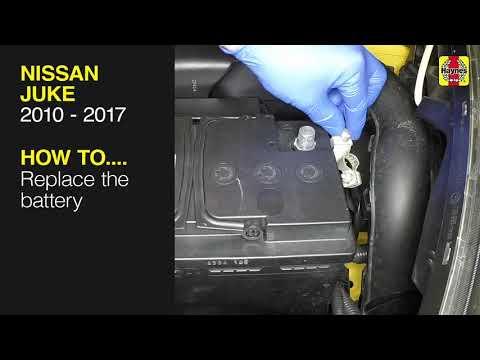





How to Replace the 12V Battery on a 2011-2017 Nissan Juke (Step-by-Step Guide) (Engine: Inline 4 1.6L)
Tools, parts list, safety tips, terminal cleaning, and torque specs for a reliable install
How to Replace the 12V Battery on a 2011-2017 Nissan Juke (Step-by-Step Guide) (Engine: Inline 4 1.6L)
Tools, parts list, safety tips, terminal cleaning, and torque specs for a reliable install for 2011, 2012, 2013, 2014, 2015, 2016, 2017


🔧 Juke - 12V Battery Replacement
You’ll be removing the old 12V battery and installing a new one, then cleaning and tightening the cable connections so the car starts and charges reliably. On your Juke, the battery sits in the engine bay and is held down with a simple bracket.
Difficulty Level: Beginner | Estimated Time: 0.5-1.0 hours
⚠️ Safety & Precautions
- ⚠️ Keep metal tools off both battery posts at once to avoid a short.
- ⚠️ Remove the negative (-) cable first and install it last.
- ⚠️ Wear eye protection; battery corrosion is acidic and can burn skin/eyes.
- ⚠️ Do not smoke or create sparks near the battery (it can vent hydrogen gas).
- 🔌 Battery disconnect is required for this replacement (unless using a memory saver).
🔧 Required Tools
You'll need the following tools for this repair:
- 10mm socket
- 10mm wrench
- Ratchet (3/8")
- Socket extension (3/8", 3"-6")
- Torque wrench (3/8", inch-pound or low Nm capable)
- Battery terminal brush
- Baking soda
- Spray bottle with water
- Nitrile gloves
- Safety glasses
- Fender cover
- OBD-II memory saver (specialty)
🔩 Required Parts
HowToo sells all the parts you need for this repair:
- 12V battery (correct group size for your Juke) - Qty: 1
- Battery terminal anti-corrosion pads - Qty: 2
- Battery terminal protectant spray - Qty: 1
📋 Before You Begin
- 🅿️ Park on level ground, shift to neutral, set the parking brake, and turn the ignition fully OFF.
- 🔑 Keep the key/fob away from the car while you work (prevents modules from waking up).
- 💾 Optional: Use an OBD-II memory saver (specialty) (a small device that keeps radio/settings alive while the battery is disconnected).
- 🧤 Put on nitrile gloves and safety glasses.
🔨 Step-by-Step Instructions
Follow these steps in order:
Step 1: Access the battery
- Open the hood and place a fender cover to protect paint.
- Locate the 12V battery in the engine bay.
Step 2: Disconnect the negative (-) battery cable
- Use a 10mm wrench or 10mm socket with a ratchet (3/8") to loosen the negative terminal clamp nut.
- Lift the clamp straight up off the battery post and move it aside so it cannot spring back.
- Tip: Twist gently—don’t pry hard.
Step 3: Disconnect the positive (+) battery cable
- Flip open the positive terminal cover (if equipped).
- Use a 10mm wrench or 10mm socket with a ratchet (3/8") to loosen the positive terminal clamp nut.
- Lift the clamp off the post and keep it from touching metal parts.
Step 4: Remove the battery hold-down
- Use a 10mm socket, ratchet (3/8"), and socket extension (3/8", 3"-6") to remove the battery hold-down fasteners.
- Remove the hold-down bracket and set it aside.
- Torque to 5 N·m (44 in-lb) when reinstalling the hold-down fasteners.
Step 5: Lift out the old battery
- Carefully lift the battery straight up and out (it’s heavy).
- Set it on the ground upright.
Step 6: Clean the battery tray and cable clamps
- If you see white/blue crust (corrosion), mix a small amount of baking soda with water in a spray bottle with water.
- Lightly spray corrosion, let it fizz, then rinse with clean water from the spray bottle with water.
- Use a battery terminal brush to clean the inside of each cable clamp until shiny metal is visible.
- Tip: Keep liquid out of the fuse/relay box.
Step 7: Install the new battery
- Place the new battery into the tray in the same orientation as the old one.
- Reinstall the hold-down bracket using a 10mm socket, ratchet (3/8"), and socket extension (3/8", 3"-6").
- Tighten with a torque wrench (3/8", inch-pound or low Nm capable): Torque to 5 N·m (44 in-lb).
Step 8: Reconnect the positive (+) cable first
- Install the positive clamp fully down onto the battery post.
- Use a 10mm socket with a ratchet (3/8") to snug the clamp.
- Finish tightening with a torque wrench (3/8", inch-pound or low Nm capable): Torque to 5 N·m (44 in-lb).
- Install battery terminal anti-corrosion pads (one per post) before final seating if your pads are the “ring” style.
Step 9: Reconnect the negative (-) cable last
- Install the negative clamp fully down onto the battery post.
- Use a 10mm socket with a ratchet (3/8") to snug the clamp.
- Finish tightening with a torque wrench (3/8", inch-pound or low Nm capable): Torque to 5 N·m (44 in-lb).
Step 10: Protect the terminals
- Lightly spray both terminals with battery terminal protectant spray.
- Make sure the positive terminal cover is closed (if equipped).
✅ After Repair
- 🔍 Start the engine and confirm the battery light turns off after starting.
- 🧪 Check that both clamps are fully seated and do not rotate by hand.
- ⚙️ Reset items as needed: clock, radio presets, and auto-up/down window function (if it lost memory).
- 🚗 If idle is rough for a few minutes, let it idle with all accessories off until it stabilizes.
💰 DIY vs Shop Cost
Shop Cost: $220-$450 (parts + labor)
DIY Cost: $140-$280 (parts only)
You Save: $80-$170 by doing it yourself!
Shop labor rates vary but typically run $100-$150/hour. This repair takes a shop approximately 0.5-1.0 hours.
🎯 Ready to get started?
HowToo makes it easy: same-day/2-day shipping on every part, plus all the tools and specialty tools you need! Check out the parts and tools sections below to add everything to your cart.