









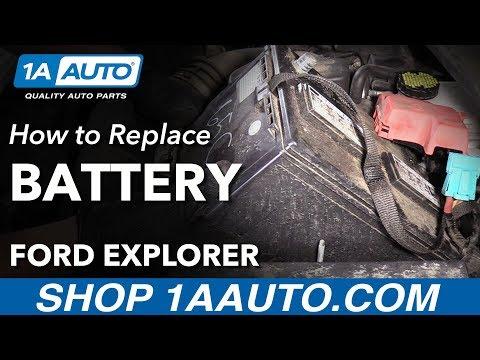





How to Replace the 12V Battery on a 1991-2019 Ford Explorer (Engine: V6 3.5L)
Step-by-step DIY battery change with tools, parts list, torque specs, BMS reset, and safety tips
How to Replace the 12V Battery on a 1991-2019 Ford Explorer (Engine: V6 3.5L)
Step-by-step DIY battery change with tools, parts list, torque specs, BMS reset, and safety tips for 1991, 1992, 1993, 1994, 1995, 1996, 1997, 1998, 1999, 2000, 2001, 2002, 2003, 2004, 2005, 2006, 2007, 2008, 2009, 2010


🔧 Explorer - Battery Replacement
You’ll be replacing the 12V battery under the hood on your Explorer. This restores reliable starting and protects the electronics from low-voltage problems.
Difficulty Level: Beginner | Estimated Time: 45-75 minutes
⚠️ Safety & Precautions
- 🛑 Always work with the engine OFF, ignition OFF, and key fob away from the vehicle.
- 🧤 Wear safety glasses and gloves; batteries contain acid and can spark.
- ⚡ Never let tools touch both battery posts at the same time; that can cause a short (big spark).
- ⚡ Always disconnect the negative (-) cable first and reconnect it last to reduce short-circuit risk.
- 🔥 Keep metal jewelry (rings, watches, bracelets) away from the battery area.
- 🧯 Have good ventilation; do not smoke or use open flames near the battery.
- 🔋 Your Explorer has a Battery Monitoring System (BMS); after replacement it should be reset with a scan tool so charging works correctly.
🔧 Required Tools
You'll need the following tools for this repair:
- 🧰 10mm socket
- 🧰 13mm socket
- 🧰 1/4" drive ratchet
- 🧰 3/8" drive ratchet
- 🧰 6" socket extension
- 🧰 Small flathead screwdriver
- 🧰 Plastic trim tool
- 🧰 Battery terminal brush
- 🧰 12V memory saver tool (OBD or power outlet type) (specialty)
- 🧰 Battery carrier strap or handle (specialty)
- 🧰 Torque wrench (inch‑pound, 30–120 in‑lb range) (specialty)
- 🧰 Digital multimeter (basic voltage tester)
- 🧰 Shop towels or rags
- 🧰 Baking soda and water mix container
- 🧰 Safety glasses
- 🧰 Mechanic gloves
🔩 Required Parts
HowToo sells all the parts you need for this repair:
- 🔩 12V AGM battery (correct group size for Explorer Platinum) - Qty: 1
- 🔩 Battery terminal protector spray - Qty: 1
- 🔩 Dielectric grease - Qty: 1
- 🔩 Battery hold‑down bolt and clamp kit - Qty: 1 (optional, if yours is rusty or damaged)
- 🔩 Battery anti‑corrosion felt washers - Qty: 2 (optional but recommended)
📋 Before You Begin
- 🚗 Park the Explorer on level ground, shift to Park, and set the parking brake.
- 🔑 Turn ignition OFF and open the hood with the hood prop rod securely in place.
- 💾 If you have a memory saver tool (keeps radio presets and window settings), connect it now following its instructions.
- 📱 Keep metal tools away from the battery until you’re ready to loosen the clamps.
- 🧪 Mix a little baking soda and water in a small container for neutralizing any corrosion on the battery tray.
🔨 Step-by-Step Instructions
Follow these steps in order:
Step 1: Locate and uncover the battery
- Open the hood and look near the front driver side; you’ll see the battery with a plastic cover on top.
- Use the plastic trim tool or your fingers to release the clips and lift off the plastic battery cover.
- Set the cover aside somewhere clean.
Step 2: Identify positive and negative terminals
- The positive (+) terminal usually has a red cover and more cables.
- The negative (-) terminal is usually black and goes to the body or engine metal.
- Double‑check signs before loosening anything.
Step 3: Disconnect the negative (-) cable first
- Use the 10mm socket and 1/4" ratchet to loosen the clamp bolt on the negative (-) battery terminal.
- You only need to loosen the bolt a few turns; do not remove it all the way.
- Gently twist the clamp side‑to‑side and lift it off the battery post.
- Move the cable away from the battery and tuck it to the side so it cannot spring back to the post. You can wrap it in a rag for extra safety.
Step 4: Disconnect the positive (+) cable
- Flip open or remove the red protective cap on the positive (+) terminal using the small flathead screwdriver if needed.
- Use the 10mm socket and 1/4" ratchet to loosen the positive clamp bolt a few turns.
- Twist the clamp gently and lift it off the battery post.
- Move the positive cable away from the battery so it cannot touch either post.
Step 5: Remove the battery hold‑down
- At the base of the battery, you’ll see a metal or plastic clamp holding the battery to the tray.
- Use the 13mm socket, 3/8" ratchet, and extension to remove the hold‑down bolt.
- Lift off the hold‑down clamp and set it aside.
- Torque spec for reassembly: 7–9 Nm (62–80 in‑lb)
Step 6: Lift out the old battery
- Batteries are heavy. Use a battery carrier strap if you have one, attaching it to the battery handle or posts as designed.
- Lift the battery straight up and out of the engine bay, being careful not to hit nearby wiring or hoses.
- Set the old battery on the ground in an upright position.
- Use your legs, not your back, when lifting.
Step 7: Clean the battery tray and cables
- Inspect the battery tray for white or green corrosion.
- Dip a towel in the baking soda and water mix and wipe the tray and surrounding area. This neutralizes any acid.
- Use the battery terminal brush to clean the inside of the cable clamps until bare, shiny metal is visible.
- Wipe dry with a clean rag.
Step 8: Place the new battery in position
- Check that the new battery’s positive (+) and negative (-) posts are on the same sides as the old one.
- Use the battery carrier strap to lower the new battery into the tray, keeping it level.
- Make sure it sits flat and fully into the tray locating features.
- Install anti‑corrosion felt washers over the posts now if you’re using them.
Step 9: Reinstall the battery hold‑down
- Reposition the hold‑down clamp at the base of the battery.
- Install the hold‑down bolt by hand to avoid cross‑threading.
- Use the 13mm socket, extension, and 3/8" ratchet to snug the bolt.
- Then tighten with the torque wrench and 13mm socket to 7–9 Nm (62–80 in‑lb).
- Battery should not slide but don’t overtighten.
Step 10: Connect the positive (+) cable
- Lightly smear a thin layer of dielectric grease on the positive post (optional but helpful).
- Place the positive (+) clamp fully down on the battery post.
- Use the 10mm socket and 1/4" ratchet to tighten the clamp bolt.
- Finish by tightening with the torque wrench and 10mm socket to 5–7 Nm (44–62 in‑lb).
- Close the red protective cap over the positive terminal.
Step 11: Connect the negative (-) cable
- Lightly smear a thin layer of dielectric grease on the negative post if desired.
- Place the negative (-) clamp fully down on the battery post.
- Use the 10mm socket and 1/4" ratchet to tighten the clamp bolt.
- Finish by tightening with the torque wrench and 10mm socket to 5–7 Nm (44–62 in‑lb).
- Make sure both clamps are fully seated and do not rotate by hand.
Step 12: Reinstall the battery cover and check voltage
- Snap the plastic battery cover back into place over the battery.
- Use the digital multimeter to check battery voltage at the posts; a fully charged new AGM battery should read around 12.6–12.8V with engine off.
- If it’s much lower, charge before heavy use.
Step 13: Reset the Battery Monitoring System (BMS)
- Ford recommends a BMS reset whenever the battery is replaced.
- The proper way is with a scan tool that supports Ford BMS reset.
- Use a scan tool (specialty) capable of Ford service functions, then follow its on‑screen path, typically like:
- Menu > Ford > Explorer > Service Functions > Battery Monitoring System Reset
- If you don’t have this, the vehicle will still run, but charging may not be perfectly optimized. You can have a local shop or mobile technician do the BMS reset quickly.
Step 14: Reinitialize auto-up windows (if needed)
- If the one‑touch up/down on the windows stopped working:
- Turn the ignition ON (engine can be off).
- Fully close one window using the switch and hold the switch up for 2–3 seconds.
- Then fully open the same window and hold the switch down for 2–3 seconds.
- Repeat for each window that lost one‑touch function.
✅ After Repair
- 🔁 Start the engine and let it idle for a few minutes; check that it cranks strongly and idles smoothly.
- 💡 Check all exterior lights, interior lights, and the infotainment system.
- 📻 Re‑enter radio presets, clock time, and any customized settings if the memory saver was not used.
- 🚗 Take a short test drive with some mixed speeds to let the charging system adapt.
- 📟 If any warning lights appear (battery, charging, etc.), have the system scanned; often this is related to BMS not being reset.
💰 DIY vs Shop Cost
Shop Cost: $250–$400 (parts + labor)
DIY Cost: $150–$250 (parts only)
You Save: $100–$150 by doing it yourself!
Shop labor rates vary but typically run $100–$150/hour. This repair takes a shop approximately 0.5–1.0 hours.
🎯 Ready to get started?
HowToo makes it easy: same-day/2-day shipping on every part, plus all the tools and specialty tools you need! Check out the parts and tools sections above to add everything to your cart.
Guide for Vehicle Battery replace for these Ford vehicles
| Year Make Model | Sub Model | Engine | Body Style |
|---|---|---|---|
| 2019 Ford Explorer | - | V6 3.5L | - |
| 2019 Ford Explorer | - | Inline 4 2.3L | - |
| 2018 Ford Explorer | - | V6 3.5L | - |
| 2018 Ford Explorer | - | Inline 4 2.3L | - |
| 2017 Ford Explorer | - | V6 3.5L | - |
| 2017 Ford Explorer | - | Inline 4 2.3L | - |
| 2016 Ford Explorer | - | V6 3.5L | - |
| 2016 Ford Explorer | - | Inline 4 2.3L | - |
| 2015 Ford Explorer | - | V6 3.5L | - |
| 2015 Ford Explorer | - | Inline 4 2.0L | - |
| 2014 Ford Explorer | - | V6 3.5L | - |
| 2014 Ford Explorer | - | Inline 4 2.0L | - |
| 2013 Ford Explorer | - | V6 3.5L | - |
| 2013 Ford Explorer | - | Inline 4 2.0L | - |
| 2012 Ford Explorer | - | V6 3.5L | - |
| 2012 Ford Explorer | - | Inline 4 2.0L | - |
| 2011 Ford Explorer | - | V6 3.5L | - |
| 2010 Ford Explorer | - | V6 4.0L | - |
| 2010 Ford Explorer | - | V8 4.6L | - |
| 2009 Ford Explorer | - | V6 4.0L | - |
| 2009 Ford Explorer | - | V8 4.6L | - |
| 2008 Ford Explorer | - | V6 4.0L | - |
| 2008 Ford Explorer | - | V8 4.6L | - |
| 2007 Ford Explorer | - | V6 4.0L | - |
| 2007 Ford Explorer | - | V8 4.6L | - |
| 2006 Ford Explorer | - | V6 4.0L | - |
| 2006 Ford Explorer | - | V8 4.6L | - |
| 2005 Ford Explorer | - | V6 4.0L | - |
| 2005 Ford Explorer | - | V8 4.6L | - |
| 2004 Ford Explorer | - | V6 4.0L | - |
| 2004 Ford Explorer | - | V8 4.6L | - |
| 2003 Ford Explorer | - | V6 4.0L | - |
| 2003 Ford Explorer | - | V8 4.6L | - |
| 2002 Ford Explorer | - | V6 4.0L | - |
| 2002 Ford Explorer | - | V8 4.6L | - |
| 2001 Ford Explorer | - | V6 4.0L | - |
| 2001 Ford Explorer | - | V8 5.0L | - |
| 2000 Ford Explorer | - | V6 4.0L | - |
| 2000 Ford Explorer | - | V8 5.0L | - |
| 1999 Ford Explorer | - | V6 4.0L | - |
| 1999 Ford Explorer | - | V8 5.0L | - |
| 1998 Ford Explorer | - | V6 4.0L | - |
| 1998 Ford Explorer | - | V8 5.0L | - |
| 1997 Ford Explorer | - | V6 4.0L | - |
| 1997 Ford Explorer | - | V8 5.0L | - |
| 1996 Ford Explorer | - | V6 4.0L | - |
| 1996 Ford Explorer | - | V8 5.0L | - |
| 1995 Ford Explorer | - | V6 4.0L | - |
| 1994 Ford Explorer | - | V6 4.0L | - |
| 1993 Ford Explorer | - | V6 4.0L | - |
| 1992 Ford Explorer | - | V6 4.0L | - |
| 1991 Ford Explorer | - | V6 4.0L | - |