









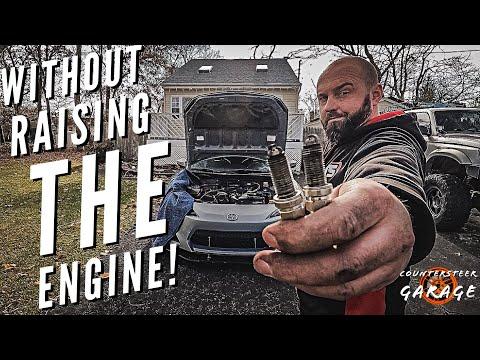







How to Replace Spark Plugs on a 2018 Subaru BRZ (FA20) — Engine Lift Method
Step-by-step DIY guide with required tools/parts, safety tips, and BRZ torque specs for 2013, 2014, 2015, 2016, 2017, 2018, 2019, 2020
How to Replace Spark Plugs on a 2018 Subaru BRZ (FA20) — Engine Lift Method
Step-by-step DIY guide with required tools/parts, safety tips, and BRZ torque specs for 2013, 2014, 2015, 2016, 2017, 2018, 2019, 2020


🔧 BRZ - Spark Plug Replacement
On your BRZ, the spark plugs sit deep in the cylinder heads and space is tight, so you’ll remove a few intake/battery parts and slightly lift the engine for access. Replacing worn plugs helps prevent misfires, rough idle, and poor fuel economy.
Difficulty Level: Advanced | Estimated Time: 3-5 hours
⚠️ Safety & Precautions
- ⚠️ Work on a fully cool engine to avoid burns and damaged threads.
- ⚠️ Disconnect the negative battery terminal before unplugging ignition coils.
- ⚠️ Support the engine safely before loosening engine mount nuts.
- ⚠️ Never put any part of your body under a car supported only by a jack.
🔧 Required Tools
You'll need the following tools for this repair:
- Safety glasses
- Nitrile gloves
- Floor jack (rated 3-ton minimum)
- Jack stands (rated 3-ton minimum)
- Wheel chocks
- 10mm socket
- 12mm socket
- 14mm socket
- 3/8" ratchet
- 3/8" torque wrench
- 3/8" extension set (3", 6", 10")
- 3/8" swivel/universal joint
- 14mm thin-wall spark plug socket (magnetic or rubber insert)
- Flat trim tool
- Phillips screwdriver
- Needle-nose pliers
- Flashlight
- Feeler gauge set (wire-type)
🔩 Required Parts
HowToo sells all the parts you need for this repair:
- Iridium spark plugs (OEM-type) - Qty: 4
- Dielectric grease (small packet) - Qty: 1
📋 Before You Begin
- Park on level ground, set the parking brake, and chock the rear wheels.
- Let the engine cool completely (at least 1-2 hours after driving).
- Use a 10mm socket to disconnect the negative battery cable and tuck it aside.
- Take photos before unplugging anything.
🔨 Step-by-Step Instructions
Follow these steps in order:
Step 1: Remove the intake tubing and airbox (right side access)
- Use a 10mm socket and Phillips screwdriver to loosen the intake hose clamp(s) and remove the intake snorkel/ducting.
- Unclip the airbox lid and remove the air filter using your hands.
- Use a 10mm socket to remove the airbox bolts, then lift the airbox out.
Step 2: Remove the battery (left side access)
- Use a 10mm socket to remove the battery hold-down bracket.
- Lift the battery out carefully (it’s heavier than it looks).
- Use a 10mm socket to remove the battery tray if it blocks access.
Step 3: Raise and support the front of the car
- Use a floor jack (rated 3-ton minimum) to lift the front at the proper jacking point.
- Set the car securely on jack stands (rated 3-ton minimum).
- Give the car a firm shake to confirm it’s stable.
Step 4: Support the engine from underneath
- Place the floor jack (rated 3-ton minimum) under the engine oil pan area with a sturdy flat pad.
- Raise the jack just until it gently supports the engine (do not lift yet).
- A swivel/universal joint is a pivoting adapter that helps sockets turn at an angle in tight spaces.
Step 5: Loosen engine mount nuts (to allow a small engine lift)
- Locate the left and right engine mount nuts from underneath.
- Use a 14mm socket and 3/8" ratchet to loosen (do not remove) the mount nuts several turns.
- Slowly lift the engine slightly using the floor jack (rated 3-ton minimum) until you gain access to the ignition coils.
- Lift only what you need for clearance.
Step 6: Remove ignition coil connectors and coil bolts (one cylinder at a time)
- On one side, use a flat trim tool to gently release the electrical connector lock tab, then unplug the coil.
- Use a 10mm socket to remove the ignition coil retaining bolt.
- Twist the coil boot slightly and pull the coil straight out.
- Do one plug at a time to avoid mix-ups.
Step 7: Remove the old spark plug
- Blow out or wipe away debris around the spark plug hole using a flashlight to inspect first.
- Install a 14mm thin-wall spark plug socket (magnetic or rubber insert) with a 3/8" extension set (3", 6", 10") and 3/8" swivel/universal joint.
- Use a 3/8" ratchet to loosen and remove the spark plug.
Step 8: Check gap and install the new spark plug
- Use a feeler gauge set (wire-type) to verify the new plug gap matches the plug maker’s spec for the BRZ.
- Thread the new plug in by hand first using the spark plug socket and an extension (no ratchet) so it doesn’t cross-thread.
- Tighten using a 3/8" torque wrench: Torque to 20 Nm (15 ft-lbs).
- Do not use anti-seize on plated plugs.
Step 9: Reinstall the ignition coil
- Apply a very small amount of dielectric grease inside the coil boot lip (not on the plug threads).
- Push the coil straight onto the plug until fully seated.
- Install the coil bolt using a 10mm socket, then finish with a 3/8" torque wrench: Torque to 10 Nm (7 ft-lbs).
- Reconnect the coil electrical connector until it clicks.
Step 10: Repeat for the remaining cylinders
- Repeat Steps 6-9 for the other plugs, lifting the engine a little more or less as needed with the floor jack.
- Swap sides as necessary (airbox side and battery side).
Step 11: Lower the engine and tighten engine mount nuts
- Slowly lower the engine using the floor jack until it fully sits on the mounts.
- Use a 14mm socket and 3/8" torque wrench to tighten the mount nuts: Torque to 55 Nm (41 ft-lbs).
Step 12: Reinstall battery and intake
- Reinstall the battery tray (if removed) using a 10mm socket.
- Reinstall the battery and hold-down using a 10mm socket.
- Reconnect terminals using a 10mm socket (negative cable last).
- Reinstall the airbox and intake tubing using a 10mm socket and Phillips screwdriver, and ensure clamps are tight.
✅ After Repair
- Start the engine and let it idle for 1-2 minutes; it should run smooth with no shaking.
- Listen for air leaks (hissing) near the intake tube/airbox.
- Test drive 10 minutes, then recheck that the intake clamps and battery hold-down are tight.
- If you get a check engine light or misfire, recheck coil connectors and coil seating.
💰 DIY vs Shop Cost
Shop Cost: $350-$650 (parts + labor)
DIY Cost: $60-$140 (parts only)
You Save: $290-$510 by doing it yourself!
Shop labor rates vary but typically run $100-$150/hour. This repair takes a shop approximately 2.5-4.0 hours.
🎯 Ready to get started?
HowToo makes it easy: same-day/2-day shipping on every part, plus all the tools and specialty tools you need! Check out the parts and tools sections below to add everything to your cart.