









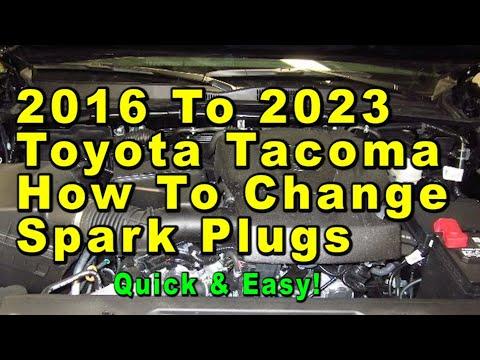





How to Replace Spark Plugs on a 2016-2023 Toyota Tacoma 3.5L V6
Step-by-step DIY spark plug change with tools, parts list, torque specs, safety tips, and cost savings
How to Replace Spark Plugs on a 2016-2023 Toyota Tacoma 3.5L V6
Step-by-step DIY spark plug change with tools, parts list, torque specs, safety tips, and cost savings for 2016, 2017, 2018, 2019, 2020, 2021, 2022, 2023


🔧 Tacoma - Spark Plug Replacement
You’ll be replacing all six spark plugs on your Tacoma’s 3.5L V6. This keeps the engine starting easily, running smoothly, and helps fuel economy.
Difficulty Level: Intermediate | Estimated Time: 2–3 hours
⚠️ Safety & Precautions
- ⚠️ Work on a completely cool engine; hot aluminum parts strip easily and can burn you.
- ⚠️ Disconnect the negative battery cable before unplugging ignition coils to avoid short circuits.
- ⚠️ Do not cross‑thread spark plugs; the cylinder head is aluminum and easily damaged.
- ⚠️ Keep dirt out of plug holes; debris in cylinders can cause engine damage.
- ⚠️ Use only the correct type of spark plug (iridium, long-life) for this engine.
🔧 Required Tools
You'll need the following tools for this repair:
- 🧰 3/8" drive ratchet
- 🧰 1/4" drive ratchet
- 🧰 3/8" drive torque wrench (5–60 ft-lbs range)
- 🧰 1/4" drive torque wrench (20–120 in-lbs range)
- 🧰 10mm socket
- 🧰 12mm socket
- 🧰 14mm deep spark plug socket (with rubber insert or magnet)
- 🧰 3" extension (3/8" drive)
- 🧰 6" extension (3/8" drive)
- 🧰 Flathead screwdriver (medium)
- 🧰 Needle-nose pliers
- 🧰 Spark plug gap gauge (wire or coin style)
- 🧰 Compressed air can or air blower
- 🧰 Fender cover or clean towel
- 🧰 Mechanic’s gloves
- 🧰 Safety glasses
🔩 Required Parts
HowToo sells all the parts you need for this repair:
- 🛠️ Iridium spark plugs (correct for 3.5L V6) - Qty: 6
- 🛠️ Dielectric grease (for ignition coil boots) - Qty: 1 small tube
- 🛠️ Anti-seize compound (nickel or aluminum-based) - Qty: 1 small tube (optional; Toyota generally says “dry install”)
- 🛠️ Throttle body/intake cleaner spray - Qty: 1 (optional, for light cleaning while open)
- 🛠️ Shop towels - Qty: 1 pack
📋 Before You Begin
- Park the Tacoma on level ground, engage the parking brake, and place the transmission in gear.
- Turn off all electrical loads (lights, AC, radio) and remove the key from the ignition.
- Open the hood and support it securely with the hood prop.
- Disconnect the negative battery terminal using a 10mm socket, and tuck the cable aside so it cannot spring back.
- Lay a fender cover or towel over the front fenders to avoid scratching paint while leaning in.
🔨 Step-by-Step Instructions
Follow these steps in order:
Step 1: Remove Engine Cover
- Put on your safety glasses and gloves.
- Locate the plastic engine cover on top of the engine.
- Use a 10mm socket and 3/8" ratchet to remove any retaining bolts (if equipped; some covers just pull off).
- Gently lift the cover straight up; if it resists, check for missed bolts or clips.
- Set the cover aside somewhere clean.
Step 2: Identify Coils and Spark Plug Layout
- This engine uses “coil-on-plug” ignition: each spark plug has its own coil on top.
- You will see three ignition coils on each side (driver and passenger) of the engine’s “V”.
- Plan to do one plug and coil at a time to avoid mixing connectors.
Step 3: Remove Components Blocking Access (if needed)
- On some positions, the air intake tube slightly blocks access.
- Use a flathead screwdriver to loosen the hose clamps at the air tube connections (air box and throttle body).
- Carefully pull the tube off and move it aside; disconnect any small hoses using your needle-nose pliers if necessary.
- No need to force anything; if it feels stuck, check for another clamp or clip.
Step 4: Unplug First Ignition Coil
- Pick one coil to start with (front passenger side is usually easiest).
- Press the locking tab on the coil’s electrical connector with your thumb or a flathead screwdriver tip, then gently pull the connector straight off.
- Do not pull on the wires themselves; grab the plastic plug body.
Step 5: Remove Ignition Coil
- Use a 10mm socket and 1/4" ratchet to remove the single bolt holding the coil to the valve cover.
- Lift the coil straight up and out; you may need to twist slightly to break the seal at the rubber boot.
- Inspect the coil boot for oil or cracks; note any damage for future replacement.
- Coil bolt torque on reassembly: 9 Nm (80 in-lbs)
Step 6: Clean Around the Spark Plug Hole
- Before removing the spark plug, use compressed air to blow out any dust or debris from around the plug well.
- If you don’t have air, use a clean shop towel carefully around the opening.
- Keeping dirt out of the cylinder is very important.
Step 7: Remove Old Spark Plug
- Attach the 14mm deep spark plug socket to a 3" or 6" extension and your 3/8" ratchet.
- Carefully lower the socket straight down into the plug well until it seats on the plug.
- Turn the ratchet counterclockwise to loosen the plug. It may be snug at first, then should turn smoothly.
- Once fully loose, lift the socket out; the plug should come up with it due to the rubber insert or magnet.
- If it feels very tight or jerky, stop and gently tighten and loosen in small movements to avoid stripping threads.
Step 8: Check and Set Gap on New Plug
- Use your spark plug gap gauge (a small tool that measures the distance between the plug’s electrodes) to check the gap.
- For the 3.5L V6, plug gap should be 1.1 mm (0.043 in).
- Most new iridium plugs come pre-gapped; just confirm the gap with the gauge.
- Do not bend the fine center electrode; if adjustment is needed, gently bend only the ground strap.
Step 9: Prepare New Plug for Installation
- If you choose to use anti-seize, apply a very thin film to the plug threads only, avoiding the first thread and the tip.
- Toyota generally installs spark plugs dry; anti-seize can affect torque.
- Apply a tiny amount of dielectric grease (non-conductive silicone grease used to protect electrical connections) inside the rubber boot area of the ignition coil, not on the metal plug tip.
Step 10: Install New Spark Plug
- Place the new plug into the 14mm spark plug socket so it’s held securely.
- Carefully lower the plug into the hole, keeping it straight.
- Use the extension only (no ratchet yet) to thread the plug in by hand, turning clockwise.
- Thread it at least several full turns by hand to ensure it’s not cross-threaded.
- Once hand-tight, attach the 3/8" ratchet and snug it gently.
- Use your 3/8" torque wrench to tighten the plug to 24 Nm (18 ft-lbs).
- If using anti-seize, reduce torque slightly to avoid over-tightening.
Step 11: Reinstall Ignition Coil
- Insert the ignition coil back into the plug well, aligning the boot over the plug.
- Push down firmly until the coil seats fully on the plug and the mounting tab aligns with its hole.
- Install the coil bolt by hand, then tighten it with a 10mm socket and 1/4" ratchet.
- Use your 1/4" torque wrench to torque the bolt to 9 Nm (80 in-lbs).
- Reconnect the electrical connector until it clicks.
Step 12: Repeat for Remaining Five Spark Plugs
- Repeat Steps 4–11 for each remaining coil and plug, one at a time.
- On tighter areas, adjust between 3" and 6" extensions as needed for better access.
- Always blow out the plug well, hand-thread the plug, and torque to 24 Nm (18 ft-lbs).
- Take your time; consistency is more important than speed.
Step 13: Reinstall Intake Tube (if removed)
- Reattach the air intake tube to the air box and throttle body.
- Slip any small hoses back onto their fittings using your hands or needle-nose pliers.
- Tighten all hose clamps using the flathead screwdriver until snug (do not overtighten and damage the rubber).
Step 14: Reinstall Engine Cover
- Position the engine cover back over the engine.
- Align the rubber grommets or bolt holes.
- If bolts are used, install and snug them with a 10mm socket and 1/4" ratchet. Hand snug is enough; they just hold plastic.
Step 15: Reconnect Battery
- Reconnect the negative battery cable to the battery terminal.
- Use a 10mm socket to tighten the clamp just enough that it does not move on the post.
✅ After Repair
- Turn the key to “ON” and wait a few seconds, then start the engine.
- The engine should start quickly and idle smoothly with no misfires or shaking.
- Listen for any unusual hissing or whistling that might indicate a loose intake hose.
- Take a short test drive, gently accelerating through the gears; confirm smooth power delivery.
- If the check engine light comes on or you feel misfires, recheck coil connectors and coil seating on the plugs.
- Any stored codes can be checked and cleared with a basic OBD2 scanner, if available.
💰 DIY vs Shop Cost
Shop Cost: $350–$550 (parts + labor)
DIY Cost: $80–$140 (parts only)
You Save: $270–$410 by doing it yourself!
Shop labor rates typically run $100–$150/hour. This repair takes a shop approximately 1.5–2.0 hours.
🎯 Ready to get started?
HowToo makes it easy: same-day/2-day shipping on every part, plus all the tools and specialty tools you need! Check out the parts and tools sections above to add everything to your cart.
Guide for Spark Plug replace for these Toyota vehicles
| Year Make Model | Sub Model | Engine | Body Style |
|---|---|---|---|
| 2023 Toyota Tacoma | - | - | - |
| 2022 Toyota Tacoma | - | - | - |
| 2021 Toyota Tacoma | - | - | - |
| 2020 Toyota Tacoma | - | - | - |
| 2019 Toyota Tacoma | - | - | - |
| 2018 Toyota Tacoma | - | - | - |
| 2017 Toyota Tacoma | - | - | - |
| 2016 Toyota Tacoma | - | - | - |