









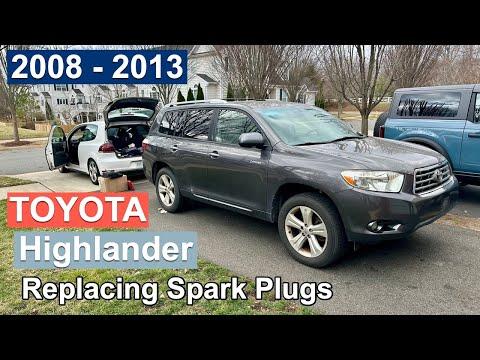





How to Replace Spark Plugs on a 2013 Toyota Highlander V6 (Front & Rear Bank)
Step-by-step DIY guide with tools, parts list, safety tips, and torque specs (intake manifold removal)
How to Replace Spark Plugs on a 2013 Toyota Highlander V6 (Front & Rear Bank)
Step-by-step DIY guide with tools, parts list, safety tips, and torque specs (intake manifold removal)


🔧 Highlander - Spark Plug Replacement
On your Highlander V6, there are 6 spark plugs—3 in the front bank (easy access) and 3 in the rear bank (under the upper intake manifold). Replacing them restores smooth idle, power, and fuel economy, and helps prevent misfires.
Difficulty Level: Intermediate | Estimated Time: 2.5-4.0 hours
⚠️ Safety & Precautions
- ⚠️ Work on a cold engine to avoid burns and stripped threads.
- ⚠️ Disconnect the negative battery terminal before unplugging ignition coils.
- ⚠️ Do not over-tighten spark plugs—aluminum cylinder heads strip easily.
- ⚠️ Keep dirt out of the intake when the manifold is off; cover openings immediately.
🔧 Required Tools
You'll need the following tools for this repair:
- Safety glasses
- Nitrile gloves
- 10mm socket
- 12mm socket
- 14mm socket
- 3/8" drive ratchet
- 3/8" drive extension set (3", 6", 10")
- 3/8" drive universal joint
- 5/8" spark plug socket
- Torque wrench (3/8" drive, 10-80 N·m range)
- Flat-blade screwdriver
- Needle-nose pliers
- Trim clip removal tool
- Shop vacuum
- Flashlight
- Clean rags
🔩 Required Parts
HowToo sells all the parts you need for this repair:
- Iridium spark plugs (V6 set) - Qty: 6
- Upper intake manifold gasket set - Qty: 1
- Throttle body gasket - Qty: 1
- Dielectric grease (for coil boots) - Qty: 1
📋 Before You Begin
- Park on level ground, shift to Park, and set the parking brake.
- Open the hood and let the engine cool fully.
- Use a 10mm socket to disconnect the negative battery terminal and tuck it aside so it can’t spring back.
- Take photos before unplugging hoses/connectors.
🔨 Step-by-Step Instructions
Follow these steps in order:
Step 1: Remove the engine cover
- Pull up to release the engine cover from its grommets (no tools on most covers).
- Set it aside so it won’t get stepped on.
Step 2: Replace the front bank spark plugs (radiator side)
- Unplug one ignition coil connector at a time (press the tab and pull).
- Use a 10mm socket to remove the coil hold-down bolt.
- Twist and pull the coil straight up to remove it.
- Use a shop vacuum to clean dirt from around the plug well.
- Use a 5/8" spark plug socket with a 3/8" ratchet and extension to remove the spark plug.
- Install the new spark plug by hand first using the spark plug socket and extension (no ratchet) so it doesn’t cross-thread.
- Tighten with a torque wrench: Torque to 18 N·m (13 ft-lbs).
- Apply a small amount of dielectric grease inside the coil boot (this helps prevent moisture and makes future removal easier).
- Reinstall the coil and tighten the bolt with a torque wrench: Torque to 9 N·m (80 in-lbs).
- Reconnect the coil connector until it clicks.
- Repeat for the other 2 front plugs.
- Do one cylinder at a time to avoid mix-ups.
Step 3: Remove the air intake tube (to access the rear bank)
- Use a flat-blade screwdriver to loosen the hose clamps.
- Unplug any attached sensor connector(s) you can see on the intake tube.
- Remove the intake tube and set it aside.
Step 4: Remove the upper intake manifold (rear bank access)
- Label and disconnect the vacuum hoses and breather hoses using needle-nose pliers (pinch clamps) as needed.
- Unplug the throttle body connector(s) you can access.
- Use a 10mm socket to remove the throttle body mounting bolts, then move the throttle body aside.
- Remove the upper intake manifold bolts/nuts using a 12mm socket (some fasteners may be in tight spots—use a universal joint and extensions).
- Lift the upper intake manifold off carefully.
- Immediately cover the exposed intake ports with clean rags so nothing can fall in.
Step 5: Replace the rear bank spark plugs (firewall side)
- Unplug one rear ignition coil connector.
- Use a 10mm socket to remove the coil bolt, then pull the coil out.
- Vacuum around the plug well using a shop vacuum.
- Remove the spark plug using a 5/8" spark plug socket, extensions, and a universal joint as needed.
- Install the new plug by hand first, then tighten with a torque wrench: Torque to 18 N·m (13 ft-lbs).
- Add a small amount of dielectric grease to the coil boot, reinstall the coil, and tighten: Torque to 9 N·m (80 in-lbs).
- Reconnect the coil connector until it clicks.
- Repeat for the other 2 rear plugs.
Step 6: Reinstall the upper intake manifold and throttle body
- Remove the rags from the intake ports.
- Replace the upper intake manifold gasket(s) with the new ones.
- Set the upper intake manifold back into place.
- Install bolts/nuts finger-tight first using a 12mm socket, then tighten evenly in a crisscross pattern.
- Tighten upper intake manifold fasteners with a torque wrench: Torque to 21 N·m (15 ft-lbs).
- Install a new throttle body gasket, reinstall the throttle body with a 10mm socket, and tighten: Torque to 10 N·m (89 in-lbs).
- Reconnect all vacuum hoses/breather hoses and electrical connectors.
- Double-check every hose clamp is fully seated.
Step 7: Reinstall the air intake tube and engine cover
- Reinstall the intake tube and tighten clamps using a flat-blade screwdriver.
- Reconnect any sensor connector(s) you unplugged.
- Reinstall the engine cover by pressing it into the grommets.
Step 8: Reconnect the battery
- Reconnect the negative battery terminal using a 10mm socket.
- Make sure the terminal is snug and doesn’t rotate by hand.
✅ After Repair
- Start the engine and let it idle for 1–2 minutes. It should idle smoothly.
- Listen for vacuum leaks (hissing). If you hear one, recheck the intake tube clamps and manifold hoses.
- If the check engine light comes on, recheck coil connectors first (a loose connector is common).
- Take a short test drive, then recheck for any stored codes if you have a scan tool.
💰 DIY vs Shop Cost
Shop Cost: $450-$850 (parts + labor)
DIY Cost: $80-$220 (parts only)
You Save: $370-$630 by doing it yourself!
Shop labor rates vary but typically run $100-$150/hour. This repair takes a shop approximately 2.5-4.0 hours.
🎯 Ready to get started?
HowToo makes it easy: same-day/2-day shipping on every part, plus all the tools and specialty tools you need! Check out the parts and tools sections below to add everything to your cart.