









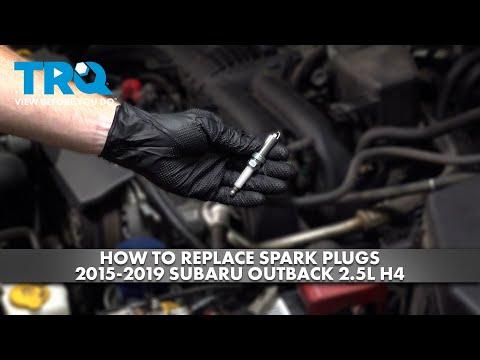







How to Replace Spark Plugs on a 2013-2019 Subaru Outback 2.5L (FB25) (Engine: Flat 4 2.5L)
Step-by-step DIY guide with tools, parts list, plug gap tips, and torque specs
How to Replace Spark Plugs on a 2013-2019 Subaru Outback 2.5L (FB25) (Engine: Flat 4 2.5L)
Step-by-step DIY guide with tools, parts list, plug gap tips, and torque specs for 2013, 2014, 2015, 2016, 2017, 2018, 2019


🔧 Outback - Spark Plug Replacement
On your Outback, the spark plugs sit deep in the cylinder heads and are reached from the sides of the engine bay. Replacing them restores smooth starts, idle quality, and fuel economy—especially if you’re near the maintenance interval.
Difficulty Level: Intermediate | Estimated Time: 1.5-3.0 hours
Assumption: Stock 2.5L FB25 with OEM-style iridium plugs.
⚠️ Safety & Precautions
- ⚠️ Work on a fully cool engine to avoid burns and damaged threads.
- ⚠️ Disconnect the negative battery cable to prevent accidental shorts.
- ⚠️ Keep dirt out of the spark plug holes—debris can damage the engine.
- ⚠️ Do not use anti-seize on modern plated spark plugs unless the plug maker explicitly says to.
🔧 Required Tools
You'll need the following tools for this repair:
- Safety glasses
- Nitrile gloves
- 10mm socket
- 3/8" ratchet
- 3/8" torque wrench (10-40 ft-lbs range)
- 3/8" extension set (3", 6", 10")
- 3/8" universal joint
- 14mm thin-wall spark plug socket (specialty)
- Flathead screwdriver
- Needle-nose pliers
- Trim clip removal tool
- Compressed air blow gun
- Feeler gauge set (wire-style)
- Small flashlight
🔩 Required Parts
HowToo sells all the parts you need for this repair:
- Spark plugs (iridium, correct spec for Outback 2.5L) - Qty: 4
- Dielectric grease - Qty: 1
📋 Before You Begin
- Park on level ground, shift to Park, and set the parking brake.
- Open the hood and let the engine cool completely (at least 1 hour).
- Use a 10mm socket to disconnect the negative battery cable and move it aside.
- Take a quick photo of hose routing first.
🔨 Step-by-Step Instructions
Follow these steps in order:
Step 1: Create working room (passenger side)
- Use a flathead screwdriver to loosen the air intake hose clamp at the air box/snorkel.
- Use needle-nose pliers to release any spring clamps on small breather hoses, then slide hoses off carefully.
- Use a trim clip removal tool to pop any plastic clips holding the snorkel/ducting (if equipped), then lift the ducting out of the way.
Step 2: Create working room (driver side)
- Use a 10mm socket to loosen the battery terminals and remove the negative cable first, then the positive if you need more room.
- If needed for access, use a 10mm socket to remove the battery hold-down and lift the battery out carefully (it’s heavy).
- Move any nearby harness clips out of the way using a trim clip removal tool (do not pull on the wires).
Step 3: Remove the ignition coil from cylinder 1 (one coil at a time)
- Locate the ignition coil (the small module sitting on top of the spark plug hole).
- Press the electrical connector tab and unplug it. Use a flathead screwdriver gently only if it’s stuck.
- Use a 10mm socket and 3/8" ratchet to remove the coil retaining bolt.
- Twist the coil slightly, then pull straight out. Wiggle—don’t pry hard.
- Definition: An ignition coil makes the high voltage the plug needs to spark.
Step 4: Clean the spark plug well
- Use a flashlight to look down the spark plug tube.
- Use compressed air blow gun to blow out dirt before removing the plug.
Step 5: Remove the spark plug
- Install a 14mm thin-wall spark plug socket (specialty) on a 3/8" extension set (3", 6", 10") with a 3/8" universal joint as needed for the tight angle.
- Use a 3/8" ratchet to break the spark plug loose, then unthread it fully.
- Carefully lift the plug out with the socket.
- Definition: A universal joint is a swivel that lets the socket bend to fit tight angles.
Step 6: Check and prepare the new spark plug
- Use a feeler gauge set (wire-style) to verify the plug gap matches the plug manufacturer/OEM spec.
- Do not bend or “re-gap” iridium tips unless the plug maker allows it.
- Apply a very small amount of dielectric grease inside the end of the coil boot (not on the plug threads).
- Definition: Dielectric grease helps prevent moisture and eases future removal.
Step 7: Install the new spark plug
- Start the plug by hand using the 14mm thin-wall spark plug socket (specialty) and 3/8" extension set (3", 6", 10") only (no ratchet at first) to avoid cross-threading.
- Once seated, use a 3/8" torque wrench (10-40 ft-lbs range) to tighten the spark plug: Torque to 20 Nm (15 ft-lbs).
Step 8: Reinstall the ignition coil
- Push the coil straight onto the plug until fully seated.
- Install the coil bolt using a 10mm socket and 3/8" ratchet, then tighten with a 3/8" torque wrench (10-40 ft-lbs range): Torque to 8 Nm (71 in-lbs).
- Reconnect the coil electrical connector until it clicks.
Step 9: Repeat for the remaining 3 cylinders
- Do one cylinder at a time so connectors and bolts don’t get mixed up.
- Use the same process: coil off, blow out debris, plug out, plug in, torque, coil on.
Step 10: Reassemble the intake/battery area
- Reinstall the air ducting and hoses, using a flathead screwdriver to snug clamps.
- If removed, reinstall the battery and hold-down using a 10mm socket.
- Reconnect battery cables (positive first, negative last) using a 10mm socket.
✅ After Repair
- Start the engine and let it idle 1-2 minutes. It should run smooth with no shaking.
- Check that no warning lights appear (especially Check Engine).
- Listen for any hissing that could indicate an intake hose left loose.
- Do a short test drive, then recheck the intake clamps and battery terminals for tightness.
💰 DIY vs Shop Cost
Shop Cost: $300-$550 (parts + labor)
DIY Cost: $60-$140 (parts only)
You Save: $160-$490 by doing it yourself!
Shop labor rates vary but typically run $100-$150/hour. This repair takes a shop approximately 1.5-2.5 hours.
🎯 Ready to get started?
HowToo makes it easy: same-day/2-day shipping on every part, plus all the tools and specialty tools you need! Check out the parts and tools sections below to add everything to your cart.