









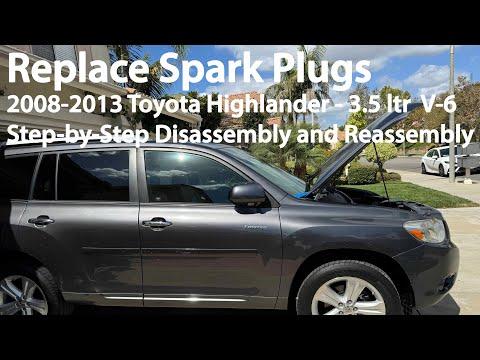




How to Replace Spark Plugs on a 2008-2016 Toyota Highlander Hybrid (Engine: V6 3.5L)
Step-by-step guide with intake removal, tools, parts, torque specs, and safety tips for 2008, 2009, 2010, 2011, 2012, 2013, 2014, 2015, 2016
How to Replace Spark Plugs on a 2008-2016 Toyota Highlander Hybrid (Engine: V6 3.5L)
Step-by-step guide with intake removal, tools, parts, torque specs, and safety tips for 2008, 2009, 2010, 2011, 2012, 2013, 2014, 2015, 2016


🔧 Highlander - Spark Plug Replacement
Replacing the spark plugs on your Highlander helps restore smooth starts, clean idle, and proper fuel economy. The rear spark plugs sit under the upper intake manifold, so this job requires careful removal of intake parts and new gaskets during reassembly.
Difficulty Level: Advanced | Estimated Time: 3-5 hours
⚠️ Safety & Precautions
- ⚠️ Your Highlander is a hybrid. Keep the ignition completely OFF and keep the key fob away from the vehicle while working.
- ⚠️ Do not touch orange high-voltage cables or hybrid components. This spark plug job does not require high-voltage battery service.
- ⚠️ Disconnect the 12V battery negative cable before removing ignition coils or intake electrical connectors.
- ⚠️ Work only on a cold engine. Hot aluminum threads can be damaged when removing spark plugs.
- ⚠️ Keep dirt, bolts, and tools out of the intake ports once the intake manifold is removed.
- ⚠️ A torque wrench is required. A torque wrench tightens bolts to the correct force so parts are not damaged.
🔧 Required Tools
You'll need the following tools for this repair:
- 10mm socket
- 12mm socket
- 14mm socket
- 5/8-inch spark plug socket
- 3/8-inch drive ratchet
- 3/8-inch drive torque wrench
- 1/4-inch drive torque wrench
- 3-inch extension
- 6-inch extension
- 10-inch extension
- Universal joint adapter
- Flat-blade screwdriver
- Phillips screwdriver
- Needle-nose pliers
- Trim clip removal tool
- Magnetic pickup tool
- Spark plug gap gauge
- Compressed air nozzle
- Clean shop towels
- Masking tape
- Permanent marker
- Nitrile gloves
- Safety glasses
🔩 Required Parts
HowToo sells all the parts you need for this repair:
- Iridium spark plugs - Qty: 6
- Upper intake manifold gasket set - Qty: 1
- Throttle body gasket - Qty: 1
- PCV hose clamp or vacuum hose clamps - Qty: As needed
- Dielectric grease - Qty: 1 tube
- Throttle body cleaner - Qty: 1 can
📋 Before You Begin
- 🅿️ Park your Highlander on level ground, shift to Park, and set the parking brake.
- 🔑 Turn the ignition OFF and move the key fob at least 15 feet away from the vehicle.
- ❄️ Let the engine cool completely before removing spark plugs.
- 🔋 Disconnect the 12V battery negative cable using a 10mm socket. The 12V battery powers the computers and ignition system.
- 🧼 Clean the top of the engine with a shop towel before removing parts.
- 🏷️ Use masking tape and a permanent marker to label hoses and connectors. This makes reassembly much easier.
🔨 Step-by-Step Instructions
Follow these steps in order:
Step 1: Remove the Engine Cover
- Use both hands to lift the plastic engine cover straight up from its rubber mounts.
- Set the cover aside where it will not get stepped on.
- Pull evenly, not sideways.
Step 2: Disconnect the 12V Battery
- Use a 10mm socket to loosen the negative battery cable clamp.
- Remove the negative cable from the battery post and wrap it with a shop towel.
- Position the cable so it cannot spring back onto the battery.
Step 3: Remove the Air Intake Duct
- Use a flat-blade screwdriver to loosen the hose clamp at the throttle body.
- Use a flat-blade screwdriver to loosen the hose clamp at the air cleaner box.
- Use needle-nose pliers to release any small hose clamps attached to the intake duct.
- Unplug the mass airflow sensor connector if its harness limits movement.
- Remove the air intake duct and place it aside.
Step 4: Remove the Throttle Body From the Intake Manifold
- Use a 10mm socket to remove the throttle body mounting bolts.
- Move the throttle body aside without pulling hard on the coolant hoses or wiring.
- If a hose must be removed, use needle-nose pliers to release the clamp, then twist the hose gently to break it loose.
- Remove and discard the old throttle body gasket.
- Do not spray cleaner directly into the electronic throttle motor.
Step 5: Label and Disconnect Intake Manifold Hoses and Connectors
- Use masking tape and a permanent marker to label vacuum hoses, PCV hoses, and electrical connectors.
- Use needle-nose pliers to release hose clamps.
- Use your fingers or a flat-blade screwdriver gently to release connector locks.
- A PCV hose carries crankcase vapors back into the intake to be burned by the engine.
- Take photos before unplugging.
Step 6: Remove Intake Manifold Supports and Brackets
- Use a 12mm socket and 3/8-inch drive ratchet to remove intake support bracket bolts where accessible.
- Use a 10mm socket to remove small harness brackets attached to the intake manifold.
- Keep bolts grouped by location using labeled tape or separate cups.
Step 7: Remove the Upper Intake Manifold
- Use a 12mm socket, 6-inch extension, and 3/8-inch drive ratchet to loosen the intake manifold bolts and nuts.
- Lift the upper intake manifold straight up and toward the front of the vehicle.
- Use a magnetic pickup tool if any fastener is dropped.
- Remove the old intake manifold gaskets.
- Immediately cover the open intake ports with clean shop towels.
- Nothing can fall inside.
Step 8: Remove the Front Ignition Coils
- Use your fingers to press each ignition coil connector tab and unplug the connector.
- Use a 10mm socket to remove each ignition coil retaining bolt.
- Twist each ignition coil gently, then pull it straight up.
- An ignition coil is the part that sends high voltage to the spark plug.
Step 9: Remove the Rear Ignition Coils
- Use your fingers to unplug the rear ignition coil connectors.
- Use a 10mm socket, 3-inch extension, and 1/4-inch drive torque wrench or ratchet to remove the coil bolts.
- Twist each coil gently and pull it straight up.
- Place the coils in order so they can return to the same cylinder if reused.
Step 10: Clean the Spark Plug Wells
- Use a compressed air nozzle to blow dirt out of each spark plug well.
- Wear safety glasses while using compressed air.
- Do not remove a spark plug until the well is clean.
Step 11: Remove the Old Spark Plugs
- Use a 5/8-inch spark plug socket, 10-inch extension, and 3/8-inch drive ratchet to loosen each spark plug.
- Use a universal joint adapter only where extra angle is needed.
- Turn slowly counterclockwise. If a plug feels stuck, tighten it slightly, then loosen again slowly.
- Remove one plug at a time and inspect it for oil, heavy white deposits, or broken ceramic.
Step 12: Check the New Spark Plugs
- Use a spark plug gap gauge to verify the gap is approximately 0.043 in.
- Do not force-adjust iridium plug tips unless the gap is clearly wrong.
- Do not apply anti-seize unless the spark plug manufacturer specifically requires it.
- Iridium tips are delicate.
Step 13: Install the New Spark Plugs
- Place one new spark plug into the 5/8-inch spark plug socket.
- Use the 10-inch extension by hand to start threading the plug clockwise.
- Thread each plug several turns by hand before using a ratchet. This prevents cross-threading.
- Use a 3/8-inch drive torque wrench to tighten each spark plug to Torque to 18 Nm (13 ft-lbs).
Step 14: Reinstall the Ignition Coils
- Apply a small amount of dielectric grease inside each coil boot. Dielectric grease helps seal moisture but does not conduct electricity.
- Push each ignition coil straight down until seated on the spark plug.
- Use a 10mm socket and 1/4-inch drive torque wrench to tighten each coil bolt to Torque to 8 Nm (71 in-lbs).
- Reconnect each ignition coil electrical connector until it clicks.
Step 15: Install New Intake Manifold Gaskets
- Remove the clean shop towels from the intake ports only when ready to install the manifold.
- Use clean shop towels to wipe the gasket surfaces.
- Install the new upper intake manifold gaskets into the manifold grooves.
- Make sure each gasket sits flat and is not twisted.
Step 16: Reinstall the Upper Intake Manifold
- Set the upper intake manifold carefully into position.
- Start all bolts and nuts by hand first.
- Use a 12mm socket, 6-inch extension, and 1/4-inch drive torque wrench to tighten the manifold fasteners evenly.
- Tighten in a center-out pattern to Torque to 21 Nm (15 ft-lbs).
Step 17: Reinstall Intake Brackets, Hoses, and Connectors
- Use a 12mm socket to reinstall support bracket bolts and tighten to Torque to 21 Nm (15 ft-lbs).
- Use a 10mm socket to reinstall small harness brackets and tighten snugly.
- Use needle-nose pliers to reinstall hose clamps in their original positions.
- Reconnect every labeled electrical connector until it clicks.
Step 18: Reinstall the Throttle Body
- Install a new throttle body gasket.
- Position the throttle body on the intake manifold.
- Use a 10mm socket and 1/4-inch drive torque wrench to tighten the throttle body bolts to Torque to 10 Nm (89 in-lbs).
- Reconnect the throttle body electrical connector and any hoses removed earlier.
Step 19: Reinstall the Air Intake Duct
- Slide the air intake duct onto the throttle body and air cleaner box.
- Use a flat-blade screwdriver to tighten both hose clamps until snug.
- Reconnect any small hoses and the mass airflow sensor connector if unplugged.
- Check that the duct is fully seated with no air gaps.
Step 20: Reconnect the 12V Battery and Start the Engine
- Use a 10mm socket to reconnect and tighten the negative battery cable.
- Reinstall the engine cover by pressing it down onto its rubber mounts.
- Start your Highlander and let it idle.
- The idle may be slightly high or uneven for a few minutes while the throttle relearns.
✅ After Repair
- ✅ Listen for hissing sounds around the intake manifold. A hiss may mean a vacuum leak.
- ✅ Confirm the engine idles smoothly after a few minutes.
- ✅ Make sure no warning lights stay on after startup.
- ✅ Test drive gently for 10-15 minutes and check for hesitation or misfire.
- ✅ Recheck that all hoses, connectors, and clamps are fully seated.
- ✅ If the check engine light comes on, scan for codes before driving far.
💰 DIY vs Shop Cost
Shop Cost: $450-$750 (parts + labor)
DIY Cost: $90-$180 (parts only)
You Save: $360-$570 by doing it yourself!
Shop labor rates vary but typically run $100-$150/hour. This repair takes a shop approximately 2.5-4.0 hours.
🎯 Ready to get started?
HowToo makes it easy: same-day/2-day shipping on every part, plus all the tools and specialty tools you need! Check out the parts and tools sections below to add everything to your cart.