









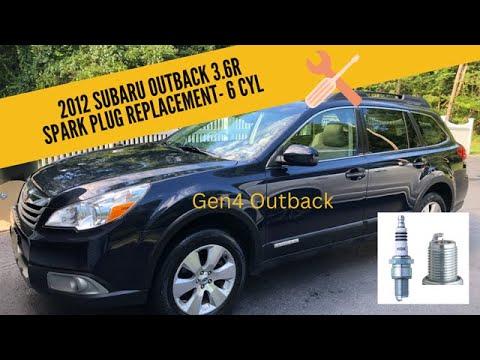







How to Replace Spark Plugs on a 2001-2019 Subaru Outback 3.6L (H6) (Engine: Flat 6 3.6L)
Step-by-step DIY guide with tools, parts list, safety tips, and torque specs for coils and plugs
How to Replace Spark Plugs on a 2001-2019 Subaru Outback 3.6L (H6) (Engine: Flat 6 3.6L)
Step-by-step DIY guide with tools, parts list, safety tips, and torque specs for coils and plugs


🔧 Outback - Spark Plug Replacement
On your Outback’s 3.6L flat-6, the spark plugs sit low on the sides of the engine. The job is mostly about making room, unplugging each ignition coil, and swapping the plugs without damaging the threads.
Difficulty Level: Advanced | Estimated Time: 2.5-4.5 hours
⚠️ Safety & Precautions
- ⚠️ Work on a cold engine to avoid burns and prevent thread damage.
- ⚠️ Disconnect the negative battery cable to avoid accidental shorts.
- ⚠️ Do not over-tighten spark plugs; the cylinder head is aluminum.
- ⚠️ Keep dirt out of the plug holes; blow them out before removing plugs.
- ⚠️ If you raise the vehicle for access, support it with jack stands (never the jack alone).
🔧 Required Tools
You'll need the following tools for this repair:
- Safety glasses
- Nitrile gloves
- Wheel chocks
- Floor jack (rated 3-ton minimum)
- Jack stands (rated 3-ton minimum)
- 10mm socket
- 12mm socket
- 3/8" drive ratchet
- 3/8" drive torque wrench (10–40 ft-lbs range)
- 5/8" spark plug socket
- 3/8" drive extension set (3", 6", 10")
- 3/8" drive universal joint
- 3/8" drive wobble extension
- Flat-blade screwdriver
- Trim clip remover
- Needle-nose pliers
- Compressed air blow gun
- Feeler gauge set
- Small flashlight
🔩 Required Parts
HowToo sells all the parts you need for this repair:
- Spark plugs (iridium, correct heat range for 3.6L) - Qty: 6
- Dielectric grease (silicone) - Qty: 1
📋 Before You Begin
- Park on level ground, shift to Park, and set the parking brake.
- Let the engine cool fully (at least 1–2 hours after driving).
- Open the hood and remove the key from the vehicle.
- Use a 10mm socket to disconnect the battery negative terminal and tuck it aside.
- Tip: Take photos before unplugging connectors.
🔨 Step-by-Step Instructions
Follow these steps in order:
Step 1: Remove the engine cover and intake ducting
- Remove the plastic engine cover by pulling it upward (it’s held by grommets).
- Use a flat-blade screwdriver to loosen the intake duct clamps as needed.
- Move the intake snorkel/ducting out of the way for hand clearance.
Step 2: Create working room on each side of the engine
- Driver side: Use a 10mm socket to remove the battery hold-down, then lift out the battery (it’s heavy).
- Passenger side: Use a 10mm socket and trim clip remover to unbolt/unclip the windshield washer fluid tank and move it aside (don’t kink the hoses).
- If a small bracket or harness clip blocks coil access, remove it using a 10mm socket or trim clip remover.
Step 3: Unplug and remove one ignition coil
- Pick one cylinder area and do them one at a time (prevents mixing connectors).
- Press the connector lock tab and unplug the coil electrical connector.
- Use a 10mm socket to remove the ignition coil retaining bolt.
- Twist the coil slightly, then pull it straight out.
- Tip: If stuck, twist—don’t pry hard.
- Ignition coil: the “pencil” part that sits on the plug.
Step 4: Clean the plug well before removal
- Use a compressed air blow gun to blow dirt out around the spark plug hole.
- Use a flashlight to confirm the plug well looks clean.
Step 5: Remove the spark plug
- Install the 5/8" spark plug socket onto a 3/8" drive extension.
- Use a 3/8" drive universal joint or wobble extension to match the angle.
- Use a 3/8" drive ratchet to loosen and remove the spark plug.
- If it feels unusually tight, tighten slightly first, then loosen again to reduce thread damage risk.
Step 6: Check and prep the new spark plug
- Use a feeler gauge set to verify the gap matches the plug manufacturer’s spec for your Outback.
- Do not use anti-seize on iridium/plated plugs unless the plug maker specifically requires it.
- Apply a very small amount of dielectric grease inside the coil boot.
- Dielectric grease: silicone grease that helps prevent moisture and sticking.
Step 7: Install the new spark plug (prevent cross-threading)
- Place the new plug into the 5/8" spark plug socket.
- Start threading the plug by hand using only the extension (no ratchet at first) until it seats smoothly.
- Use a 3/8" drive torque wrench to tighten: Torque to 21 Nm (15 ft-lbs).
Step 8: Reinstall the ignition coil
- Push the coil straight onto the plug until fully seated.
- Install the coil bolt using a 10mm socket, then snug with a torque wrench: Torque to 8 Nm (71 in-lbs).
- Reconnect the coil electrical connector until it clicks.
Step 9: Repeat for all remaining cylinders
- Repeat Steps 3–8 for the remaining 5 spark plugs.
- Use the wobble extension/universal joint as needed for the rear cylinders (tightest access).
- Tip: Take breaks—tight access is tiring.
Step 10: Reinstall removed components
- Reinstall the washer tank using a 10mm socket and the original clips.
- Reinstall the battery and hold-down using a 10mm socket.
- Reconnect the battery negative terminal using a 10mm socket.
- Reinstall intake ducting and tighten clamps with a flat-blade screwdriver.
- Press the engine cover back onto its grommets.
✅ After Repair
- Start the engine and let it idle for 1–2 minutes.
- Listen for misfires (shaking/rough idle) and check that the Check Engine Light stays off.
- Verify all coil connectors are fully clicked in and no hoses were left disconnected.
- Take a short test drive and recheck for any warning lights.
💰 DIY vs Shop Cost
Shop Cost: ₹12,000-₹25,000 (parts + labor)
DIY Cost: ₹4,500-₹10,500 (parts only)
You Save: ₹7,500-₹14,500 by doing it yourself!
Shop labor rates vary but typically run ₹800-₹1,500/hour. This repair takes a shop approximately 2.5-4.5 hours.
🎯 Ready to get started?
HowToo makes it easy: same-day/2-day shipping on every part, plus all the tools and specialty tools you need! Check out the parts and tools sections below to add everything to your cart.