









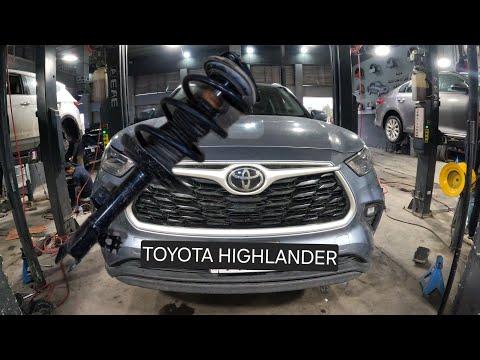






How to Replace Shocks and Struts on a 2022 Toyota Highlander
Step-by-step 2022 Highlander suspension guide with tools, parts list, torque specs, safety tips, and DIY cost savings for 2020, 2021, 2022
How to Replace Shocks and Struts on a 2022 Toyota Highlander
Step-by-step 2022 Highlander suspension guide with tools, parts list, torque specs, safety tips, and DIY cost savings for 2020, 2021, 2022


🔧 Highlander - Shock Absorber Replacement
You’ll be replacing the shocks/struts that control how your Highlander rides and handles. Worn units can cause bouncing, nose-diving when braking, or uneven tire wear. This job is very doable at home if you work slowly and carefully.
Difficulty Level: Intermediate | Estimated Time: 4-6 hours for all 4 (2-3 hours for front pair, 1.5-2.5 hours for rear pair)
⚠️ Safety & Precautions
- ⚠️ Always support the Highlander with jack stands; never rely on the floor jack alone.
- ⚠️ You will be removing suspension parts; keep hands clear of pinch points when lowering control arms or hubs.
- ⚠️ Use a coil spring compressor only if you are disassembling the front strut; the spring is under high tension and can be dangerous.
- ⚠️ Wear safety glasses and mechanic gloves to protect your eyes and hands.
- ⚠️ Work on a flat, solid surface and chock the wheels that stay on the ground so the vehicle cannot roll.
- ⚠️ Do not loosen or remove any brake hydraulic lines. If a brake hose is clipped to the strut, only remove the clip/bracket bolt.
- ⚠️ An alignment is strongly recommended after front strut replacement to avoid tire wear and pulling.
🔧 Required Tools
You'll need the following tools for this repair:
- Floor jack (rated 3-ton minimum)
- Jack stands (rated 3-ton, Qty: 4)
- Wheel chocks
- Lug wrench (21mm)
- Socket set (10mm–22mm)
- Metric combination wrench set (10mm–22mm)
- Breaker bar 1/2" drive
- Torque wrench 3/8" drive (up to 80 Nm / 60 ft-lbs)
- Torque wrench 1/2" drive (up to 250 Nm / 185 ft-lbs)
- Pry bar 12"-18"
- Flathead screwdriver medium
- Needle-nose pliers
- Hammer medium
- Metric Allen key set
- Coil spring compressor (external clamp style) (specialty)
- Penetrating oil spray
- Paint marker or white correction pen
- Rubber mallet
- Trim clip removal tool
- Safety glasses
- Mechanic gloves
- Shop rags
🔩 Required Parts
HowToo sells all the parts you need for this repair:
- Front loaded strut assembly (left) - Qty: 1
- Front loaded strut assembly (right) - Qty: 1
- Rear shock absorber (left) - Qty: 1
- Rear shock absorber (right) - Qty: 1
- Front upper strut mount nuts - Qty: 6
- Front strut-to-knuckle bolts and nuts - Qty: 4
- Rear shock lower bolt and nut set - Qty: 2
- Rear shock upper nuts - Qty: 4
- Anti-seize compound - Qty: 1
- Penetrating oil - Qty: 1
Replace shocks and struts in left/right pairs.
📋 Before You Begin
- Park the Highlander on level ground, set the parking brake, and place wheel chocks at the wheels staying on the ground.
- Loosen (but do not remove) all wheel lug nuts with the 21mm lug wrench before lifting the vehicle.
- Have all four new units ready and laid out so you can compare length and mounting points with the old parts.
- Spray all lower shock/strut mounting bolts and nuts with penetrating oil 15–20 minutes before removal.
- Battery disconnection is not required for this job.
🔨 Step-by-Step Instructions
Follow these steps in order:
Step 1: Lift and Support the Highlander
- Use the floor jack at the front center jacking point to raise the front until both front wheels are off the ground.
- Place jack stands under the front pinch welds or frame points and slowly lower the vehicle onto them with the floor jack.
- Repeat for the rear if you are doing the rear shocks at the same time.
- Shake the vehicle gently by hand to confirm it is stable on the stands.
- Remove the wheels using the 21mm lug wrench.
Step 2: Front Strut Overview (Know What You’re Looking At)
- On each front corner, locate the strut (a large shock with a spring around it) running from the wheel knuckle up into the body.
- Note the brake hose bracket and ABS sensor wire that clip to or bolt onto the strut body.
- Take a photo of each side before disassembly.
Step 3: Disconnect Brake Hose and ABS Wire from Front Strut
- Use a 10mm socket to remove any small bolts holding the brake hose or ABS wire bracket to the strut.
- If there are plastic clips, use the trim clip removal tool or flathead screwdriver to gently pry them out of the strut tab.
- Let the hose and wire hang free, but do not stretch them.
Step 4: Mark Front Strut-to-Knuckle Position
- Use the paint marker to draw lines across the strut flange and the steering knuckle where they meet.
- This gives you a reference to keep alignment close when installing the new strut.
Step 5: Remove Front Strut Lower Bolts
- Support the lower control arm or hub with the floor jack lightly, just touching.
- Use a 22mm socket and breaker bar on the strut-to-knuckle nuts, and a 22mm wrench on the bolt head if needed.
- Break both nuts loose, then remove the nuts and push out the bolts. You may need a hammer and punch or old bolt to tap them out.
- Do not let the brake hose get tight as the knuckle moves; adjust the jack as needed.
Step 6: Remove Front Strut Upper Nuts and Strut Assembly
- Open the hood and locate the three upper strut mount nuts on the strut tower for each side.
- Use a 14mm socket and ratchet to remove two of the nuts, leaving the third loosely threaded to support the strut.
- With one hand supporting the strut from below, remove the last nut using the 14mm socket.
- Carefully lower and maneuver the strut out of the wheel well. You might need to turn the steering slightly or move the knuckle.
Step 7: Prepare New Front Strut Assemblies
- If you bought loaded strut assemblies (spring and mount pre-installed), you do not need a spring compressor.
- If you bought bare struts, you must compress the old spring with the coil spring compressor, move the spring and mount to the new strut, and reassemble. For a first-time DIYer, it is much safer to use loaded assemblies.
- Compare the new strut to the old one for length, mount orientation, and bracket locations.
Step 8: Install New Front Strut Assembly
- Feed the new strut up into the wheel well and insert the studs through the holes in the strut tower.
- Install the upper nuts by hand using a 14mm socket, but do not fully tighten yet.
- Align the lower strut flange with the steering knuckle, using the floor jack under the lower arm to help position it.
- Insert the lower bolts from the rear or same direction as original. Lightly tap with a hammer if needed.
- Install the new nuts and snug them with a 22mm socket and wrench, but do not final-torque yet.
- Rotate the strut slightly so your paint marks line up as close as possible.
Step 9: Torque Front Strut Fasteners
- Torque the lower strut-to-knuckle bolts with the 1/2" torque wrench and 22mm socket to 177 Nm (131 ft-lbs).
- Torque the three upper strut mount nuts with the 3/8" torque wrench and 14mm socket to 59 Nm (44 ft-lbs).
- Reattach the brake hose and ABS wire brackets with the 10mm socket and torque to 9 Nm (80 in-lbs).
Step 10: Rear Shock Overview
- At the rear, you have separate shocks (no spring around them) mounted between the lower suspension arm and the body.
- Access to the upper shock nuts is usually from inside the wheel well or behind interior trim near the cargo area, depending on exact layout.
- Do one side at a time to avoid confusion.
Step 11: Remove Rear Shock Lower Bolt
- Support the rear lower control arm or suspension arm with the floor jack under the arm.
- Use a 19mm socket and breaker bar on the lower shock bolt head, and a 19mm wrench on the nut if present.
- Remove the nut and tap the bolt out with a hammer if it is stuck.
Step 12: Remove Rear Shock Upper Mount Fasteners
- From the wheel well or cargo area (depending on design), locate the two upper mounting nuts of the shock.
- Use a 14mm socket and ratchet to remove the nuts.
- Hold the shock body with your other hand so it does not drop when the last nut comes off.
- Lower the old shock out of the vehicle.
Step 13: Install New Rear Shock
- Compare the new rear shock to the old one for length and mount type.
- Position the new shock in place and slide the upper studs through their holes.
- Install the upper nuts by hand with the 14mm socket, but do not fully tighten yet.
- Align the lower eyelet with the suspension arm and install the lower bolt and nut by hand using a 19mm socket and wrench.
Step 14: Torque Rear Shock Fasteners
- With the suspension supported at near-normal ride height by the floor jack under the arm, torque the lower bolt using the 1/2" torque wrench and 19mm socket to 137 Nm (101 ft-lbs).
- Torque the upper shock nuts with the 3/8" torque wrench and 14mm socket to 40 Nm (30 ft-lbs).
Step 15: Reinstall Wheels and Lower the Vehicle
- Reinstall each wheel and hand-thread the lug nuts.
- Use the 21mm lug wrench to snug the nuts in a star pattern.
- Raise the vehicle slightly with the floor jack, remove the jack stands, and lower the vehicle fully to the ground.
- Torque the lug nuts with the 1/2" torque wrench and 21mm socket to 131 Nm (97 ft-lbs) in a star pattern.
✅ After Repair
- Start the Highlander and turn the steering wheel lock to lock while stationary to ensure there is no binding or noise.
- Take a short, slow test drive on a smooth road. Listen for clunks, rattles, or pops over bumps.
- Recheck all lug nuts with the torque wrench after the test drive.
- Schedule a four-wheel alignment, especially after replacing front struts, to protect your tires and handling.
- Over the next few days, listen for any unusual noises and re-inspect visible fasteners if something sounds off.
💰 DIY vs Shop Cost
Shop Cost: $900-$1,400 (parts + labor) for all four
DIY Cost: $350-$700 (parts only, using quality aftermarket or OEM-equivalent)
You Save: $550-$700 by doing it yourself!
Shop labor rates vary but typically run $100-$150/hour. This repair takes a shop approximately 3-4 hours.
🎯 Ready to get started?
HowToo makes it easy: same-day/2-day shipping on every part, plus all the tools and specialty tools you need! Check out the parts and tools sections above to add everything to your cart.