









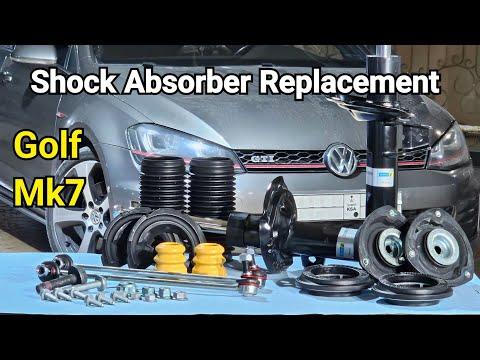






How to Replace Shock Absorbers on a 2015-2017 Volkswagen GTI (Trim: S)
Step-by-step front strut and rear shock replacement with tools, torque specs, and safety tips
How to Replace Shock Absorbers on a 2015-2017 Volkswagen GTI (Trim: S)
Step-by-step front strut and rear shock replacement with tools, torque specs, and safety tips for 2015, 2016, 2017


🔧 Shock Absorbers - Replacement
Your GTI uses front strut assemblies and rear shock absorbers. The front and rear jobs are different, so the safest approach is to replace each axle separately and in pairs. If the goal is ride control, handling, or leaking fluid, replacing both sides on the same axle keeps the car balanced.
Difficulty Level: Intermediate | Estimated Time: 3-6 hours
⚠️ Safety & Precautions
- Support the car with jack stands; never work under a car held only by a jack.
- Use a spring compressor on the front strut only. A coil spring stores a lot of energy and can hurt you badly if released.
- Keep hands clear of the rear suspension when lowering the axle; the spring can shift.
- Torque fasteners at ride height where required so bushings are not preloaded.
- No battery disconnect is normally required for this repair.
🔧 Required Tools
You'll need the following tools for this repair:
- Floor jack (rated 3-ton minimum)
- Jack stands (pair, rated 3-ton minimum)
- Wheel chocks
- 17mm socket
- 18mm socket
- 19mm socket
- 21mm socket
- Triple-square M14 socket
- Torx T25 screwdriver
- Torx T30 screwdriver
- Breaker bar
- Torque wrench
- Ratchet and extensions
- Spring compressor (specialty)
- Trim tool
- Penetrating oil
- Paint marker
- Safety glasses
- Mechanic gloves
🔩 Required Parts
HowToo sells all the parts you need for this repair:
- Front strut assembly - Qty: 2
- Rear shock absorber - Qty: 2
- Front strut mount and bearing kit - Qty: 2
- Front dust boot and bump stop kit - Qty: 2
- Rear upper shock mount - Qty: 2
- Rear dust boot and bump stop kit - Qty: 2
- New self-locking hardware - Qty: 1 set
📋 Before You Begin
- Park on level ground.
- Set the parking brake.
- Chock the wheels that stay on the ground.
- Loosen the wheel bolts slightly before lifting.
- Mark camber bolt positions at the front if equipped; this helps get close enough to drive to alignment.
- Plan on a professional alignment after front strut replacement.
🔨 Step-by-Step Instructions
Follow these steps in order:
Step 1: Lift and remove the wheels
- Use a 17mm socket to loosen the wheel bolts, then raise the car with a floor jack.
- Place it securely on jack stands.
- Remove the wheels and set them aside.
Step 2: Remove the rear shock absorber
- Use a 19mm socket or 21mm socket to remove the lower shock bolt.
- Use a Torx T25 screwdriver or trim tool to open the trunk-side access to the upper mount if needed.
- Use a 17mm socket to remove the upper shock fastener.
- Remove the shock from the car.
Step 3: Install the rear shock absorber
- Install the new rear shock by hand first.
- Use a 17mm socket for the upper fastener and a 19mm socket or 21mm socket for the lower bolt.
- Torque to 25 Nm (18 ft-lbs) plus 90° for the lower bolt if your replacement hardware calls for stretch tightening.
- Torque to 20 Nm (15 ft-lbs) for the upper mount fastener unless your kit specifies otherwise.
- Snug everything before final torque.
Step 4: Remove the front strut assembly
- Use a 17mm socket to disconnect the sway bar link from the strut if it blocks removal.
- Use a Triple-square M14 socket to remove the strut pinch bolt at the steering knuckle.
- Use a 19mm socket or 21mm socket to remove the upper strut mount nuts under the hood.
- Lower the steering knuckle slightly and remove the complete strut assembly.
Step 5: Disassemble and rebuild the front strut
- Install the strut in a spring compressor and compress the coil spring evenly.
- Use a 21mm socket and the correct pass-through tool setup, if needed, to remove the top nut.
- Swap over the spring, mount, bearing, boot, and bump stop to the new strut.
- Make sure the spring ends seat correctly in the lower perch.
- Keep the spring compressor opposite and even.
Step 6: Install the front strut assembly
- Raise the strut into place and start the upper nuts by hand.
- Align the strut to the knuckle and install the pinch bolt.
- Use a Triple-square M14 socket for the pinch bolt and a 19mm socket or 21mm socket for the upper mount hardware.
- Torque the strut top nuts to 60 Nm (44 ft-lbs).
- Torque the front strut pinch bolt to 70 Nm (52 ft-lbs) plus 90°.
- Torque the sway bar link nut to 65 Nm (48 ft-lbs).
Step 7: Reinstall wheels and final-tighten
- Reinstall the wheels with a 17mm socket.
- Lower the car enough for the tires to touch the ground lightly.
- Torque the wheel bolts to 120 Nm (89 ft-lbs).
Step 8: Final check and alignment
- Bounce each corner gently to settle the suspension.
- Check that the springs are seated correctly and nothing is rubbing.
- Schedule a front-end alignment after front strut replacement.
✅ After Repair
- Road test at low speed first.
- Listen for clunks, squeaks, or knocking.
- Check that the steering wheel is centered.
- Recheck wheel bolt torque after the first drive.
- Get an alignment if the front struts were replaced.
💰 DIY vs Shop Cost
Shop Cost: $900-$1,800 (parts + labor)
DIY Cost: $250-$700 (parts only)
You Save: $650-$1,100 by doing it yourself!
Shop labor rates vary but typically run $100-$150/hour. This repair takes a shop approximately 3-6 hours.
🎯 Ready to get started?
HowToo makes it easy: same-day/2-day shipping on every part, plus all the tools and specialty tools you need! Check out the parts and tools sections below to add everything to your cart.