









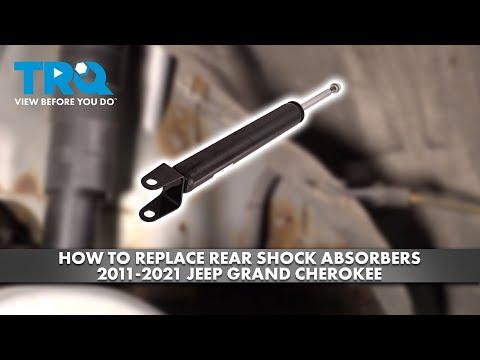







How to Replace Shock Absorbers on a 2011-2021 Jeep Grand Cherokee
Step-by-step DIY guide with tools, parts, torque specs, safety tips, and cost savings
How to Replace Shock Absorbers on a 2011-2021 Jeep Grand Cherokee
Step-by-step DIY guide with tools, parts, torque specs, safety tips, and cost savings for 2011, 2012, 2013, 2014, 2015, 2016, 2017, 2018, 2019, 2020, 2021


🔧 Grand Cherokee - Shock Absorber Replacement
This repair replaces the worn shock absorbers on your Grand Cherokee. Shock absorbers control bouncing and help keep the tires planted, so replacing weak ones improves ride control, braking stability, and tire wear.
Difficulty Level: Intermediate | Estimated Time: 2-4 hours
Assumption: This guide covers standard suspension without Quadra-Lift air suspension.
⚠️ Safety & Precautions
- ⚠️ Work on a flat, solid surface and never rely on a jack alone.
- ⚠️ Use jack stands under the vehicle before removing any wheel.
- ⚠️ Shock absorbers are suspension parts; support the axle/control arm before removing bolts so parts do not drop suddenly.
- ⚠️ Do not loosen coil spring mounts. This job does not require spring removal.
- ⚠️ Wear safety glasses and gloves because rust, dirt, and road debris can fall while working underneath.
- ⚠️ Battery disconnect is not required for standard shock absorber replacement.
🔧 Required Tools
You'll need the following tools for this repair:
- Floor jack (rated 3-ton minimum)
- Jack stands (rated 3-ton minimum)
- Wheel chocks
- 22mm lug nut socket
- 1/2-inch drive breaker bar
- 1/2-inch drive ratchet
- 15mm socket
- 18mm socket
- 21mm socket
- 15mm wrench
- 18mm wrench
- 21mm wrench
- Torque wrench (10-250 ft-lbs)
- Trim clip removal tool
- Flathead screwdriver
- Rubber mallet
- Penetrating oil
- Wire brush
- Paint marker
- Mechanic gloves
- Safety glasses
🔩 Required Parts
HowToo sells all the parts you need for this repair:
- Front shock absorbers - Qty: 2
- Rear shock absorbers - Qty: 2
- Shock absorber mounting hardware kit - Qty: 1
Best practice: Replace shocks in pairs on the same axle. For best ride balance, replace all four.
📋 Before You Begin
- Park your Grand Cherokee on level ground.
- Shift to Park and apply the parking brake.
- Place wheel chocks in front of and behind the wheels that stay on the ground.
- Spray penetrating oil on the shock mounting bolts 10-15 minutes before removal.
- A shock absorber is the tube-shaped part that bolts between the suspension and body/frame to control bounce.
- A torque wrench is a tool that tightens bolts to a measured amount so they are not too loose or too tight.
🔨 Step-by-Step Instructions
Follow these steps in order:
Step 1: Loosen the Wheel Lug Nuts
- Use a 22mm lug nut socket and 1/2-inch drive breaker bar to loosen each lug nut about half a turn.
- Do this before lifting the vehicle so the wheels do not spin.
- Loosen only, do not remove yet.
Step 2: Raise and Support the Vehicle
- Use a floor jack to lift the axle or approved lift point near the corner you are working on.
- Place jack stands under strong frame/support points.
- Lower the vehicle gently onto the jack stands using the floor jack.
- Give the vehicle a light push by hand to confirm it is stable before working underneath.
Step 3: Remove the Wheel
- Use a 22mm lug nut socket and 1/2-inch drive ratchet to remove the lug nuts.
- Remove the wheel and set it flat under the side of the vehicle as an extra safety backup.
Step 4: Support the Suspension
- Use the floor jack to lightly support the lower control arm or rear axle near the shock being replaced.
- Do not lift the vehicle off the jack stands.
- This keeps the suspension from dropping when the shock bolts are removed.
Step 5: Replace the Front Shock Absorber
- Use a wire brush to clean the upper and lower shock bolt threads.
- Spray the bolts again with penetrating oil if they look rusty.
- Use a paint marker to mark the original bolt positions if the mounts have visible alignment marks.
- Use an 18mm socket and 18mm wrench to remove the lower shock mounting bolt and nut.
- Use a 15mm socket or 15mm wrench to remove the upper shock mounting fasteners.
- Pull the old shock out by hand. If it sticks, tap it gently with a rubber mallet.
- Install the new front shock in the same direction as the old one.
- Start all bolts by hand first to avoid cross-threading. Cross-threading means the bolt is going in crooked and damaging the threads.
- Use an 18mm socket and 18mm wrench to snug the lower bolt.
- Use a 15mm socket or 15mm wrench to snug the upper fasteners.
- With the suspension lightly loaded by the floor jack, tighten the lower front shock bolt to Torque to 100 Nm (74 ft-lbs).
- Tighten the upper front shock fasteners to Torque to 75 Nm (55 ft-lbs).
- Start bolts by hand every time.
Step 6: Replace the Rear Shock Absorber
- Use a wire brush to clean the upper and lower rear shock mounting bolt areas.
- Use penetrating oil on the upper and lower rear shock bolts.
- Use a 21mm socket and 21mm wrench to remove the lower rear shock bolt and nut.
- Use an 18mm socket and 18mm wrench to remove the upper rear shock bolt and nut.
- If access is tight, use a trim clip removal tool or flathead screwdriver to gently move any plastic splash shield or liner clips out of the way.
- Remove the old rear shock by hand.
- Install the new rear shock in the same orientation as the old one.
- Start the upper and lower bolts by hand first.
- Use an 18mm socket and 18mm wrench to snug the upper rear shock bolt.
- Use a 21mm socket and 21mm wrench to snug the lower rear shock bolt.
- With the suspension lightly loaded by the floor jack, tighten the upper rear shock bolt to Torque to 100 Nm (74 ft-lbs).
- Tighten the lower rear shock bolt to Torque to 135 Nm (100 ft-lbs).
- Do one shock at a time.
Step 7: Repeat on the Other Side
- Use the same tools and steps to replace the shock absorber on the opposite side of the same axle.
- If replacing all four, complete both front shocks first, then both rear shocks.
- Keep the floor jack lightly supporting the suspension during bolt removal and final tightening.
Step 8: Reinstall the Wheels
- Lift the wheel onto the hub by hand.
- Start all lug nuts by hand.
- Use a 22mm lug nut socket and 1/2-inch drive ratchet to snug the lug nuts in a star pattern.
- Use the floor jack to raise the vehicle slightly, then remove the jack stands.
- Lower the vehicle fully to the ground.
- Use a torque wrench and 22mm lug nut socket to tighten the lug nuts in a star pattern to Torque to 176 Nm (130 ft-lbs).
✅ After Repair
- ✅ Bounce each corner of your Grand Cherokee by pushing down on the body. It should rise and settle quickly, not keep bouncing.
- ✅ Take a slow test drive first. Listen for clunks, rattles, or rubbing noises.
- ✅ Recheck lug nut torque after 25-50 miles using a torque wrench and 22mm lug nut socket.
- ✅ If the steering wheel is off-center or the vehicle pulls, get an alignment inspection.
- ✅ No scan tool reset or infotainment reset is required for standard shock absorber replacement.
💰 DIY vs Shop Cost
Shop Cost: $650-$1,200 (parts + labor)
DIY Cost: $250-$650 (parts only)
You Save: $400-$550 by doing it yourself!
Shop labor rates vary but typically run $100-$150/hour. This repair takes a shop approximately 2-4 hours.
🎯 Ready to get started?
HowToo makes it easy: same-day/2-day shipping on every part, plus all the tools and specialty tools you need! Check out the parts and tools sections below to add everything to your cart.
Guide for Suspension Shock Absorber replace for these Jeep vehicles
| Year Make Model | Sub Model | Engine | Body Style |
|---|---|---|---|
| 2021 Jeep Grand Cherokee | - | - | - |
| 2020 Jeep Grand Cherokee | - | - | - |
| 2019 Jeep Grand Cherokee | - | - | - |
| 2018 Jeep Grand Cherokee | - | - | - |
| 2017 Jeep Grand Cherokee | - | - | - |
| 2016 Jeep Grand Cherokee | - | - | - |
| 2015 Jeep Grand Cherokee | - | - | - |
| 2014 Jeep Grand Cherokee | - | - | - |
| 2013 Jeep Grand Cherokee | - | - | - |
| 2012 Jeep Grand Cherokee | - | - | - |
| 2011 Jeep Grand Cherokee | - | - | - |