









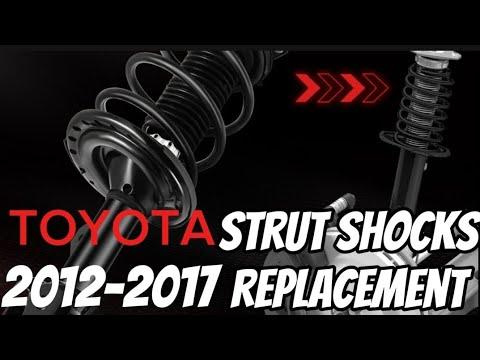







How to Replace Rear Shocks & Front Struts on a 2012-2017 Toyota Camry (DIY Guide) (Trim: Hybrid LE)
Step-by-step instructions with required tools/parts, safety tips, torque specs, and alignment notes
How to Replace Rear Shocks & Front Struts on a 2012-2017 Toyota Camry (DIY Guide) (Trim: Hybrid LE)
Step-by-step instructions with required tools/parts, safety tips, torque specs, and alignment notes for 2012, 2013, 2014, 2015, 2016, 2017


🔧 Camry - Shock Absorber Replacement
On your Camry, the rear uses separate shock absorbers, while the front uses struts (a strut is a shock that also supports the spring and affects alignment). Below are factory-style steps for replacing rear shocks and (if needed) front struts.
Difficulty Level: Intermediate | Estimated Time: Rear: 1.5–3 hours | Front: 3–6 hours
⚠️ Safety & Precautions
- ⚠️ Support the car with jack stands on solid lift points; never rely on a floor jack alone.
- ⚠️ Keep the car OFF and keep the key fob 10+ feet away so the hybrid system can’t wake up unexpectedly.
- ⚠️ If doing front struts: coil springs store serious energy—use a coil spring compressor correctly (it clamps the spring so it can’t expand).
- ⚠️ Do not pull/stretch brake hoses or ABS wires; unbolt brackets instead.
- ⚠️ Battery disconnect is not required for this job, but avoid touching any orange high-voltage cables.
🔧 Required Tools
You'll need the following tools for this repair:
- Floor jack (rated 3-ton minimum)
- Jack stands (rated 3-ton minimum)
- Wheel chocks
- Safety glasses
- Mechanic gloves
- Breaker bar 1/2"
- Torque wrench 3/8" (10–100 ft-lb range)
- Torque wrench 1/2" (50–200 ft-lb range)
- Socket set (10mm–22mm)
- Wrench set (10mm–22mm)
- 21mm socket
- 14mm socket
- 17mm socket
- 19mm socket
- Needle-nose pliers
- Trim removal tool
- Penetrating oil
- Pry bar
- Paint marker
- Allen key set (5mm–8mm)
- Coil spring compressor (specialty)
🔩 Required Parts
HowToo sells all the parts you need for this repair:
- Rear shock absorbers (replace in pairs) - Qty: 2
- Rear shock upper mount kit (recommended) - Qty: 2
- Rear shock dust boot & bump stop kit (recommended) - Qty: 2
- Front struts (if replacing fronts; replace in pairs) - Qty: 2
- Front strut mount & bearing kit (recommended) - Qty: 2
- Front strut dust boot & bump stop kit (recommended) - Qty: 2
- Optional: Front complete strut assemblies (pre-assembled; no spring compressor) - Qty: 2
📋 Before You Begin
- Park on level ground, turn the car OFF, set the parking brake, and chock the wheels.
- Crack the lug nuts loose with a 21mm socket before lifting (about 1/4 turn).
- Spray penetrating oil on the lower shock/strut bolts using penetrating oil and wait 5–10 minutes.
- If doing front struts, plan for a professional alignment afterward.
🔨 Step-by-Step Instructions
Follow these steps in order:
Step 1: Lift and secure the car
- Use a floor jack (rated 3-ton minimum) to lift the front or rear (depending on what you’re replacing).
- Set the car down onto jack stands (rated 3-ton minimum) at proper support points.
- Remove the wheels using a 21mm socket.
Step 2: Rear shock replacement (rear of the car)
- Open the trunk and remove the side trim panels near each rear shock tower using a trim removal tool. Go slow to avoid breaking clips.
- Support the rear suspension arm with a floor jack (rated 3-ton minimum) (light pressure only).
- Remove the lower shock bolt/nut using a 17mm socket and 17mm wrench. Torque to 103 Nm (76 ft-lb) during reassembly.
- Remove the upper shock nuts in the trunk using a 14mm socket. Torque to 19 Nm (14 ft-lb) during reassembly.
- Remove the shock from the car. If it’s stuck, use a pry bar gently at the lower mount.
- Transfer/replace the upper mount, dust boot, and bump stop as needed using wrench set (10mm–22mm).
- Install the new shock: start the upper nuts by hand using a 14mm socket, then install the lower bolt using a 17mm socket.
- Final-tighten to spec with a torque wrench 3/8" / torque wrench 1/2": Upper 19 Nm (14 ft-lb), Lower 103 Nm (76 ft-lb).
Step 3: Front strut replacement (front of the car, if needed)
- In the engine bay, locate the strut mount nuts (top of each strut tower).
- At the wheel well, unbolt the brake hose/ABS wire brackets from the strut using a 10mm socket or 12mm socket (as equipped). Do not let hoses hang by tension.
- If the stabilizer (sway bar) end link is attached to the strut, remove the end link nut using a 17mm socket and hold the stud with an Allen key set (5mm–8mm) as needed. Torque to 74 Nm (55 ft-lb) during reassembly.
- Mark the strut-to-knuckle relationship with a paint marker so you can reinstall close to the original position.
- Remove the two large strut-to-steering-knuckle bolts/nuts using a 19mm socket, 19mm wrench, and breaker bar 1/2". Torque to 177 Nm (131 ft-lb) during reassembly.
- Support the knuckle/hub so it doesn’t pull on the axle or hoses (use the floor jack (rated 3-ton minimum) under the control arm lightly).
- Remove the three upper strut mount nuts using a 14mm socket, then remove the strut assembly. Torque to 39 Nm (29 ft-lb) during reassembly.
- If installing a bare strut (not a complete assembly): compress the spring evenly using a coil spring compressor (specialty) until it’s loose in the mount. Then remove the center nut using a 17mm socket while holding the shaft with an Allen key set (5mm–8mm) as needed. Keep hands clear of the spring path.
- Reassemble with the new strut, mount/bearing, boot, and bump stop. Slowly release the spring compressor.
- Install the strut back into the car: start the top nuts by hand, then install the lower bolts, then torque everything: Upper 39 Nm (29 ft-lb), Lower 177 Nm (131 ft-lb), End link 74 Nm (55 ft-lb).
Step 4: Reinstall wheels and lower the car
- Reinstall the wheels using a 21mm socket.
- Lower the car off the jack stands (rated 3-ton minimum) using the floor jack (rated 3-ton minimum).
- Torque lug nuts in a star pattern using a torque wrench 1/2": Torque to 103 Nm (76 ft-lb).
✅ After Repair
- Do a slow test drive and listen for clunks over small bumps.
- Recheck lug nut torque using a torque wrench 1/2" after 25–50 miles.
- If you replaced front struts, get a 4-wheel alignment as soon as possible.
- Look under the car for any pulled/twisted ABS wires or brake hoses.
💰 DIY vs Shop Cost
Shop Cost: $900-$1,900 (parts + labor, front + rear)
DIY Cost: $250-$900 (parts only, depending on struts vs complete assemblies)
You Save: $650-$1,000 by doing it yourself!
Shop labor rates vary but typically run $100-$150/hour. This repair takes a shop approximately 4–8 hours.
🎯 Ready to get started?
HowToo makes it easy: same-day/2-day shipping on every part, plus all the tools and specialty tools you need! Check out the parts and tools sections below to add everything to your cart.
Guide for Suspension Strut replace for these Toyota vehicles
| Year Make Model | Sub Model | Engine | Body Style |
|---|---|---|---|
| 2017 Toyota Camry | Hybrid LE | - | - |
| 2017 Toyota Camry | Hybrid XLE | - | - |
| 2017 Toyota Camry | LE | - | - |
| 2017 Toyota Camry | XLE | - | - |
| 2017 Toyota Camry | Hybrid SE | - | - |
| 2016 Toyota Camry | Hybrid LE | - | - |
| 2016 Toyota Camry | Hybrid XLE | - | - |
| 2016 Toyota Camry | LE | - | - |
| 2016 Toyota Camry | XLE | - | - |
| 2016 Toyota Camry | Hybrid SE | - | - |
| 2015 Toyota Camry | Hybrid LE | - | - |
| 2015 Toyota Camry | Hybrid XLE | - | - |
| 2015 Toyota Camry | LE | - | - |
| 2015 Toyota Camry | XLE | - | - |
| 2015 Toyota Camry | Hybrid SE | - | - |
| 2014 Toyota Camry | Hybrid LE | - | - |
| 2014 Toyota Camry | Hybrid XLE | - | - |
| 2014 Toyota Camry | L | - | - |
| 2014 Toyota Camry | LE | - | - |
| 2014 Toyota Camry | XLE | - | - |
| 2014 Toyota Camry | Hybrid SE | - | - |
| 2013 Toyota Camry | Hybrid LE | - | - |
| 2013 Toyota Camry | Hybrid XLE | - | - |
| 2013 Toyota Camry | L | - | - |
| 2013 Toyota Camry | LE | - | - |
| 2013 Toyota Camry | XLE | - | - |
| 2012 Toyota Camry | Hybrid LE | - | - |
| 2012 Toyota Camry | Hybrid XLE | - | - |
| 2012 Toyota Camry | L | - | - |
| 2012 Toyota Camry | LE | - | - |
| 2012 Toyota Camry | XLE | - | - |