









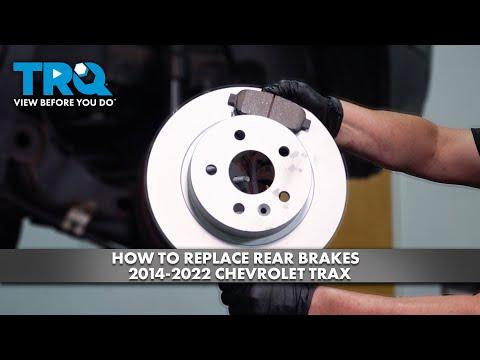






How to Replace Rear Brake Pads & Rotors on a 2018 Chevrolet Trax
Step-by-step rear brake job with tools, parts list, safety tips, and caliper piston rewind vs push-in guidance
How to Replace Rear Brake Pads & Rotors on a 2018 Chevrolet Trax
Step-by-step rear brake job with tools, parts list, safety tips, and caliper piston rewind vs push-in guidance


🔧 Trax - Rear Brake Pads & Rotor Replacement
Replacing the rear pads and rotors on your Trax involves lifting the rear, removing the caliper and bracket, swapping the rotor, and installing new pads with the caliper piston properly retracted. The only “gotcha” is the parking-brake design—some rear calipers push straight in, others must be rotated in.
Difficulty Level: Intermediate | Estimated Time: 2-4 hours
⚠️ Safety & Precautions
- 🧯 Work on level ground and support the rear with jack stands before removing any wheels.
- 🔥 Brakes can be very hot; let them cool before starting.
- 🧤 Do not press the brake pedal while a caliper is off the rotor.
- 🧼 Avoid breathing brake dust; use brake cleaner, not compressed air.
- 🅿️ Parking brake must be fully released before caliper removal.
🔧 Required Tools
You'll need the following tools for this repair:
- Floor jack (rated 3-ton minimum)
- Jack stands (rated 3-ton minimum)
- Wheel chocks
- 17mm lug nut socket
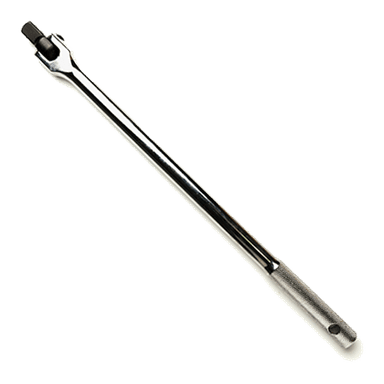
- Breaker bar (1/2")
- Torque wrench (20–200 ft-lbs range)
- Ratchet (3/8")
- Ratchet (1/2")
- Socket set (8mm–21mm)
- Hex bit socket set (4mm–10mm)
- Torque bit socket set (T20–T55)
- Flat-blade screwdriver
- Needle-nose pliers
- Brake caliper hanger hook
- C-clamp (6")
- Disc brake piston rewind tool kit (specialty)
- Wire brush
- Rubber mallet
- Brake cleaner
- High-temp silicone brake grease
- Shop towels
- Nitrile gloves
- Safety glasses
🔩 Required Parts
HowToo sells all the parts you need for this repair:
- Rear brake pad set - Qty: 1
- Rear brake rotors - Qty: 2 Replace in pairs
- Rear brake hardware kit - Qty: 1 If not included with pads
- Brake caliper bracket bolt threadlocker - Qty: 1
- Brake fluid (DOT 3) - Qty: 1 bottle
📋 Before You Begin
- 🅿️ Park on level ground, put the shifter in Park, and release the parking brake.
- 🧱 Chock the front wheels with wheel chocks.
- 🔎 Quick check: remove one rear wheel and look at the caliper piston face.
- ❓ Two quick questions so I give you the exact piston method and torque specs:
- Does your Trax have a manual parking brake (hand lever/foot pedal) or an electronic parking brake button?
- Can you upload a clear photo of the rear caliper piston face (straight-on)?
🔨 Step-by-Step Instructions
Follow these steps in order:
Step 1: Loosen the rear wheels
- Use a 17mm lug nut socket and breaker bar (1/2") to crack the lug nuts loose about 1/2 turn while the vehicle is on the ground.
Step 2: Lift and support the rear
- Use a floor jack (rated 3-ton minimum) to lift the rear at the approved jacking point.
- Set the vehicle down onto jack stands (rated 3-ton minimum).
- Shake the vehicle lightly to confirm it’s stable before working.
Step 3: Remove the rear wheels
- Finish removing the lug nuts using a 17mm lug nut socket and ratchet (1/2").
- Remove the wheel and set it under the vehicle as a backup safety measure.
Step 4: Access the caliper and pads
- Turn the steering is not needed for the rear; just position yourself for clear access.
- Use a flat-blade screwdriver to gently pry the pad ears away if they’re tight in the bracket.
- Use a wire brush to knock off heavy rust around the caliper/bracket so bolts are visible.
Step 5: Remove the caliper (do not let it hang)
- Use the correct socket set (8mm–21mm) or hex bit socket set (4mm–10mm) to remove the caliper guide pin bolts (these vary by build).
- Lift the caliper off the bracket and support it using a brake caliper hanger hook.
- Never hang a caliper by the brake hose.
Step 6: Remove pads and caliper bracket
- Remove the inner/outer pads from the bracket by hand (use flat-blade screwdriver if stuck).
- Use a ratchet (1/2") and the appropriate socket set (8mm–21mm) to remove the caliper bracket bolts.
- Set the bracket aside.
Step 7: Remove the rotor
- If there is a rotor retaining screw, remove it using the correct Torx bit socket set (T20–T55).
- Pull the rotor off. If it’s rusted on, tap the rotor hat with a rubber mallet to free it.
- Clean the hub face with a wire brush, then spray with brake cleaner and wipe with shop towels.
Step 8: Install the new rotor
- Clean the new rotor friction surfaces using brake cleaner and shop towels (removes shipping oil).
- Install the rotor onto the hub. If it uses a retaining screw, reinstall it using a Torx bit socket.
Step 9: Retract the caliper piston (this depends on your parking brake design)
- STOP here and reply with your parking brake type + piston photo so I can give you the correct method and the exact OEM torque specs for your Trax.
- If the piston face is smooth, it typically compresses straight in using a C-clamp (6").
- If the piston face has two notches, it typically must be rotated in using a disc brake piston rewind tool kit (specialty). (A “rewind tool” is a tool that turns and pushes the piston at the same time.)
Step 10: Reassemble with new pads (after piston is fully seated)
- Clean and lightly grease pad contact points using high-temp silicone brake grease (avoid rotor/pad friction surfaces).
- Reinstall the bracket and caliper using your socket set and torque wrench.
- Install the wheel and snug lugs using a 17mm lug nut socket.
✅ After Repair
- 🦶 Before driving, pump the brake pedal slowly 8–12 times until it feels firm.
- 🧴 Check brake fluid level and top off with DOT 3 if needed (do not overfill).
- 🔍 Check for leaks and make sure the wheels spin freely with the parking brake released.
- 🛣️ Bed-in (break-in) new pads with several gentle stops; avoid hard braking for the first 150–200 miles.
💰 DIY vs Shop Cost
Shop Cost: $450-$850 (parts + labor)
DIY Cost: $140-$350 (parts only)
You Save: $300-$500 by doing it yourself!
Shop labor rates vary but typically run $100-$150/hour. This repair takes a shop approximately 2-3 hours.
🎯 Ready to get started?
HowToo makes it easy: same-day/2-day shipping on every part, plus all the tools and specialty tools you need! Check out the parts and tools sections below to add everything to your cart.
Guide for replace for these Chevrolet vehicles
| Year Make Model | Sub Model | Engine | Body Style |
|---|