









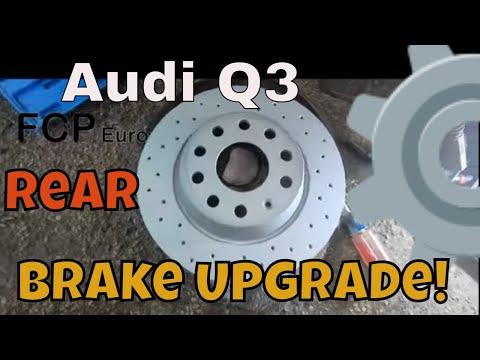







How to Replace Rear Brake Pads & Rotors on a 2016 Audi Q3 (EPB Service Mode)
Step-by-step DIY guide with tools, parts list, EPB retraction (OBDeleven/VCDS), and torque specs for 2016, 2017
How to Replace Rear Brake Pads & Rotors on a 2016 Audi Q3 (EPB Service Mode)
Step-by-step DIY guide with tools, parts list, EPB retraction (OBDeleven/VCDS), and torque specs for 2016, 2017


🔧 Q3 - Rear Brake Pads & Rotor Replacement
You’ll remove the rear wheels, retract the electronic parking brake (EPB), then replace the rear brake pads and rotors. This restores braking performance and prevents vibration, noise, and uneven stopping caused by worn pads or warped rotors.
Difficulty Level: Intermediate | Estimated Time: 2-4 hours
⚠️ Safety & Precautions
- ⚠️ Support your Q3 on jack stands before working underneath.
- ⚠️ Let brakes cool fully; hot rotors can burn you.
- ⚠️ Do not press the brake pedal with a caliper removed.
- ⚠️ EPB must be put in service mode before compressing the rear caliper piston.
- ⚠️ Watch brake fluid level; it can overflow when pistons are pushed in.
- ⚠️ Battery support is recommended during EPB service mode (low voltage can set faults).
🔧 Required Tools
You'll need the following tools for this repair:
- Floor jack (rated 3-ton minimum)
- Jack stands (rated 3-ton minimum)
- Wheel chocks
- 17mm socket
- 3/8" drive ratchet
- 1/2" drive breaker bar
- Torque wrench (20–200 Nm range)
- 13mm socket
- 15mm wrench
- 16mm socket
- 18mm socket
- Torx T30 bit
- Flat trim/pry tool
- Brake caliper piston compressor tool
- OBDeleven or VCDS scan tool (specialty)
- Wire brush
- Bungee cord or mechanic’s wire
- Micrometer or ruler
- Nitrile gloves
- Safety glasses
🔩 Required Parts
HowToo sells all the parts you need for this repair:
- Rear brake pad set - Qty: 1
- Rear brake rotors - Replace in pairs - Qty: 2
- Rear caliper carrier bolts - Replace in pairs (recommended) - Qty: 4
- Rear rotor set screws - Qty: 2
- Brake cleaner - Qty: 1
- Brake lubricant (silicone/ceramic) - Qty: 1
- Medium-strength threadlocker - Qty: 1
📋 Before You Begin
- Park on level ground, turn steering straight, and place wheel chocks at the front wheels.
- Release the parking brake fully before starting.
- Open the hood and check the brake fluid reservoir level; siphon a little out if it’s near MAX (a clean syringe tool works best).
- Plan to retract the EPB with a scan tool: this “backs off” the parking brake motor so you can safely compress the piston.
🔨 Step-by-Step Instructions
Follow these steps in order:
Step 1: Loosen wheel bolts and lift the rear
- Use a 17mm socket and breaker bar to loosen the rear wheel bolts 1/2 turn (do not remove yet).
- Use a floor jack to lift the rear, then set the vehicle securely on jack stands.
- Remove the wheel bolts with a 17mm socket and take the wheels off.
Step 2: Retract the electronic parking brake (EPB) into service mode
- Connect your OBDeleven or VCDS scan tool (specialty).
- Turn ignition ON (engine OFF).
- In the scan tool, go to the parking brake module and run the “open”/service function:
- Use OBDeleven: Control Units > 53 Parking Brake > Basic Settings > Open Rear Parking Brake
- Use VCDS: Select > 53 Parking Brake > Basic Settings > Open Rear Parking Brake
- EPB service mode = motors retract for pad service.
Step 3: Remove the rear caliper
- Use a flat trim/pry tool to remove the spring clip from the outside of the caliper (hold it firmly; it can pop).
- Remove the caliper guide/slider bolts:
- Use a 13mm socket to turn the bolt.
- Hold the slider with a 15mm wrench if it spins.
- Lift the caliper off the bracket and hang it with a bungee cord or mechanic’s wire (never let it dangle by the brake hose).
Step 4: Remove old pads and inspect
- Pull the inner and outer pads out of the bracket by hand (use a flat trim/pry tool if they’re stuck).
- Check pad wear pattern and look for torn dust boots or leaking caliper.
Step 5: Remove the caliper carrier (bracket)
- Remove the carrier bolts from the back of the knuckle using a 16mm socket or 18mm socket (varies by brake package).
- If reusing bolts, clean threads and apply medium-strength threadlocker.
- Set the carrier aside.
Step 6: Remove the rotor
- Remove the rotor retaining screw using a Torx T30 bit.
- Pull the rotor off the hub. If it’s stuck, tap the rotor hat firmly (use controlled force) while pulling outward.
- Clean the hub face with a wire brush and spray with brake cleaner.
- A clean hub helps prevent rotor wobble.
Step 7: Install the new rotor
- Clean the new rotor with brake cleaner to remove shipping oil.
- Install the rotor onto the hub and install a new set screw with a Torx T30 bit.
- Torque to 4 Nm (35 in-lbs).
Step 8: Reinstall the carrier (bracket)
- Install the carrier bolts using a 16mm socket or 18mm socket.
- Torque to 90 Nm (66 ft-lbs).
Step 9: Compress the rear caliper piston
- Make sure EPB is still in service mode.
- Use a brake caliper piston compressor tool to slowly press the piston straight back into the caliper.
- Go slowly and watch the brake fluid reservoir as the level rises.
- Slow compression reduces seal damage risk.
Step 10: Install new pads and refit the caliper
- Apply a thin layer of brake lubricant to pad ears/slide points (metal-to-metal contact points only).
- Install the new pads into the carrier.
- Set the caliper over the pads and install the guide/slider bolts using a 13mm socket (hold with 15mm wrench if needed).
- Torque to 35 Nm (26 ft-lbs).
- Reinstall the caliper spring clip.
Step 11: Repeat on the other rear side
- Repeat Steps 3–10 for the opposite rear wheel.
- Always replace pads/rotors as a set (both sides).
Step 12: Exit EPB service mode
- Use your OBDeleven or VCDS scan tool (specialty) to close the parking brake:
- OBDeleven: Control Units > 53 Parking Brake > Basic Settings > Close Rear Parking Brake
- VCDS: Select > 53 Parking Brake > Basic Settings > Close Rear Parking Brake
- Clear any EPB-related faults if they stored during service.
Step 13: Reinstall wheels
- Install wheels and hand-tighten wheel bolts.
- Lower the vehicle off jack stands using the floor jack.
- Use a torque wrench with a 17mm socket to tighten wheel bolts in a star pattern.
- Torque to 120 Nm (89 ft-lbs).
✅ After Repair
- With engine OFF, pump the brake pedal 8–12 times until it feels firm (this seats the pads).
- Check brake fluid level and top off if needed.
- Start the engine and confirm normal brake pedal feel.
- Apply and release the EPB a few times to confirm correct operation.
- Do a careful test drive and listen for abnormal grinding or pulling.
- Pad bedding (break-in): do several moderate stops from 40–10 mph with cool-down between; avoid hard panic stops for the first 200 miles.
💰 DIY vs Shop Cost
Shop Cost: $450-$900 (parts + labor)
DIY Cost: $180-$450 (parts only)
You Save: $270-$450 by doing it yourself!
Shop labor rates vary but typically run $100-$150/hour. This repair takes a shop approximately 2-3 hours.
🎯 Ready to get started?
HowToo makes it easy: same-day/2-day shipping on every part, plus all the tools and specialty tools you need! Check out the parts and tools sections below to add everything to your cart.