














How to Replace Rear Brake Pads & Rotors on a 2014 Ford Fusion (DIY Guide)
Step-by-step instructions with required tools, parts list, caliper wind-back tips, and torque specs
How to Replace Rear Brake Pads & Rotors on a 2014 Ford Fusion (DIY Guide)
Step-by-step instructions with required tools, parts list, caliper wind-back tips, and torque specs


🔧 Fusion - Rear Brake Pads & Rotor Replacement
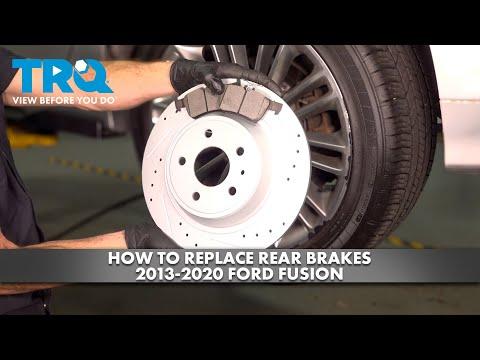
You’ll remove the rear wheels, swap the brake pads and rotors, then reassemble and torque everything correctly. The key is retracting the rear caliper piston the right way (rear pistons often need to be rotated while being pushed in because of the parking brake design).
Difficulty Level: Intermediate | Estimated Time: 2-4 hours
Quick check (answer these 2 and I’ll tailor the steps perfectly):
1) Does your Fusion have an electronic parking brake switch or a foot-operated parking brake pedal?
2) On the back of the rear caliper, are the slide pins a 7mm hex/Allen style or a bolt head (typically 13mm)?
⚠️ Safety & Precautions
- ⚠️ Support the car with jack stands before working under/around the wheels.
- ⚠️ Chock the front wheels and leave the transmission in 1st gear while lifted.
- ⚠️ Do not press the brake pedal while a caliper is off the rotor.
- ⚠️ Brake dust is harmful—use brake cleaner, not compressed air.
- ⚠️ If your parking brake uses the rear calipers, keep the parking brake released during the entire job.
🔧 Required Tools
You'll need the following tools for this repair:
- Floor jack (rated 3-ton minimum)
- Jack stands (rated 3-ton minimum)
- Wheel chocks
- 19mm socket
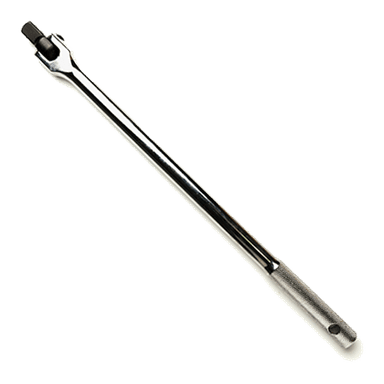
- 1/2" drive breaker bar
- 1/2" drive torque wrench (50-150 ft-lbs range)
- 3/8" drive ratchet
- 3/8" drive torque wrench (10-50 ft-lbs range)
- 7mm hex bit socket
- 13mm socket
- 15mm socket
- Flathead screwdriver
- Brake caliper wind-back tool (specialty)
- Bungee cord
- Wire brush
- Brake cleaner
- High-temp silicone brake grease
- Anti-seize compound
- Safety glasses
- Nitrile gloves
🔩 Required Parts
HowToo sells all the parts you need for this repair:
- Rear brake pad set - Qty: 1
- Rear brake rotors - Replace in pairs - Qty: 2
- Rear pad hardware kit (clips/shims) - Qty: 1
- Brake cleaner - Qty: 1
- High-temp silicone brake grease - Qty: 1
📋 Before You Begin
- Park on level ground, turn the engine off, and put the transmission in 1st gear.
- Release the parking brake полностью (all the way).
- Chock both front wheels.
- Break the rear lug nuts loose with a 19mm socket and breaker bar before lifting.
- Lift the rear and support the car with jack stands at proper lift points.
- Do one side at a time to match parts.
🔨 Step-by-Step Instructions
Follow these steps in order:
Step 1: Remove the rear wheel
- Use a 19mm socket to remove the lug nuts, then remove the wheel.
Step 2: Locate the caliper, then remove the caliper slide pin bolts
- Turn the steering wheel straight (rear doesn’t need turning), and look at the back of the caliper for the two slide pin fasteners.
- If your caliper uses Allen/hex style pins: use a 7mm hex bit socket to remove the two slide pin bolts.
- If your caliper uses bolt-head style pins: use a 13mm socket to remove the two slide pin bolts.
- Lift the caliper off the bracket. If it’s stuck, gently pry with a flathead screwdriver.
- Hang the caliper from the suspension spring using a bungee cord. Do not let it hang by the hose.
Step 3: Remove the old pads and hardware
- Pull the inner and outer pads out of the bracket by hand.
- Remove the stainless pad clips (hardware) from the bracket (usually they pop out by hand or with a flathead screwdriver).
Step 4: Remove the caliper bracket
- Use a 15mm socket and breaker bar to remove the two caliper bracket bolts.
- Set the bracket aside.
- When reinstalling later: Torque to 115 Nm (85 ft-lbs).
Step 5: Remove the rotor
- If the rotor is held by rust, spray the hub/center area with brake cleaner and tap the rotor hat firmly with a (tool not listed) method not used here; instead, wiggle/pull and use penetrating rust break with repeated hand force.
- If it still won’t come off, reinstall two lug nuts a few turns and pull/wiggle the rotor evenly by hand.
- Clean the hub face with a wire brush until it’s smooth.
- Apply a very thin film of anti-seize compound to the hub face (avoid the wheel studs).
Step 6: Install the new rotor
- Clean both sides of the new rotor with brake cleaner to remove shipping oil.
- Slide the rotor onto the hub.
- To keep it from wobbling while you work, install one lug nut hand-tight using the 19mm socket.
Step 7: Service the bracket and install new hardware
- Clean the pad “lands” (where the clips sit) using a wire brush.
- Install the new pad clips by hand.
- Apply a light smear of high-temp silicone brake grease where the pad ears touch the clips. Keep grease off pad friction material and rotor face.
Step 8: Retract the rear caliper piston (the important part)
- Remove the brake fluid reservoir cap under the hood (this helps fluid return as you compress the piston).
- Use a brake caliper wind-back tool (specialty) to push and rotate the piston inward at the same time. This tool presses while turning—exactly what many rear calipers require.
- Turn slowly until the piston is fully seated and the caliper will fit over the new thicker pads.
- Go slow—fluid level can rise quickly.
Step 9: Reinstall the bracket, pads, and caliper
- Reinstall the caliper bracket over the new rotor using a 15mm socket.
- Torque to 115 Nm (85 ft-lbs).
- Install the new pads into the bracket by hand (match any inner/outer differences).
- Slide the caliper over the pads.
- Reinstall the slide pin bolts using either a 7mm hex bit socket or 13mm socket (whichever your caliper has).
- Torque to 28 Nm (21 ft-lbs).
Step 10: Reinstall the wheel
- Reinstall the wheel and hand-thread the lug nuts.
- Lower the car until the tire just touches the ground so it won’t spin.
- Use a 1/2" drive torque wrench with a 19mm socket to tighten lug nuts in a star pattern: Torque to 135 Nm (100 ft-lbs).
Step 11: Repeat on the other rear side
- Repeat Steps 1–10 on the other rear wheel.
✅ After Repair
- With the engine off, pump the brake pedal slowly 10–15 times until it feels firm.
- Check brake fluid level and top off only if needed.
- Apply and release the parking brake a few times to ensure normal operation.
- Do a cautious test drive: start at low speed and confirm no grinding, pulling, or pulsation.
- If your pads include a bedding procedure, follow it (common method: several smooth stops from 30–40 mph without coming to a complete stop).
💰 DIY vs Shop Cost
Shop Cost: $450-$800 (parts + labor)
DIY Cost: $140-$320 (parts only)
You Save: $310-$480 by doing it yourself!
Shop labor rates vary but typically run $100-$150/hour. This repair takes a shop approximately 2-3 hours.
🎯 Ready to get started?
HowToo makes it easy: same-day/2-day shipping on every part, plus all the tools and specialty tools you need! Check out the parts and tools sections below to add everything to your cart.