








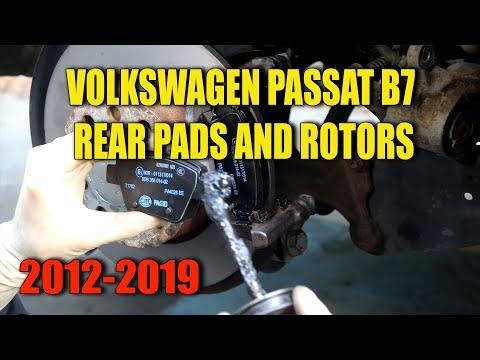







How to Replace Rear Brake Pads & Rotors on a 2012-2022 Volkswagen Passat (EPB or Cable)
Step-by-step DIY guide with tools, parts list, EPB service mode tips, and key torque specs
How to Replace Rear Brake Pads & Rotors on a 2012-2022 Volkswagen Passat (EPB or Cable)
Step-by-step DIY guide with tools, parts list, EPB service mode tips, and key torque specs for 2012, 2013, 2014, 2015, 2016, 2017, 2018, 2019, 2020, 2021, 2022


🔧 Passat - Rear Brake Pads & Rotor Replacement
Replacing the rear brake pads and rotors means removing the rear calipers, swapping the rotors, and installing new pads with the correct caliper piston reset. On your Passat, the “make-or-break” detail is whether the rear parking brake is Electronic (EPB) or a manual cable, because the piston reset procedure is different.
Difficulty Level: Intermediate | Estimated Time: 2.0-3.5 hours
⚠️ Safety & Precautions
- ⚠️ Work on a flat surface and support the car with jack stands before removing wheels.
- ⚠️ Do not press the brake pedal with a caliper removed; the piston can pop out.
- ⚠️ If your Passat has Electronic Parking Brake (EPB), you must put it in service mode (or retract it) before pushing the pistons back.
- ⚠️ Brake dust is irritating—wear a dust mask and use brake cleaner, not compressed air.
- ⚠️ Keep brake fluid off paint; it can damage the finish.
🔧 Required Tools
You'll need the following tools for this repair:
- Floor jack (rated 3-ton minimum)
- Jack stands (rated 3-ton minimum)
- Wheel chocks
- 17mm socket
- 3/8" drive ratchet
- 1/2" drive breaker bar
- Torque wrench (10-200 Nm range)
- 13mm socket
- 15mm wrench
- 14mm triple-square (XZN) bit
- Torque bit set (T30)
- Flathead screwdriver
- Pry bar
- Brake caliper hanger hook
- Rear brake caliper piston rewind tool kit (specialty)
- OBD scan tool with VW EPB service mode (specialty)
- Wire brush
- Brake cleaner
- Nitrile gloves
- Safety glasses
- Dust mask
🔩 Required Parts
HowToo sells all the parts you need for this repair:
- Rear brake pad set - Qty: 1
- Rear brake rotors - Replace in pairs - Qty: 2
- Rear pad hardware/anti-rattle clip kit - Qty: 1
- Brake caliper guide pin bolt kit - Qty: 1
- Rear caliper carrier bolt kit - Qty: 1
- Rotor retaining screw kit - Qty: 1
- High-temp brake grease - Qty: 1
- Brake cleaner - Qty: 2 cans
- DOT 4 brake fluid - Qty: 1 liter
📋 Before You Begin
- Park on level ground, put the shifter in P, and chock the front wheels with wheel chocks.
- Open the hood and check the brake fluid level; when you push pistons in, the level rises. Remove a little if near MAX.
- If your Passat has an EPB button (electronic parking brake), plan to use an OBD scan tool to retract/enter service mode before compressing pistons.
- Loosen rear wheel bolts 1/2 turn using a 17mm socket and breaker bar before lifting.
🔨 Step-by-Step Instructions
Follow these steps in order:
Step 1: Lift and secure the rear of the car
- Use a floor jack to lift at the approved rear jack point, then place jack stands under solid lift points.
- Remove both rear wheels using a 17mm socket.
Step 2: Identify your parking brake type (important)
- Look at the rear caliper: if you see an electrical motor on the caliper and an EPB button in the cabin, it’s EPB.
- If you see a cable going to a lever on the caliper, it’s a manual cable parking brake.
Step 3 (EPB only): Retract the electronic parking brake
- Connect your OBD scan tool with VW EPB service mode (specialty).
- Run the rear parking brake Open/Service Mode function (wording varies by tool). This backs the EPB mechanism off so the piston can be reset.
- If you don’t retract EPB, you can damage the caliper motor.
Step 4: Remove the caliper (both sides)
- Unclip/remove the outer spring/retainer (if equipped) using a flathead screwdriver.
- Remove the caliper guide pin bolts using a 13mm socket while holding the slide pin with a 15mm wrench.
- Lift the caliper off and hang it from the suspension with a brake caliper hanger hook. Do not let it hang by the hose.
Step 5: Remove pads and caliper bracket
- Remove the brake pads from the bracket by hand (use a pry bar gently if stuck).
- Remove the caliper carrier/bracket bolts using a 14mm triple-square (XZN) bit and a breaker bar.
- When reinstalling these bolts later: Torque to 90 Nm (66 ft-lbs) unless your replacement bolt kit specifies otherwise.
Step 6: Remove the rotor
- Remove the rotor retaining screw using a T30 Torx bit.
- Pull the rotor off the hub. If stuck, tap the rotor hat lightly (use your pry bar carefully) and clean the hub face with a wire brush.
- A clean hub prevents rotor wobble.
Step 7: Install the new rotor
- Spray shipping oil off the new rotor using brake cleaner.
- Install the rotor and the new retaining screw with a T30 Torx bit: Torque to 4.5 Nm (40 in-lbs) (snug, not tight).
Step 8: Reset the caliper piston
- Manual cable parking brake: Use the rear brake caliper piston rewind tool kit (specialty) to push and rotate the piston back in. (A “rewind tool” is a press that turns the piston while pushing.)
- EPB: After service mode, use the rear brake caliper piston rewind tool kit (specialty) to push the piston in smoothly. Do not force it.
- Keep an eye on the brake fluid reservoir while compressing.
Step 9: Reinstall bracket and pads
- Reinstall the caliper carrier using the 14mm triple-square (XZN) bit and torque wrench: Torque to 90 Nm (66 ft-lbs).
- Apply a thin layer of high-temp brake grease to pad ears/slide contact points (not on rotor or pad friction surface).
- Install new pad hardware/clips (if included) and install the new pads.
Step 10: Reinstall the caliper
- Slide the caliper over the new pads.
- Install guide pin bolts using a 13mm socket while holding with a 15mm wrench: Torque to 35 Nm (26 ft-lbs).
- Reinstall the outer spring/retainer using a flathead screwdriver (if equipped).
Step 11 (EPB only): Close/initialize the parking brake
- Use the OBD scan tool with VW EPB service mode (specialty) to run Close/Basic Setting for the rear parking brake.
- This re-engages the EPB mechanism to the new pad thickness.
Step 12: Reinstall wheels
- Install wheels and hand-thread wheel bolts.
- Lower the car and torque wheel bolts using a torque wrench: Torque to 120 Nm (89 ft-lbs).
✅ After Repair
- Before driving, pump the brake pedal 10-15 times until it feels firm.
- Check brake fluid level and top off with DOT 4 brake fluid if needed.
- Start the car and confirm no brake warning lights remain (EPB cars may need the scan tool close/initialize step).
- Do a slow test drive and confirm smooth braking with no grinding.
- Pad bedding (break-in): Make 6-10 moderate stops from ~50 km/h to ~10 km/h with cool-down time between.
💰 DIY vs Shop Cost
Shop Cost: ₹9,000-₹18,000 (parts + labor)
DIY Cost: ₹4,500-₹10,000 (parts only)
You Save: ₹4,500-₹8,000 by doing it yourself!
Shop labor rates vary but typically run ₹800-₹2,000/hour. This repair takes a shop approximately 2-3 hours.
🎯 Ready to get started?
HowToo makes it easy: same-day/2-day shipping on every part, plus all the tools and specialty tools you need! Check out the parts and tools sections below to add everything to your cart.