














How to Replace Rear Brake Pads or Drum Shoes on a 2004-2008 Toyota Corolla
Step-by-step disc vs drum identification, tools/parts list, safety tips, and torque specs
How to Replace Rear Brake Pads or Drum Shoes on a 2004-2008 Toyota Corolla
Step-by-step disc vs drum identification, tools/parts list, safety tips, and torque specs for 2004, 2007, 2008


🔧 Corolla - Rear Brake Pad Replacement
Your Corolla may have rear disc brakes (pads) or rear drum brakes (shoes, not pads). The first step is to identify which setup you have, then follow the matching procedure so the brakes stay safe and quiet.
Difficulty Level: Intermediate | Estimated Time: 1.5-3.0 hours
⚠️ Safety & Precautions
- ⚠️ Work on level ground and use jack stands—never rely on a jack alone.
- ⚠️ Do not press the brake pedal with a caliper removed (disc setup) or with a drum off (drum setup).
- ⚠️ Rear brake work usually requires the parking brake OFF to remove parts.
- ⚠️ Avoid breathing brake dust; use brake cleaner, not compressed air.
- ⚠️ If you get brake fluid on paint, wipe and rinse immediately.
🔧 Required Tools
You'll need the following tools for this repair:
- Floor jack (rated 2-ton minimum)
- Jack stands (pair, rated 2-ton minimum)
- Wheel chocks
- 19mm lug nut socket
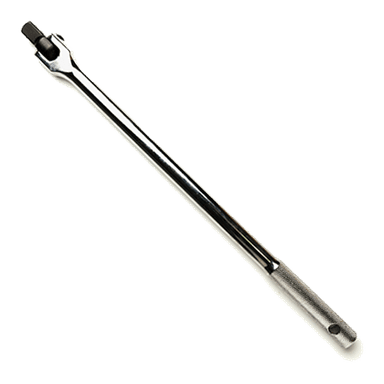
- Breaker bar (1/2")
- Torque wrench (10–150 ft-lbs range)
- 14mm socket
- 17mm socket
- Ratchet (3/8" or 1/2")
- Flathead screwdriver
- C-clamp (6")
- Needle-nose pliers
- Bungee cord
- Wire brush
- Brake spoon adjuster tool (specialty)
- Drum brake spring tool (specialty)
- Safety glasses
- Nitrile gloves
🔩 Required Parts
HowToo sells all the parts you need for this repair:
- Rear brake pad set - Qty: 1
- Rear brake hardware kit (disc) - Qty: 1
- Brake caliper slide pin grease (silicone) - Qty: 1
- Brake cleaner - Qty: 1-2 cans
- Rear brake rotors (optional if worn/grooved) - Qty: 2
- Rear brake shoe set (only if rear drums) - Qty: 1
- Rear drum brake hardware kit (only if rear drums) - Qty: 1
- Brake fluid DOT 3 (top-off as needed) - Qty: 1 quart
📋 Before You Begin
- Park on level ground, put the transmission in 1st gear, and chock the front wheels.
- Release the parking brake completely before lifting the rear.
- Loosen rear lug nuts 1/2 turn using a 19mm lug nut socket and breaker bar before jacking.
- Lift the rear with a floor jack and support with jack stands under the proper rear lift/support points.
🔨 Step-by-Step Instructions
Follow these steps in order:
Step 1: Identify rear brake type (disc vs drum)
- Remove a rear wheel using a 19mm lug nut socket and ratchet.
- If you see a shiny flat rotor and a caliper (clamp-looking part), you have rear disc brakes (pads).
- If you see a closed “can” shape, you have a rear drum (shoes, not pads).
- Disc = pads, Drum = shoes.
Step 2: Remove both rear wheels
- Remove the other rear wheel using a 19mm lug nut socket.
- Set wheels aside and keep lug nuts together.
Step 3: Choose the correct procedure
- If you have rear disc brakes, continue to Step 4.
- If you have rear drum brakes, skip to Step 11.
Step 4: (Rear Disc) Remove the caliper
- Turn the steering wheel slightly if needed for access (rear access is usually fine).
- Remove the lower and upper caliper slide bolts using a 14mm socket and ratchet.
- Lift the caliper off and support it with a bungee cord (do not let it hang by the hose).
Step 5: (Rear Disc) Remove old pads and hardware clips
- Pull the brake pads out by hand; use a flathead screwdriver gently if stuck.
- Remove the stainless pad hardware clips from the bracket using a flathead screwdriver.
- Clean the bracket pad “shelves” with brake cleaner and a wire brush.
Step 6: (Rear Disc) Service the slide pins
- Pull each slide pin out of the caliper bracket by hand (use needle-nose pliers if needed).
- Wipe old grease off, then apply fresh brake caliper slide pin grease (this grease helps the caliper move smoothly).
- Reinstall the slide pins and make sure they move freely.
Step 7: (Rear Disc) Compress the caliper piston
- Place an old pad against the piston face, then use a C-clamp (6") to slowly push the piston back in.
- Check the brake fluid reservoir level as you compress; don’t let it overflow.
- Go slow to avoid damaging seals.
Step 8: (Rear Disc) Install new hardware and pads
- Install new hardware clips from the rear brake hardware kit into the bracket by hand.
- Apply a thin film of brake caliper slide pin grease to pad contact points (where pads touch the clips), not on pad friction material.
- Install the new pads into the bracket; they should slide smoothly.
Step 9: (Rear Disc) Reinstall caliper and torque bolts
- Lower the caliper over the new pads.
- Install the slide bolts using a 14mm socket and ratchet.
- Torque to 25 Nm (19 ft-lbs) using a torque wrench.
Step 10: (Rear Disc) Repeat on the other side
- Repeat Steps 4–9 on the other rear wheel.
- Reinstall wheels and snug lug nuts with a 19mm lug nut socket.
Step 11: (Rear Drum) Remove the brake drum
- Make sure the parking brake is fully released.
- Pull the drum straight off by hand; if stuck, tap around the drum face lightly using the handle of a breaker bar.
- If it won’t come off, back off the adjuster through the access slot using a flathead screwdriver and brake spoon adjuster tool (specialty).
Step 12: (Rear Drum) Confirm: shoes, not pads
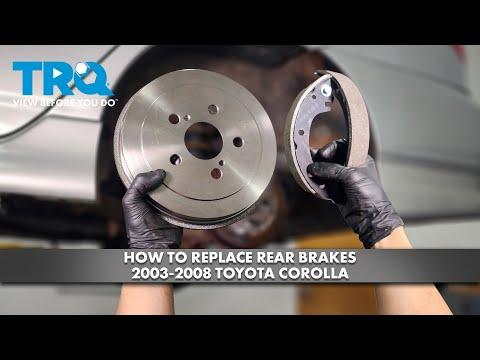
- Inside the drum you’ll see curved friction pieces—those are brake shoes.
- If your goal was “rear pads,” this means your Corolla uses rear shoes; proceed with shoe replacement below.
Step 13: (Rear Drum) Take a reference photo
- Use your phone to take a clear photo of springs and lever positions before disassembly.
- Your photo is your reassembly map.
Step 14: (Rear Drum) Remove springs and hold-down hardware
- Use a drum brake spring tool (specialty) to remove the return springs.
- Remove hold-down pins/springs using needle-nose pliers (press and twist to release).
Step 15: (Rear Drum) Remove shoes and adjuster
- Lift the shoes outward and off the backing plate by hand.
- Remove the adjuster assembly and keep left/right parts organized.
- Clean the backing plate using brake cleaner and wipe dry.
Step 16: (Rear Drum) Install new shoes and hardware
- Install new hardware from the rear drum brake hardware kit (springs should not be reused if rusty/weak).
- Reinstall the adjuster and both shoes in the same orientation as your reference photo.
- Use the drum brake spring tool (specialty) to reinstall return springs.
Step 17: (Rear Drum) Adjust shoes to fit the drum
- Turn the star wheel adjuster using a brake spoon adjuster tool (specialty) until the drum slides on with slight drag.
- If it won’t go on, back the adjuster off slightly using the brake spoon adjuster tool (specialty).
Step 18: (Rear Drum) Reinstall drum and wheels
- Reinstall the drum by hand.
- Reinstall wheels and snug lug nuts using a 19mm lug nut socket.
Step 19: Lower the car and torque lug nuts
- Lower the car off the jack stands using the floor jack.
- Torque lug nuts to 103 Nm (76 ft-lbs) using a torque wrench in a star pattern.
✅ After Repair
- Pump the brake pedal 10–15 times until it feels firm (this seats the pads/shoes).
- Check brake fluid level and top off with DOT 3 if needed.
- Apply and release the parking brake several times; for rear drums it helps self-adjust.
- Do a slow test drive and confirm no grinding, pulling, or brake warning light.
- New pads need gentle stops for 200 miles.
💰 DIY vs Shop Cost
Shop Cost: $250-$500 (parts + labor)
DIY Cost: $40-$140 (parts only)
You Save: $210-$360 by doing it yourself!
Shop labor rates vary but typically run $100-$150/hour. This repair takes a shop approximately 1.5-3.0 hours.
🎯 Ready to get started?
HowToo makes it easy: same-day/2-day shipping on every part, plus all the tools and specialty tools you need! Check out the parts and tools sections below to add everything to your cart.