














How to Replace Rear Brake Pads on a 2020 Toyota Camry (EPB Service Guide)
Step-by-step rear brake pad replacement with tools, parts list, torque specs, and electric parking brake service mode instructions
How to Replace Rear Brake Pads on a 2020 Toyota Camry (EPB Service Guide)
Step-by-step rear brake pad replacement with tools, parts list, torque specs, and electric parking brake service mode instructions


🔧 Camry - Rear Brake Pad Replacement
You’ll be removing the rear wheels, releasing the electric parking brake, unbolting the rear calipers, and swapping the pads on your Camry. Then you’ll reassemble everything, torque the bolts correctly, and cycle the parking brake so it recalibrates.
Difficulty Level: Intermediate | Estimated Time: 2–3 hours
⚠️ Safety & Precautions
- ⚠️ Always support the car on jack stands; never work under a car held only by a jack.
- ⚠️ Chock (block) the front wheels so the car cannot roll.
- ⚠️ Your Camry has an electric parking brake (EPB); the pistons must be retracted with the EPB in service mode. Do not press the EPB switch or disconnect the actuator while the system is active.
- ⚠️ Turn ignition OFF and remove the key/fob from the car when working near moving parts.
- ⚠️ Brakes get very hot after driving. Let them cool completely before starting.
- ⚠️ Brake dust can be harmful. Do not blow it with air; use brake cleaner and a rag.
- ⚠️ If you open any brake fluid fittings, avoid getting fluid on paint; wipe and rinse any spills immediately.
🔧 Required Tools
You'll need the following tools for this repair:
- 🛠️ Floor jack (rated 3-ton minimum)
- 🛠️ Jack stands (rated 3-ton minimum) - Qty: 2
- 🛠️ Wheel chocks
- 🛠️ 21mm socket
- 🛠️ 14mm socket
- 🛠️ 17mm socket
- 🛠️ 3/8" drive ratchet
- 🛠️ 1/2" drive ratchet
- 🛠️ 1/2" drive breaker bar
- 🛠️ Torque wrench (3/8" drive, 5–60 ft-lbs range)
- 🛠️ Torque wrench (1/2" drive, 30–150 ft-lbs range)
- 🛠️ Flat-blade screwdriver (medium)
- 🛠️ Needle-nose pliers
- 🛠️ C-clamp or disc brake piston compressor tool
- 🛠️ Wire brush (small)
- 🛠️ Bungee cord or mechanics wire
- 🛠️ OBD2 scan tool with EPB service function (specialty, optional)
- 🛠️ Work light
- 🛠️ Shop rags
- 🛠️ Safety glasses
- 🛠️ Mechanic gloves
🔩 Required Parts
HowToo sells all the parts you need for this repair:
- 🔩 Rear brake pad set - Qty: 1 set (replace both sides together)
- 🔩 Rear brake pad hardware kit (shims/clips) - Qty: 1 set
- 🔩 High-temperature brake grease - Qty: 1 small tube
- 🔩 Brake cleaner spray - Qty: 1–2 cans
- 🔩 Rear caliper bracket bolts - Qty: 4 (optional, if originals are corroded)
- 🔩 Rear caliper slide pin boots - Qty: 4 (optional, if torn)
- 🔩 Brake fluid (DOT 3 or DOT 4, Toyota-approved) - Qty: 1 small bottle (for top-off only)
📋 Before You Begin
- Park the Camry on a flat, solid surface with the transmission in P and the front wheels straight.
- Apply the parking brake once to park, then release it when following the service mode steps below.
- Loosen rear wheel lug nuts slightly (about one turn) with the 21mm socket before jacking up.
- Place wheel chocks in front of the front tires.
- Do not disconnect the 12V battery until the EPB has been placed in pad replacement (service) mode; normally you will leave the battery connected the whole time.
- If using a scan tool: connect it before you start and locate the EPB service / pad replacement function in the brake menu.
🔨 Step-by-Step Instructions
Follow these steps in order:
Step 1: Put the Electric Parking Brake into Service Mode
- The EPB is an electric motor on the rear caliper that applies the brake; service mode fully releases it for pad changes.
- Method A – With scan tool:
- Turn ignition to ON (engine off).
- Connect scan tool and use its menu: EPB/Brake > Pad Replacement / Service Mode (wording varies by tool).
- Follow prompts until the tool says the rear brakes are in service mode.
- Method B – Without scan tool (Camry EPB switch method):
- Turn ignition to ON (engine off).
- Press and hold the EPB switch DOWN (release position).
- While holding the switch DOWN, press the accelerator pedal fully and hold for about 5 seconds until you hear the rear actuators move and see an EPB service message or warning light.
- Release the accelerator and EPB switch, then turn ignition OFF.
- If unsure, do not continue forcing anything.
Step 2: Lift and Support the Rear of the Camry
- Use the 21mm socket and breaker bar to loosen (but not remove) both rear wheel lug nuts about one turn.
- Place the floor jack under the rear center jacking point or one side pinch weld as specified in the owner’s manual.
- Raise the car until the rear wheels are off the ground.
- Place jack stands under the rear pinch welds or approved support points and slowly lower the car onto the stands.
- Shake the car gently to be sure it is stable on the stands.
Step 3: Remove Rear Wheels
- Use the 21mm socket and 1/2" drive ratchet to remove the lug nuts.
- Remove both rear wheels and set them aside.
- Keep lug nuts together so none are lost.
Step 4: Inspect the Caliper and Locate Bolts
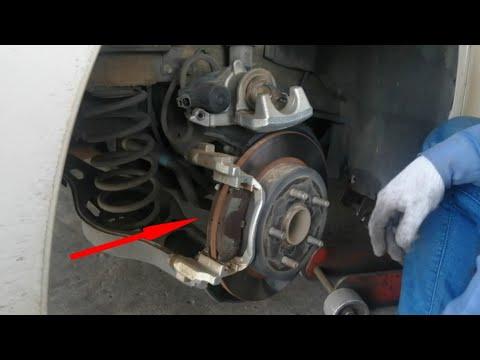
- The rear caliper sits over the rotor; the EPB motor is the small electric unit attached to the caliper.
- Locate the two caliper slide pin bolts on the back of the caliper (top and bottom) – they take a 14mm socket.
- Behind the caliper, you will also see the larger caliper bracket bolts that hold the bracket to the knuckle; these use a 17mm socket.
Step 5: Remove Caliper Slide Pin Bolts
- Use the 14mm socket and 3/8" ratchet to loosen and remove the upper and lower caliper slide pin bolts.
- Carefully slide the caliper off the pads and rotor.
- Use a bungee cord or mechanics wire to hang the caliper from the suspension spring so there is no strain on the rubber brake hose or EPB wires.
- Never let the caliper hang by the hose or cable.
Step 6: Remove Old Pads and Hardware
- Slide the old brake pads out of the caliper bracket by hand.
- Use a flat-blade screwdriver gently if they are stuck, prying against the bracket, not the rotor.
- Remove the metal pad clips (hardware) from the caliper bracket using the flat-blade screwdriver or needle-nose pliers.
Step 7: Clean Bracket and Slide Pins
- Spray brake cleaner on the caliper bracket and pad contact areas; wipe with shop rags.
- Use a wire brush to clean rust and debris from where the clips sit on the bracket.
- Inspect the caliper slide pins (the bolts you removed) and their rubber boots:
- Pull the slide pins out carefully by hand.
- Clean old grease off the pins with brake cleaner and rags.
- Check the rubber boots for tears; replace if damaged.
- Apply a thin, even coat of brake grease to the pins and reinstall them into the boots, making sure they move smoothly.
- Pins should slide freely without sticking.
Step 8: Install New Hardware and Pads in Bracket
- Clip the new metal pad hardware onto the caliper bracket by hand, making sure each piece snaps fully into place.
- Apply a very thin film of brake grease to the pad contact points on the hardware (where the pads’ ears will sit). Do not get grease on pad friction surfaces or rotor.
- Install the new inner and outer brake pads into the bracket, seating the pad “ears” into the new clips.
Step 9: Retract the Caliper Piston
- The piston is the round part inside the caliper that presses the inner pad.
- Place an old brake pad against the piston face.
- Use the C-clamp or disc brake piston compressor tool over the back of the caliper and the old pad, then slowly turn the tool to push the piston straight back into the caliper.
- If you feel strong resistance, stop and verify the EPB is truly in service mode; the piston on this Camry should push straight in, not twist.
- Watch the brake fluid reservoir under the hood; if it is very full, pushing the piston back can raise the level. Remove a little fluid with a clean rag or syringe if needed.
Step 10: Reinstall Caliper Over New Pads
- Position the caliper over the new pads and rotor.
- Align the slide pin holes with the threaded holes in the caliper bracket.
- Start both slide pin bolts by hand to avoid cross-threading.
- Use the 14mm socket and 3/8" ratchet to snug them down.
- Then use the 3/8" torque wrench with the 14mm socket to tighten slide pin bolts to 34 Nm (25 ft-lbs).
Step 11: (If Needed) Remove Caliper Bracket and Rotor
- If you are also replacing rotors or want more space, you can remove the caliper bracket:
- Use the 17mm socket and 1/2" breaker bar to remove the two large caliper bracket bolts.
- Remove the bracket and rotor.
- Reinstall the rotor and bracket.
- Use the 17mm socket and 1/2" torque wrench to torque the caliper bracket bolts to 107 Nm (79 ft-lbs).
- If only doing pads, you may skip this.
Step 12: Repeat on the Other Rear Side
- Repeat Steps 5 through 11 on the other rear wheel.
- Always replace rear pads on both sides at the same time.
Step 13: Reinstall Wheels
- Put each wheel back on its hub.
- Thread all lug nuts on by hand.
- Use the 21mm socket and 1/2" ratchet to snug the lug nuts in a star pattern.
Step 14: Lower the Camry and Torque Lug Nuts
- Use the floor jack to raise the car slightly and remove the jack stands.
- Lower the car fully to the ground.
- Use the 1/2" torque wrench and 21mm socket to tighten all rear wheel lug nuts in a star pattern to 103 Nm (76 ft-lbs).
Step 15: Pump the Brake Pedal and Exit EPB Service Mode
- Sit in the driver’s seat and turn ignition to ON (engine off).
- Slowly press and release the brake pedal 10–15 times until it feels firm; this seats the new pads against the rotors.
- Exit EPB service mode:
- If using scan tool, select the command to Exit Pad Replacement / Normal Mode and follow prompts.
- If using the switch method: turn ignition ON, pull the EPB switch UP (apply) and then push it DOWN (release) once or twice until the EPB warning messages clear.
Step 16: Final Checks Under the Hood
- Check brake fluid level in the master cylinder reservoir; it should be between MIN and MAX lines.
- If low, add a small amount of correct brake fluid; do not overfill.
- Check around the rear calipers for any signs of fluid leakage.
✅ After Repair
- Start the engine and gently press the brake pedal; it should feel firm, not spongy.
- Apply and release the electric parking brake a few times to ensure it engages and releases without noise or warning lights.
- Drive at low speed in a safe area and perform several gentle stops from 20–30 km/h to bed in the pads. Avoid hard braking for the first 300–500 km.
- Listen for scraping, grinding, or clicking. If you hear anything unusual, stop and recheck your work.
- After the first drive, recheck lug nut torque on the rear wheels.
💰 DIY vs Shop Cost
Shop Cost: $250–$400 (parts + labor)
DIY Cost: $60–$150 (parts only)
You Save: $100–$300 by doing it yourself!
Shop labor rates vary but typically run $100–$150/hour. This repair takes a shop approximately 1.0–1.5 hours.
🎯 Ready to get started?
HowToo makes it easy: same-day/2-day shipping on every part, plus all the tools and specialty tools you need! Check out the parts and tools sections above to add everything to your cart.