









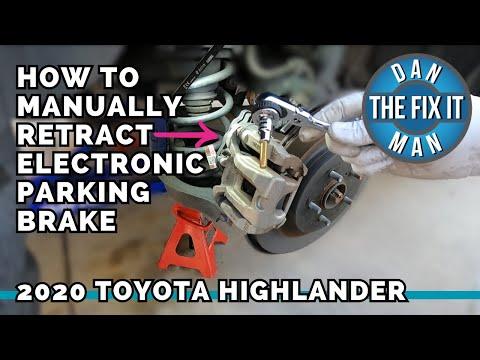







How to Replace Rear Brake Pads on a 2020-2024 Toyota Highlander (EPB)
Step-by-step DIY rear brake pad change with EPB service mode, tools, parts, torque specs, and safety tips
How to Replace Rear Brake Pads on a 2020-2024 Toyota Highlander (EPB)
Step-by-step DIY rear brake pad change with EPB service mode, tools, parts, torque specs, and safety tips for 2020, 2021, 2022, 2023, 2024


🔧 Highlander - Rear Brake Pad Replacement
You’ll be replacing the rear brake pads on your Highlander and resetting the electronic parking brake (EPB) so the new pads fit and work correctly. This job is very doable for a careful beginner if you follow each step slowly and safely.
Difficulty Level: Intermediate | Estimated Time: 2–3 hours
⚠️ Safety & Precautions
- ⚠️ Always work on level ground, with the transmission in Park and front wheels securely chocked so the vehicle cannot roll.
- ⚠️ This Highlander uses an electronic parking brake (EPB); never remove the caliper or press the brake pedal unless the EPB is in service/maintenance mode, or you can damage the EPB motor.
- ⚠️ Support the vehicle with jack stands under the rear jacking points; never rely on a jack alone.
- ⚠️ Wear safety glasses and mechanic gloves; brake dust is harmful and metal edges are sharp.
- ⚠️ Keep brake fluid off paint and skin; wipe spills immediately and wash with water.
- ⚠️ Do not open the driver’s door, press the brake pedal, or operate the EPB switch while a rear caliper is off the rotor.
- ⚠️ If you are not using a scan tool, be very careful entering and exiting EPB maintenance mode exactly as described on screen.
🔧 Required Tools
You'll need the following tools for this repair:
- 🧰 Floor jack (rated 3-ton minimum)
- 🧰 Jack stands (rated 3-ton minimum, Qty: 2)
- 🧰 Wheel chocks (rubber or metal, Qty: 2–4)
- 🧰 Lug wrench or 21mm socket with breaker bar
- 🧰 3/8" drive ratchet
- 🧰 1/2" drive ratchet
- 🧰 3/8" drive torque wrench (up to 60 ft-lbs)
- 🧰 1/2" drive torque wrench (up to 120 ft-lbs)
- 🧰 14mm socket
- 🧰 17mm socket
- 🧰 Flat-blade screwdriver (medium)
- 🧰 Brake caliper compression tool (screw-type)
- 🧰 Needle-nose pliers
- 🧰 Wire brush (small)
- 🧰 Bungee cord or wire hanger
- 🧰 Shop rags or paper towels
- 🧰 Disposable drip tray
- 🧰 OBD2 scan tool with EPB service function (specialty)
- 🧰 Safety glasses
- 🧰 Mechanic gloves
🔩 Required Parts
HowToo sells all the parts you need for this repair:
- 🔩 Rear brake pad set (left and right) - Qty: 1 set (replace both sides)
- 🔩 Rear brake pad hardware kit (anti-rattle clips/shims) - Qty: 1 set
- 🔩 High-temperature brake grease (synthetic, ceramic-safe) - Qty: 1 tube
- 🔩 Brake cleaner spray - Qty: 1–2 cans
- 🔩 Shop towels - Qty: 1 pack
- 🔩 Rear brake rotors - Qty: 2 (optional, if worn or damaged)
- 🔩 Anti-seize compound - Qty: 1 small tube
📋 Before You Begin
- Park the Highlander on level ground, shift to Park, and set the parking brake. Turn the engine off.
- Place wheel chocks in front of both front wheels to prevent any movement.
- Open the hood and locate the brake fluid reservoir; clean the cap area so dirt does not fall in.
- Loosen (do not remove) the rear wheel lug nuts about one turn with the 21mm socket or lug wrench.
- Connect your OBD2 scan tool and review how to use its EPB/Rear Brake Service function. This function moves the electronic parking brake to maintenance position.
- If you do not have a scan tool with this function, do not start until you have confirmed another safe method for EPB maintenance mode for this exact model.
🔨 Step-by-Step Instructions
Follow these steps in order:
Step 1: Enter EPB Service / Maintenance Mode
- Turn ignition to ON (engine off), keep your foot off the brake pedal for now.
- Connect the OBD2 scan tool with EPB service function to the diagnostic port under the dash.
- Using the scan tool, navigate to Brake/EPB > Service Functions > Pad Replacement / Maintenance Mode or similar menu as your tool shows.
- Follow the on-screen instructions to place the rear EPB into service/maintenance mode; you will hear the EPB motors retract.
- Turn ignition OFF when the scan tool confirms the EPB is in maintenance mode, and disconnect the scan tool.
- Do not touch EPB switch until all reassembly is done.
Step 2: Jack up the rear and support safely
- Use the floor jack at the rear center jacking point (under the rear subframe crossmember). Lift until both rear wheels are off the ground.
- Place jack stands under the designated rear pinch weld or frame points on both sides.
- Slowly lower the vehicle onto the jack stands and leave the jack in place as a backup if possible.
- Gently shake the rear of the vehicle by hand to confirm it is stable.
Step 3: Remove the rear wheels
- Use the 21mm socket and ratchet or lug wrench to remove all lug nuts from both rear wheels.
- Remove the rear wheels and set them aside, lying flat so they do not roll.
Step 4: Inspect the caliper and rotor
- Look at the rear caliper: you will see the caliper body over the rotor and the electronic parking brake motor attached at the back.
- Visually inspect the rotor for deep grooves, heavy rust, or a large lip at the edge; if present, rotors should be replaced.
- Take a photo now to remember clip and pad positions.
Step 5: Remove the rear caliper (leaving bracket in place)
- Locate the two caliper slide pin bolts at the back of the caliper (upper and lower).
- Use the 14mm socket and 3/8" ratchet to loosen and remove the upper and lower slide pin bolts.
- Carefully slide the caliper off the rotor and outer pad. If it is tight, gently pry with a flat-blade screwdriver between pad and rotor while pulling the caliper.
- Support the caliper with a bungee cord or wire hanger from the suspension spring; do not let it hang from the brake hose or EPB wiring.
Step 6: Remove old pads and hardware
- Slide the outer and inner brake pads out of the caliper bracket by hand.
- Note which side was inner and outer; the inner pad often has a wear indicator tab.
- Remove the metal pad support clips (hardware) from the caliper bracket using needle-nose pliers if they are tight.
- Set all old pads and clips aside; you will compare them to the new parts.
Step 7: Clean bracket and rotor contact surfaces
- Use brake cleaner spray to clean the caliper bracket, especially where the clips sit and where pad ears slide.
- Use a wire brush to remove rust and debris from the bracket sliding surfaces.
- If you are reusing rotors, spray the rotor faces with brake cleaner and wipe with shop towels.
- A clean bracket helps pads move smoothly and quietly.
Step 8: Retract the caliper piston
- Check the brake fluid level in the reservoir; if it is very full, remove a little fluid with a clean rag or syringe into a container to prevent overflow when pistons retract.
- Inspect the caliper piston and dust boot for tears or leaks; any damage means the caliper should be replaced or rebuilt.
- Place the old inner pad against the piston face for protection.
- Use the brake caliper compression tool between the pad and the back of the caliper body to slowly press the piston fully back into the caliper.
- Turn the tool slowly and steadily; do not use sudden force.
- Once fully retracted, remove the tool and the old pad.
Step 9: Install new hardware and prepare new pads
- Install the new metal hardware clips into the caliper bracket by hand; press until fully seated.
- Apply a very thin layer of high-temperature brake grease to the areas of the clips where the pad ears will slide. Do not get grease on pad friction surfaces or rotor.
- Apply a thin smear of brake grease to the pad backing plates where they contact the caliper or piston.
- If your pad set has an inner pad with a wear indicator (small metal tab), match it to the old inner pad orientation.
Step 10: Install new rear pads
- Slide the new inner pad into the caliper bracket on the inside, aligning the ears into the new hardware clips.
- Slide the new outer pad into place on the outside side of the rotor.
- Make sure both pads are fully seated and can move slightly in the bracket.
Step 11: Reinstall the caliper
- Lower the supported caliper over the new pads and rotor, making sure the piston lines up with the inner pad.
- If it will not fit over the pads easily, double-check the piston is fully retracted using the caliper compression tool.
- Reinstall the upper and lower slide pin bolts by hand to avoid cross-threading.
- Use the 14mm socket and 3/8" torque wrench to tighten each slide pin bolt to 37 Nm (27 ft-lbs).
Step 12: Repeat on the other rear side
- Repeat Steps 5–11 on the other rear wheel.
- Always replace pads on both sides of an axle.
Step 13: Reinstall wheels and lower vehicle
- Mount each rear wheel back onto the hub and install all lug nuts by hand.
- Snug the lug nuts in a star pattern using the 21mm socket and ratchet, but do not fully torque yet.
- Use the floor jack to lift the rear slightly, remove the jack stands, and carefully lower the vehicle to the ground.
- With the vehicle on the ground, use the 21mm socket and 1/2" torque wrench to torque each lug nut in a star pattern to 140 Nm (103 ft-lbs).
Step 14: Exit EPB service mode and set pads
- Turn ignition to ON (engine can remain off at first).
- Before touching the EPB, firmly press the brake pedal slowly 5–10 times until it feels firm. This seats the pads against the rotors.
- Reconnect your OBD2 scan tool and select the EPB service function again.
- Use the menu option to Exit Maintenance Mode / Complete Pad Replacement as directed by the scan tool.
- You will hear the EPB motors operate and return to normal position.
- Turn ignition OFF, then ON again, and check that no brake/EPB warning lights stay on.
Step 15: Final fluid and visual checks
- Check the brake fluid reservoir; adjust fluid level to the “MAX” line if needed using the correct brake fluid type shown on the cap.
- Inspect around both rear calipers for any leaks or loose wiring/hoses.
- Make sure the EPB wiring connectors are fully seated and undamaged.
✅ After Repair
- Start the engine and press the brake pedal several times; it should feel firm, not spongy.
- Engage and release the electronic parking brake a few times while parked to confirm it works and no warning lights appear.
- Perform a short, careful test drive in a safe area:
- Check braking at low speed first (10–20 km/h).
- Listen for grinding, scraping, or clunking noises.
- Verify the vehicle tracks straight when braking.
- Bed-in (break-in) the new pads: make 5–10 medium stops from about 40–50 km/h down to 10–15 km/h, allowing a minute of driving between stops so the brakes can cool slightly.
- After the test drive, recheck lug nut torque and inspect for any fluid leaks.
💰 DIY vs Shop Cost
Shop Cost: $280–$450 (parts + labor)
DIY Cost: $80–$160 (parts only)
You Save: $200–$300 by doing it yourself!
Shop labor rates typically run $100–$150/hour. This repair takes a shop approximately 1.5–2.0 hours.
🎯 Ready to get started?
HowToo makes it easy: same-day/2-day shipping on every part, plus all the tools and specialty tools you need! Check out the parts and tools sections above to add everything to your cart.
Guide for Disc Brake Pad Set replace for these Toyota vehicles
| Year Make Model | Sub Model | Engine | Body Style |
|---|---|---|---|
| 2024 Toyota Highlander | - | - | - |
| 2023 Toyota Highlander | - | - | - |
| 2022 Toyota Highlander | - | - | - |
| 2021 Toyota Highlander | - | - | - |
| 2020 Toyota Highlander | - | - | - |