















How to Replace Rear Brake Pads on a 2017-2019 Ford Escape (Step-by-Step)
Complete DIY rear brake pad replacement guide with tools, parts list, torque specs, safety tips, and cost savings
How to Replace Rear Brake Pads on a 2017-2019 Ford Escape (Step-by-Step)
Complete DIY rear brake pad replacement guide with tools, parts list, torque specs, safety tips, and cost savings for 2017, 2018, 2019


🔧 Escape - Rear Brake Pad Replacement
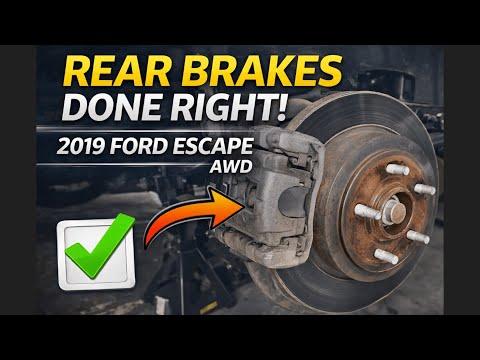
You’ll be removing the rear wheels, unbolting the brake calipers, swapping the pads, and reassembling everything with the correct torque. This restores braking performance and prevents damage to the rotors.
Difficulty Level: Beginner/Intermediate | Estimated Time: 2-3 hours
⚠️ Safety & Precautions
- 🛑 Always work on a cool brake system; hot brakes can burn skin.
- 🛑 Park the Escape on level ground, shift to Park, and chock (block) the front wheels.
- 🛑 Use a proper floor jack and jack stands; never rely on the jack alone.
- 🛑 Wear safety glasses and a dust mask; brake dust is harmful if inhaled.
- 🛑 Do not press the brake pedal with a caliper removed; it can pop the piston out.
- 🛑 Keep grease off pad friction surfaces and rotors; it will ruin braking.
- 🛑 No battery disconnect is required for this job on your Escape.
🔧 Required Tools
You'll need the following tools for this repair:
- 🧰 Floor jack (rated 3-ton minimum)
- 🧰 Jack stands (rated 3-ton minimum, Qty: 2)
- 🧰 Wheel chocks
- 🧰 19mm socket
- 🧰 1/2" drive ratchet
- 🧰 1/2" drive torque wrench (10-150 ft-lbs range)
- 🧰 13mm socket
- 🧰 15mm socket
- 🧰 Short extension (1/2" drive)
- 🧰 Flathead screwdriver (medium)
- 🧰 Needle-nose pliers
- 🧰 C-clamp (6" or larger) or disc brake caliper press tool (specialty)
- 🧰 Wire brush (small)
- 🧰 Bungee cord or mechanic’s wire
- 🧰 Brake cleaner spray
- 🧰 Shop rags or paper towels
- 🧰 Catch pan or tray
- 🧰 Safety glasses
- 🧰 Mechanic’s gloves
- 🧰 Dust mask or respirator (rated for dust)
🔩 Required Parts
HowToo sells all the parts you need for this repair:
- 🧱 Rear brake pad set (left and right) - Qty: 1 set (replace both sides)
- 🧱 Rear brake hardware kit (pad clips / abutment clips) - Qty: 1 set
- 🧱 Brake lubricant (high-temp synthetic for caliper pins and pad ears) - Qty: 1 small tube
- 🧱 Brake cleaner - Qty: 1-2 cans
- 🧱 Rear brake rotors - Qty: 2 (optional but recommended if worn, grooved, or below spec)
- 🧱 Caliper bracket bolts (rear, one-time-use if corroded or damaged) - Qty: 4 (optional)
📋 Before You Begin
- 🧭 Park the Escape on a flat surface, shift to Park, set the parking brake, and place wheel chocks in front of the front tires.
- 🧭 Loosen rear wheel lug nuts with a 19mm socket about one turn while the vehicle is still on the ground.
- 🧭 Release the parking brake before lifting the rear; the rear brakes must be free to move.
- 🧭 Raise the rear using the floor jack under the rear center jacking point and support both sides with jack stands under the rear pinch welds.
- 🧭 Make sure the Escape is stable on jack stands before removing any wheels. Try to rock it gently to confirm stability.
🔨 Step-by-Step Instructions
Follow these steps in order:
Step 1: Remove the rear wheels
- Use the floor jack to lift the rear if not already raised, then rest the Escape securely on jack stands.
- Use the 19mm socket and 1/2" ratchet to remove the rear wheel lug nuts.
- Pull each wheel straight off the hub and set it aside.
- Place the wheels under the body as backup safety.
Step 2: Inspect the brake assembly
- Look at the caliper (the part that squeezes the pads), the bracket (the metal frame it bolts to), and the rotor (the disc).
- Check for any leaking brake fluid around the caliper; if you see wet areas, stop and have a professional inspect it.
- Spin the rotor by hand; it should turn smoothly without heavy grinding.
Step 3: Remove the lower caliper guide pin bolt
- Locate the two caliper bolts on the back side of the caliper (top and bottom).
- Use a 13mm socket and ratchet to loosen and remove the lower caliper guide pin bolt.
- Leave the upper bolt in place; this will act as a hinge so you can swing the caliper up.
Step 4: Swing the caliper up and support it
- Rotate the caliper upward around the upper bolt to expose the brake pads.
- Use a bungee cord or mechanic’s wire to hang the caliper from the suspension spring so there is no tension on the brake hose.
- Never let the caliper hang by the rubber hose.
Step 5: Remove the old pads and hardware
- Slide the inner and outer brake pads out of the caliper bracket by hand.
- Use a flathead screwdriver if needed to gently pry them free.
- Remove the metal pad clips (hardware) from the caliper bracket with the flathead screwdriver.
- Note how the clips are installed so you can match the new ones.
Step 6: (Optional but recommended) Remove caliper bracket and rotor
- If you are replacing or resurfacing the rotors, remove the caliper bracket:
- Use a 15mm socket and ratchet to remove the two caliper bracket bolts on the back side.
- Slide the caliper bracket off and set it aside.
- Remove the rotor from the hub. If it is stuck, tap around the rotor hat with a rubber mallet (if available) or gently with your hand to loosen rust.
- Clean the hub surface with a wire brush so the new rotor sits flat.
- If not replacing the rotor, skip removing it but still clean exposed areas with the wire brush.
Step 7: Install new rotor (if replacing)
- Spray the new rotor’s friction surfaces with brake cleaner and wipe with shop rags to remove protective oil.
- Place the rotor onto the hub and hold it in place with one or two lug nuts threaded by hand using the 19mm socket to keep it from wobbling.
- Reinstall the caliper bracket using the 15mm socket and ratchet.
- Use the torque wrench with the 15mm socket to tighten the caliper bracket bolts to 85 Nm (63 ft-lbs).
Step 8: Clean and install new hardware
- Use the wire brush to clean the areas of the caliper bracket where the pad clips sit.
- Lightly spray brake cleaner and wipe any loose rust and dust with shop rags.
- Snap the new pad clips (hardware) into the caliper bracket by hand; make sure they are fully seated and not twisted.
- Apply a very thin layer of brake lubricant to the sliding surfaces on the clips where the “ears” of the pads will contact them. A little lube goes a long way.
Step 9: Service the caliper guide pins
- Gently pull the caliper guide pins out of the bracket one at a time using your hands or needle-nose pliers.
- Wipe off old grease and dirt with shop rags.
- Apply fresh brake lubricant to each guide pin, then slide them back into their boots until they move smoothly.
- Pins should slide freely with no sticking.
Step 10: Compress the caliper piston
- Place one of the old brake pads against the caliper piston face as a cushion.
- Use a C-clamp or disc brake caliper press tool to slowly push the piston back into the caliper housing until it is flush.
- Check the brake fluid level in the master cylinder reservoir under the hood; if it gets too full, remove a little with a clean rag or turkey baster so it does not overflow.
- Compress slowly to avoid damaging seals.
Step 11: Install the new brake pads
- Identify the inner pad (often has a spring clip or wear sensor tab) and the outer pad.
- Slide the new pads into the caliper bracket along the new clips by hand. Make sure the friction material faces the rotor on both sides.
- Press them firmly so they sit flat and even.
Step 12: Reinstall the caliper over the new pads
- Lower the caliper back down over the new pads and rotor.
- Align the lower guide pin hole with the bracket.
- Install the lower caliper guide pin bolt by hand, then tighten with the 13mm socket and ratchet.
- Use the torque wrench with the 13mm socket to tighten both upper and lower caliper guide pin bolts to 27 Nm (20 ft-lbs).
Step 13: Repeat on the other side
- Repeat Steps 3–12 on the other rear wheel.
- Always replace pads on both sides of an axle.
Step 14: Reinstall wheels and lower the Escape
- Place each wheel back onto the hub and hand-thread the lug nuts using the 19mm socket by hand.
- Use the floor jack to lift the Escape slightly, remove the jack stands, then lower the vehicle fully to the ground.
- Use the torque wrench and 19mm socket to tighten the lug nuts in a star pattern to 135 Nm (100 ft-lbs).
Step 15: Pump the brake pedal
- Sit in the driver’s seat and pump the brake pedal slowly 10–15 times until it feels firm.
- This seats the pads against the rotors and removes the extra clearance from the compressed pistons.
✅ After Repair
- 🚗 With the engine running, press the brake pedal and hold; ensure it feels firm and does not sink.
- 🚗 Check the brake fluid level in the reservoir and adjust if needed so it is between MIN and MAX.
- 🚗 Take a short, low-speed test drive in your neighborhood, applying the brakes gently several times to confirm smooth, quiet operation.
- 🚗 For the first 200–300 miles, avoid hard braking when possible; this helps “bed in” the new pads and rotors for best life and performance.
- 🚗 After the drive, recheck around the rear calipers for any fluid leaks and recheck lug nut torque.
💰 DIY vs Shop Cost
Shop Cost: $350–$500 (parts + labor) for rear pads, often more if rotors are replaced.
DIY Cost: $80–$160 (parts only) depending on pad and rotor quality.
You Save: $200–$350 by doing it yourself!
Shop labor rates in Los Angeles typically run $120–$160/hour. This repair takes a shop approximately 1.0–1.5 hours.
🎯 Ready to get started?
HowToo makes it easy: same-day/2-day shipping on every part, plus all the tools and specialty tools you need! Check out the parts and tools sections above to add everything to your cart.
Guide for Disc Brake Pad Set replace for these Ford vehicles
| Year Make Model | Sub Model | Engine | Body Style |
|---|---|---|---|
| 2019 Ford Escape | - | - | - |
| 2018 Ford Escape | - | - | - |
| 2017 Ford Escape | - | - | - |