









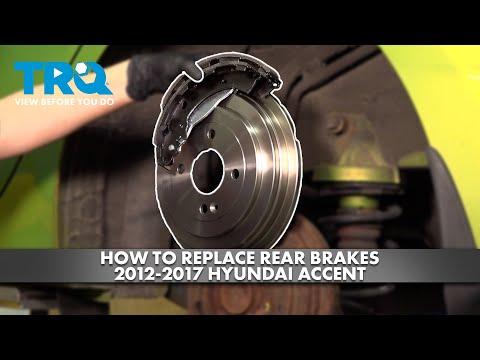







How to Replace Rear Brake Pads on a 2016 Hyundai Accent (Disc or Drum Setup)
Step-by-step DIY instructions with tools, parts list, safety tips, and torque specs for rear brakes for 2013, 2014, 2015, 2016, 2017
How to Replace Rear Brake Pads on a 2016 Hyundai Accent (Disc or Drum Setup)
Step-by-step DIY instructions with tools, parts list, safety tips, and torque specs for rear brakes for 2013, 2014, 2015, 2016, 2017


🔧 Accent - Rear Brake Pad Replacement
On your Accent, rear braking can be either disc brakes (pads) or drum brakes (shoes), depending on the rear brake setup. Below are both procedures—use the one that matches what you see behind the rear wheel (a visible caliper = pads; a closed drum “hat” with no caliper = shoes).
Difficulty Level: Intermediate | Estimated Time: 1.5-3.0 hours
⚠️ Safety & Precautions
- ⚠️ Work on level ground and use jack stands; never rely on a jack alone.
- ⚠️ Brake dust is unhealthy—use brake cleaner, not compressed air.
- ⚠️ Keep the parking brake released while servicing rear brakes.
- ⚠️ Do not press the brake pedal with a caliper removed.
- ⚠️ If brake fluid rises near “MAX” when compressing pistons, remove a small amount with a syringe.
🔧 Required Tools
You'll need the following tools for this repair:
- Floor jack (rated 2-ton minimum)
- Jack stands (pair, rated 2-ton minimum)
- Wheel chocks
- 21mm socket
- Breaker bar
- Torque wrench (10–200 Nm range)
- Ratchet
- 14mm socket
- 17mm socket
- Flathead screwdriver
- C-clamp brake piston compressor
- Brake caliper hanger hook
- Needle-nose pliers
- Wire brush
- Brake spring tool (specialty)
- Safety glasses
- Nitrile gloves
🔩 Required Parts
HowToo sells all the parts you need for this repair:
- Rear brake pad set - Qty: 1
- Rear brake hardware kit (clips/shims) - Qty: 1
- Brake parts cleaner - Qty: 1
- Silicone brake grease - Qty: 1
- Rear brake rotors - Qty: 2 (only if worn or damaged)
- Brake fluid (DOT 3/DOT 4) - Qty: 1 (only if topping off)
- Rear brake shoe set - Qty: 1 (only if you have drum brakes)
- Rear drum brake hardware kit - Qty: 1 (only if you have drum brakes)
- Rear brake drums - Qty: 2 (only if worn or heavily scored)
📋 Before You Begin
- Park on level ground, put the transmission in 1st gear, and place wheel chocks at the front wheels.
- Release the parking brake fully.
- Crack the rear lug nuts loose using a 21mm socket and breaker bar before lifting.
- Lift the rear with a floor jack and support with jack stands at solid rear lift points.
🔨 Step-by-Step Instructions
Follow these steps in order:
Step 1: Remove the rear wheels
- Use a 21mm socket and ratchet to remove the lug nuts.
- Remove both rear wheels.
Step 2: Identify rear brake type (disc vs drum)
- If you see a caliper squeezing a rotor, you have disc brakes (pads).
- If you see a closed drum with no caliper, you have drum brakes (shoes).
Step 3A: (Disc brakes) Remove the caliper
- Turn the steering of your view by rotating the hub by hand for access (rear hub will still rotate freely with parking brake off).
- Use a 14mm socket and ratchet to remove the two caliper slide bolts.
- Lift the caliper off the bracket and support it with a brake caliper hanger hook (this prevents stressing the brake hose).
Step 4A: (Disc brakes) Remove old pads and inspect
- Remove the inner and outer pads by hand.
- Use brake parts cleaner to clean the bracket and pad contact points.
- Check rotor surface; if deeply grooved or below spec, replace rotors in pairs.
- Tip: Take a quick photo before disassembly.
Step 5A: (Disc brakes) Compress the caliper piston
- Remove the brake master reservoir cap under the hood by hand (loosening it helps fluid return).
- Place an old pad against the piston face, then use a C-clamp brake piston compressor to press the piston fully back in.
- Watch the brake fluid level; remove excess if needed.
Step 6A: (Disc brakes) Service slide pins and install new hardware
- Pull the caliper slide pins out by hand.
- Wipe clean and apply a thin coat of silicone brake grease, then reinstall the pins.
- Replace the abutment clips/shims using a flathead screwdriver if your hardware kit includes them.
- Tip: Grease goes on pins, not pad friction.
Step 7A: (Disc brakes) Install new pads and reinstall caliper
- Install the new pads into the bracket by hand (make sure they slide freely).
- Reinstall the caliper over the pads.
- Use a 14mm socket and torque wrench to tighten the slide bolts: Torque to 25–30 Nm (18–22 ft-lbs).
- If you removed the caliper bracket (only needed for rotor replacement), use a 17mm socket and torque wrench: Torque to 70–80 Nm (52–59 ft-lbs).
Step 3B: (Drum brakes) Remove the brake drum
- Pull the drum straight off by hand.
- If it’s stuck, tap around the drum face with a flathead screwdriver handle (or use light rocking by hand).
- If still stuck, retract the adjuster through the backing plate access hole using a flathead screwdriver.
Step 4B: (Drum brakes) Replace shoes and hardware
- Use brake parts cleaner to clean, then let it dry.
- Use needle-nose pliers and a brake spring tool (specialty) to remove springs and hold-down hardware.
- Swap shoes one side at a time so you can match the layout.
- Lightly grease the backing plate shoe contact pads using silicone brake grease (tiny amount).
- Tip: Replace hardware; old springs get weak.
Step 5B: (Drum brakes) Adjust and reinstall drum
- Turn the star wheel adjuster with a flathead screwdriver until shoes lightly drag when the drum is installed.
- Reinstall the drum by hand.
Step 8: Reinstall wheels and torque lug nuts
- Reinstall wheels and snug lug nuts using a 21mm socket and ratchet.
- Lower the car, then use a torque wrench to tighten lug nuts in a star pattern: Torque to 90–110 Nm (66–81 ft-lbs).
Step 9: Restore pedal feel
- With the engine OFF, press the brake pedal slowly 10–15 times until it feels firm.
- Reinstall and tighten the brake fluid reservoir cap by hand.
✅ After Repair
- Start the engine and confirm the brake pedal feels normal (not sinking).
- Check brake fluid level and top off with DOT 3/DOT 4 if needed.
- Test at low speed first; verify straight stops and no grinding noises.
- Brake pad break-in: make 6–10 moderate stops from 30–40 mph, allow cooling between stops.
- Re-check lug nut torque after 25–50 miles using a torque wrench.
💰 DIY vs Shop Cost
Shop Cost: $250-$450 (parts + labor)
DIY Cost: $60-$180 (parts only)
You Save: $190-$270 by doing it yourself!
Shop labor rates vary but typically run $100-$150/hour. This repair takes a shop approximately 1.5-3.0 hours.
🎯 Ready to get started?
HowToo makes it easy: same-day/2-day shipping on every part, plus all the tools and specialty tools you need! Check out the parts and tools sections below to add everything to your cart.