








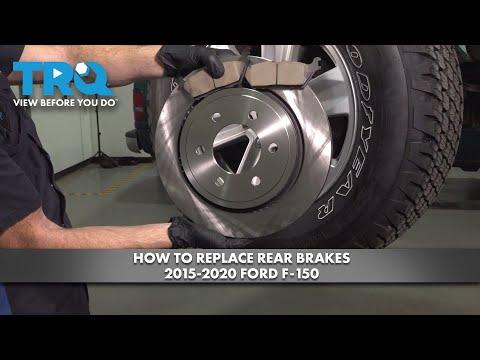







How to Replace Rear Brake Pads on a 2015 Ford F-150 (Step-by-Step Repair Guide)
Detailed DIY rear brake pad replacement with tools list, torque specs, safety tips, and step-by-step instructions for your 2015 F-150 for 2012, 2013, 2014, 2015, 2016, 2017, 2018, 2019, 2020
How to Replace Rear Brake Pads on a 2015 Ford F-150 (Step-by-Step Repair Guide)
Detailed DIY rear brake pad replacement with tools list, torque specs, safety tips, and step-by-step instructions for your 2015 F-150 for 2012, 2013, 2014, 2015, 2016, 2017, 2018, 2019, 2020


F-150 - Rear Brake Pad Replacement 🛠️
Since you said “proceed” and didn’t specify, I’ll give you the procedure for the common setup on your 2015 Platinum: rear disc brakes with a foot-operated parking brake pedal (no electric parking brake button). If you actually have an EPB button, tell me and I’ll add the extra steps.
Always replace brake pads on both rear wheels as a pair.
Tools & Supplies 🧰
- 🧱 Jack & jack stands (rated for a full-size truck)
- 🔧 Lug wrench or 21 mm socket + breaker bar (for wheel nuts)
- 🔧 Socket set (you’ll typically need:
- 13 mm or 15 mm socket for caliper slide bolts
- 18 mm socket for caliper bracket bolts (if removing bracket)
- 🔩 Torque wrench (tool that lets you tighten bolts to a specific torque)
- 🗜️ C-clamp or disc brake piston tool (to push the caliper piston back)
- 🪛 Flathead screwdriver or small pry bar (to help remove pads / spread caliper)
- 🧴 Brake cleaner spray
- 🧴 High-temp brake grease (for slide pins and pad contact points)
- 🧤 Mechanic gloves and safety glasses
- 🧽 Shop rags or paper towels
- 🧯 Wheel chocks (blocks to keep the truck from rolling)
- 📦 New rear brake pads (for your F-150 Platinum, rear axle set)
Key Torque Specs 🔩
- 🔧 Rear caliper slide bolts: ~24–27 lb-ft (32–37 N·m)
- 🔧 Rear caliper bracket bolts: ~85–96 lb-ft (115–130 N·m)
- 🔧 Wheel lug nuts: 150 lb-ft (203 N·m)
Values are typical for your generation F-150; if you have a factory manual, follow its exact numbers.
Safety First ⚠️
- 🛑 Work on a flat, solid surface. No dirt or soft ground.
- 🧱 Always support the truck with jack stands, never just the jack.
- 🧯 Chock the front wheels so the truck can’t roll.
- 🔥 Brakes get very hot. Make sure everything is cool to the touch before starting.
Step 1 – Prep the Truck 🚙
- 🧱 Chock the front wheels (both sides).
- 🛑 Release the parking brake pedal fully (important so the rear brakes are not clamped).
- 🔧 Slightly loosen the rear wheel lug nuts (about 1 turn) while the truck is still on the ground.
- 🧰 Place the jack under the rear axle (under the axle tube near the wheel you’re working on) and lift until the tire is off the ground.
- 🧱 Put jack stands under the frame or axle on both sides and gently lower the truck onto them.
- 🔧 Remove the rear wheels completely.
Step 2 – Inspect & Access the Caliper 🔍
- 👀 Look at the rear caliper (the clamp over the rotor). You’ll see:
- Two slide bolts on the back (top and bottom).
- The brake hose going into the caliper—do not stretch or kink this.
- 🧴 Spray a little brake cleaner on the caliper and rotor to remove dust. Let it drip onto a pan or cardboard.
Step 3 – Remove the Caliper 🪛
- 🔧 Use your socket (usually 13 or 15 mm) to remove the two caliper slide bolts on the back.
- 🪛 Gently wiggle and pull the caliper off the bracket. If it’s stuck, use a flathead screwdriver to pry a little between the pad and rotor to relieve pressure.
- ⚠️ Do not let the caliper hang by the hose. Use a wire, bungee cord, or set it on a box to support it.
Step 4 – Remove Old Pads & Hardware 🧹
- 🧱 Slide the old brake pads out of the caliper bracket. Note which side had the wear indicator tab (if present).
- 🧰 Remove the stainless pad clips (hardware) from the bracket if your new pads come with new clips.
- 🧴 Spray the caliper bracket with brake cleaner and wipe off rust and dust.
Step 5 – Compress the Caliper Piston 🗜️
- 🧤 Check the brake fluid reservoir under the hood. If it’s very full, remove a little fluid with a clean syringe or turkey baster into a container. This prevents overflow when you push the piston back.
- 🗜️ Place an old brake pad against the piston face inside the caliper.
- 🗜️ Use a C-clamp over the caliper body and old pad, and slowly tighten to push the piston fully back into the caliper.
- ⚠️ Go slow. If it feels extremely hard or jerky, stop and tell me—there may be another issue.
Step 6 – Install New Hardware & Pads 🧩
- 📦 Clip the new stainless pad clips into the caliper bracket where the old ones were.
- 🧴 Apply a thin layer of brake grease on:
- The areas of the clips where the pad “ears” slide.
- The slide pins (the smooth pins the caliper bolts go through), after pulling them out one at a time, cleaning, and regreasing them.
- 📦 Install the new pads into the bracket:
- Make sure they sit flat and move smoothly in the clips.
- If one pad has a wear indicator tab, install it in the same position as the old one (usually inner pad).
Step 7 – Reinstall the Caliper 🔧
- 🧱 Position the caliper over the new pads and bracket. It should slide on easily if the piston is fully compressed.
- 🔧 Reinstall the caliper slide bolts by hand first to avoid cross-threading.
- 🔧 Tighten the slide bolts to about 24–27 lb-ft with your torque wrench.
Step 8 – Repeat on the Other Side 🔁
- 🔁 Do the exact same steps on the other rear wheel.
- 🧴 Keep everything clean and avoid getting grease on the rotor or pad friction surfaces.
Step 9 – Reinstall Wheels & Lower the Truck 🚗
- 🔧 Put the wheels back on and hand-tighten the lug nuts in a star pattern.
- 🧰 Jack the truck slightly, remove the jack stands, and lower it to the ground.
- 🔧 Torque the lug nuts to 150 lb-ft in a star pattern.
Step 10 – Pump Brakes & Check Fluid 🧪
- 🦶 Before driving, pump the brake pedal slowly 10–15 times until it feels firm. This seats the pads against the rotors.
- 🧪 Check the brake fluid level in the reservoir and adjust to the “MAX” line if needed.
- 🛑 Now apply and release the parking brake pedal a few times to make sure it works normally.
Step 11 – Bed-In (Break-In) the New Pads 🛣️
- 🚙 Find a safe, empty road.
- 🔁 Do about 8–10 medium stops from 30–35 mph down to 5–10 mph, letting the brakes cool slightly between each stop.
- ⚠️ Avoid hard panic stops for the first 200–300 miles unless needed for safety.
What’s Next 👍
If you tell me which brand pads you’re using (or want to use), I can give you specific tips for noise prevention and best break-in for that pad type.
HowToo makes it easy: below this answer you’ll see recommended rear brake pads, rotors, brake cleaner, grease, and any tools you’re missing—shipped fast. You can add them to your cart right from the parts section.