









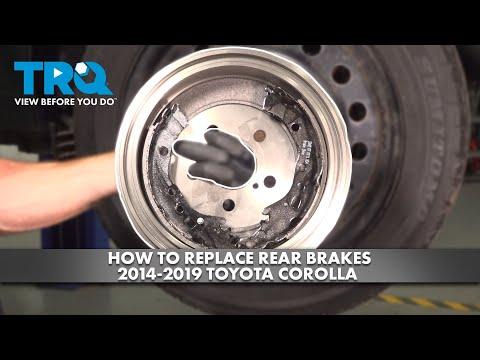







How to Replace Rear Brake Pads (Disc) or Drum Shoes on a 2009-2019 Toyota Corolla (Engine: Inline 4 1.8L | Body: Sedan)
Step-by-step DIY guide with tools, parts list, safety tips, and key torque specs for rear brakes
How to Replace Rear Brake Pads (Disc) or Drum Shoes on a 2009-2019 Toyota Corolla (Engine: Inline 4 1.8L | Body: Sedan)
Step-by-step DIY guide with tools, parts list, safety tips, and key torque specs for rear brakes for 2009, 2010, 2011, 2014, 2015, 2016, 2017, 2018, 2019


🔧 Corolla - Rear Brake Pad Replacement
On your Corolla, the rear “pads” may be either disc brake pads (if it has rear disc brakes) or brake shoes inside a drum (if it has rear drum brakes). The job is mainly removing the wheel, swapping the friction material, then reassembling with correct torque and a careful test drive.
Assumption: Some Corolla LE trims use rear drums; steps below cover both rear disc pads and rear drum shoes.
Difficulty Level: Intermediate | Estimated Time: 1.5-3.0 hours
⚠️ Safety & Precautions
- ⚠️ Work on a flat, solid surface; support the car with jack stands before going under or pulling on parts.
- ⚠️ Chock the front wheels; the rear brakes will be disabled during the job.
- ⚠️ Brake dust is harmful—avoid blowing it with air; use brake cleaner and let it drip into a catch pan.
- ⚠️ Do not press the brake pedal with a caliper removed or a drum off.
- ⚠️ Parking brake: your Corolla uses a mechanical parking brake—release it fully before rear brake work.
- 🔋 Battery disconnect is not required.
🔧 Required Tools
You'll need the following tools for this repair:
- Floor jack (rated 2-ton minimum)
- Jack stands (rated 2-ton minimum)
- Wheel chocks
- 21mm lug nut socket
- 1/2" drive breaker bar
- 1/2" drive torque wrench (20-150 ft-lbs range)
- 14mm socket
- 17mm socket
- Ratchet (3/8" or 1/2" drive)
- Flathead screwdriver
- C-clamp (6" minimum)
- Brake caliper hanger hook
- Needle-nose pliers
- Drum brake spring tool (specialty)
- Brake cleaner spray
- Catch pan
- Wire brush
- Nitrile gloves
- Safety glasses
🔩 Required Parts
HowToo sells all the parts you need for this repair:
- Rear brake pad set - Qty: 1
- Rear brake hardware kit - Qty: 1
- Brake caliper grease (silicone) - Qty: 1
- Rear brake shoes - Qty: 1
- Rear drum brake hardware kit - Qty: 1
📋 Before You Begin
- Park on level ground, shift to P, and release the parking brake fully.
- Place wheel chocks in front of both front tires.
- Crack the rear lug nuts loose 1/4 turn using a 21mm lug nut socket and breaker bar before lifting.
- Lift the rear with a floor jack and support with jack stands under proper rear lift/support points.
- Do one side at a time.
🔨 Step-by-Step Instructions
Follow these steps in order:
Step 1: Remove the rear wheels
- Use a 21mm lug nut socket and ratchet to remove the lug nuts.
- Remove both rear wheels and set them aside.
- When reinstalling later: Torque to 103 Nm (76 ft-lbs) using a torque wrench.
Step 2: Identify rear brake type (disc vs drum)
- Look at the brake assembly behind the wheel studs.
- If you see a shiny rotor (flat disc) and a caliper: follow Steps 3–7 (Disc).
- If you see a closed “can” (drum): follow Steps 8–13 (Drum).
Step 3 (Disc): Remove the caliper
- Turn the steering wheel is not needed for rear; just access the caliper.
- Use a 14mm socket and ratchet to remove the caliper slide pin bolts.
- Lift the caliper off the bracket.
- Support it with a brake caliper hanger hook (a hook that holds the caliper so the brake hose isn’t stretched).
Step 4 (Disc): Remove old pads and hardware
- Remove the inner and outer pads by hand.
- Remove the stainless pad clips (hardware) from the bracket using a flathead screwdriver.
- Clean the bracket pad lands (where the clips sit) with brake cleaner spray and a wire brush.
Step 5 (Disc): Compress the caliper piston
- Place an old pad against the piston face.
- Use a C-clamp (6" minimum) to slowly push the piston back in.
- Go slow to avoid overflowing the brake fluid.
Step 6 (Disc): Install new hardware and pads
- Install new pad clips from the rear brake hardware kit by hand.
- Apply a thin film of brake caliper grease (silicone) to the clip contact points where the pad ears slide (not on pad friction material).
- Install the new pads into the bracket.
Step 7 (Disc): Reinstall the caliper
- Lower the caliper over the new pads.
- Install the slide pin bolts using a 14mm socket and ratchet.
- Torque to 25 Nm (19 ft-lbs) using a torque wrench.
- If you removed the caliper bracket (not always necessary): reinstall bracket bolts with a 17mm socket and torque wrench, Torque to 65 Nm (48 ft-lbs).
Step 8 (Drum): Remove the brake drum
- Pull the drum straight off by hand.
- If stuck: tap around the drum face using the handle end of a ratchet (light taps), then pull again.
- If it still won’t come off, the shoes may be adjusted too tight—use a flathead screwdriver through the backing plate access slot to back off the adjuster (small “star wheel”).
Step 9 (Drum): Take a reference photo
- Use your phone to take a clear picture of the springs/adjuster layout before disassembly.
- This prevents “mystery spring” reassembly.
Step 10 (Drum): Remove springs and shoes
- Use a drum brake spring tool (specialty) to remove the return springs.
- Use needle-nose pliers to remove hold-down pins/clips.
- Remove the shoes and the adjuster assembly.
Step 11 (Drum): Clean and lightly lube contact points
- Spray the backing plate and hardware area with brake cleaner spray over a catch pan.
- Clean the six shoe contact pads on the backing plate with a wire brush.
- Apply a tiny amount of brake caliper grease (silicone) to the backing plate contact pads (not on shoe lining).
Step 12 (Drum): Install new shoes and hardware
- Install the new shoes and new springs from the rear drum brake hardware kit using the drum brake spring tool (specialty).
- Reinstall the adjuster in the same orientation as your photo.
- Make sure the parking brake lever/cable is seated correctly on the shoe.
Step 13 (Drum): Adjust shoes and reinstall drum
- Install the drum over the shoes by hand.
- If it slides on too easily, expand the adjuster slightly using a flathead screwdriver through the access slot until you feel a light drag when spinning the drum.
- Light drag is normal; heavy drag is too tight.
Step 14: Reinstall wheels and lower the car
- Install lug nuts hand-tight.
- Lower the car off the jack stands using the floor jack.
- Torque lug nuts in a star pattern: Torque to 103 Nm (76 ft-lbs) using a torque wrench.
✅ After Repair
- Pump the brake pedal 10–15 times until it feels firm (this seats the pistons/shoes).
- Check brake fluid level and top off only if needed.
- Test at low speed first: confirm normal braking and no pulling/noise.
- Brake bedding (break-in): do 6–8 gentle stops from 30–35 mph with cool-down between stops; avoid hard stops for the first 200 miles.
- If rear drums: set the parking brake and release it a few times to help the self-adjuster settle.
💰 DIY vs Shop Cost
Shop Cost: $250-$450 (parts + labor)
DIY Cost: $40-$140 (parts only)
You Save: $110-$410 by doing it yourself!
Shop labor rates vary but typically run $100-$150/hour. This repair takes a shop approximately 1.5-3.0 hours.
🎯 Ready to get started?
HowToo makes it easy: same-day/2-day shipping on every part, plus all the tools and specialty tools you need! Check out the parts and tools sections below to add everything to your cart.
Guide for Disc Brake Pad Set replace for these Toyota vehicles
| Year Make Model | Sub Model | Engine | Body Style |
|---|---|---|---|
| 2019 Toyota Corolla | - | Inline 4 1.8L | Sedan |
| 2018 Toyota Corolla | - | Inline 4 1.8L | Sedan |
| 2017 Toyota Corolla | - | Inline 4 1.8L | Sedan |
| 2016 Toyota Corolla | - | Inline 4 1.8L | Sedan |
| 2015 Toyota Corolla | - | Inline 4 1.8L | Sedan |
| 2014 Toyota Corolla | - | Inline 4 1.8L | Sedan |
| 2011 Toyota Corolla | - | Inline 4 1.8L | Sedan |
| 2010 Toyota Corolla | - | Inline 4 1.8L | Sedan |
| 2010 Toyota Corolla | - | Inline 4 2.4L | Sedan |
| 2009 Toyota Corolla | - | Inline 4 1.8L | Sedan |
| 2009 Toyota Corolla | - | Inline 4 2.4L | Sedan |