









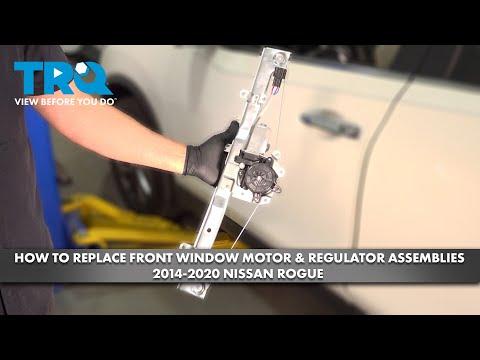





How to Replace Front Window Regulators on a 2019 Nissan Rogue
Step-by-step DIY front window regulator and motor replacement with tools, parts list, safety tips, and testing instructions
How to Replace Front Window Regulators on a 2019 Nissan Rogue
Step-by-step DIY front window regulator and motor replacement with tools, parts list, safety tips, and testing instructions


🔧 Rogue - Front Window Regulator Replacement
You’ll be removing the inner door panel, unbolting the glass from the regulator, then swapping the old regulator and motor assembly for a new one. This restores smooth power window operation if your window is stuck, slow, or crooked.
Difficulty Level: Intermediate | Estimated Time: 1.5–2.5 hours per door
⚠️ Safety & Precautions
- ⚠️ Disconnect the negative battery cable before working to prevent accidental window movement and avoid short circuits.
- ⚠️ Support the glass securely with tape before unbolting it so it cannot drop and crack.
- ⚠️ Keep fingers clear of the regulator “scissor/track” areas; the mechanism can pinch hard.
- ⚠️ Use jack stands only if you ever need to raise the vehicle; this job is usually done with the Rogue on the ground.
- ⚠️ Work gently around the door’s side-impact sensor wiring; do not unplug any yellow airbag connectors.
🔧 Required Tools
You'll need the following tools for this repair:
- 🛠️ 10mm socket
- 🛠️ 8mm socket
- 🛠️ 1/4" drive ratchet
- 🛠️ 1/4" drive extension (3–6")
- 🛠️ Phillips #2 screwdriver
- 🛠️ Flathead screwdriver (small)
- 🛠️ Trim removal tool set (plastic)
- 🛠️ Needle-nose pliers
- 🛠️ Panel clip removal tool
- 🛠️ Pick tool (small hook)
- 🛠️ Torque wrench (inch-lb and ft-lb scale)
- 🛠️ Masking tape (wide)
- 🛠️ Work light
- 🛠️ Mechanic gloves
- 🛠️ Safety glasses
🔩 Required Parts
HowToo sells all the parts you need for this repair:
- 🔩 Front left window regulator with motor (driver side) - Qty: 1
- 🔩 Front right window regulator with motor (passenger side) - Qty: 1 (if you are doing both)
- 🔩 Front door panel push clips - Qty: 6–10 per door have extras in case some break
- 🔩 Butyl sealant or waterproof tape - Qty: 1 roll (for vapor barrier resealing if damaged)
📋 Before You Begin
- Park your Rogue on level ground, set the parking brake, and turn off the ignition.
- Lower the affected window to about halfway if it still moves; this makes the glass bolts easier to reach.
- Open the door fully and make sure you have good lighting and space to work.
- Disconnect the negative battery terminal using a 10mm socket and move the cable aside so it cannot spring back.
- Lay a towel on the door sill to protect paint and to rest tools.
🔨 Step-by-Step Instructions
Follow these steps in order:
Step 1: Remove trim covers and visible screws
- Use a trim removal tool to gently pry off the small plastic cover behind the interior door pull handle (where you grab to close the door).
- Use a trim removal tool or small flathead screwdriver to pop off the small cover behind the inner door release handle (chrome or black handle you pull to open the door).
- Use a Phillips #2 screwdriver to remove the screws hidden behind these covers. Place the screws in a container so you don’t lose them.
- On some Rogues, there may be an additional screw at the lower front of the door panel; check and remove using the Phillips #2 screwdriver.
Step 2: Remove the window switch panel
- Use a trim removal tool to carefully pry up the window switch panel from the front edge, then lift it out.
- Press the locking tabs on the electrical connectors with your thumb or a pick tool and unplug all connectors from the switch panel.
- Set the switch panel aside somewhere safe.
Step 3: Remove the door panel
- Starting at the bottom rear corner, slide a trim removal tool between the door panel and the metal door skin.
- Twist the tool gently to pop the first plastic clip loose; you will hear it “pop”.
- Work your way around the bottom and sides, releasing all the clips with the trim removal tool or panel clip removal tool.
- Once the clips are free, lift the entire door panel straight up to unhook it from the window ledge, then pull it slightly away from the door.
- Reach behind the panel and disconnect any remaining electrical connectors (courtesy light, etc.) using your hands or a pick tool for tabs.
- Fully remove the door panel and set it on a soft surface.
Step 4: Remove or loosen the vapor barrier
- The vapor barrier is the thin plastic sheet stuck to the metal door with sticky butyl sealant to keep water out.
- Use your hands or a trim removal tool to slowly peel the barrier off around the large opening where the regulator sits.
- Try not to tear it; peel carefully so the sticky sealant stays on the plastic. If it tears, you can repair with new butyl or tape later.
Step 5: Secure and separate the glass from the regulator
- Look through the large openings to find the two glass clamp bolts attaching the glass to the regulator track. These are typically 10mm bolts.
- If the glass isn’t at the right height to access the bolts, temporarily reconnect the window switch connector, reconnect the battery negative with the 10mm socket, and move the window until you see the bolts. Then disconnect the battery cable again.
- Use a 10mm socket and ratchet to loosen (but do not fully remove) the two glass clamp bolts until the glass can slide free of the clamps.
- From the top of the door, gently lift the glass fully up into the frame by hand.
- Use several strips of masking tape on the outside of the door: run tape from the glass over the top of the door frame to the inside to hold the glass in the “up” position.
Step 6: Remove the old regulator and motor assembly
- Locate the power window motor, usually toward the front lower part of the door.
- Press the tab and unplug the window motor connector by hand or with a pick tool.
- Use a 10mm socket and ratchet to remove the bolts holding the regulator tracks and the motor to the door inner panel (usually 5–7 bolts).
- Keep track of which bolts go where; most will be the same length.
- Once all bolts are out, maneuver the regulator and motor assembly out through the large opening in the door. Rotate and tilt it as needed.
- Torque spec note: Nissan does not publish a critical torque for these small body bolts; when reinstalling, you will snug them firmly by hand using the 1/4" drive ratchet, not over-tightening.
Step 7: Install the new window regulator and motor
- Compare the new regulator with the old one to verify same shape, mounting points, and connector.
- Feed the new regulator and motor assembly into the door opening in the same orientation as the old one.
- Align the regulator and motor mounting holes with the holes in the door.
- Install all regulator and motor bolts by hand first to avoid cross-threading.
- Use a 10mm socket and 1/4" ratchet to tighten each bolt evenly. Tighten to “snug” — approximately 7–9 Nm (62–80 in-lb) without overtightening the small bolts.
- Reconnect the window motor electrical connector by pushing it on until it clicks.
Step 8: Reattach the glass to the new regulator
- Remove the masking tape from the glass while holding the glass with one hand so it doesn’t fall.
- Gently lower the glass by hand until it sits into the regulator clamps again, visible through the access openings.
- Use a 10mm socket to tighten the two glass clamp bolts evenly on both sides. Tighten to snug: about 5–7 Nm (44–62 in-lb); do not overtighten or you could crack the glass.
- Tighten each side little by little, alternating sides.
Step 9: Test the window operation (before closing the door)
- Temporarily reconnect the window switch panel to its connector by hand.
- Reconnect the negative battery cable using the 10mm socket.
- Turn the ignition to ON (engine can be off).
- Run the window up and down several times using the switch:
- Listen for grinding or binding.
- Make sure the glass travels smoothly and seats fully at the top and bottom.
- If it seems crooked, loosen the glass clamp bolts slightly with the 10mm socket, adjust the glass by hand, then retighten.
- Turn ignition OFF and disconnect the negative battery cable again with the 10mm socket before reassembling.
Step 10: Reinstall the vapor barrier
- Press the plastic vapor barrier back into its original position using your hands.
- If the original butyl seal is damaged, apply fresh butyl sealant or waterproof tape along any gaps and press firmly.
- Good sealing keeps water out of the interior.
Step 11: Reinstall the door panel
- Reconnect all electrical connectors (window switch, courtesy light, etc.) by hand until each clicks into place.
- Hang the top of the door panel on the window ledge by lining up the upper hooks and pushing down gently.
- Once hooked at the top, push the panel flush against the door.
- Use your palms to firmly press around the edges of the panel to re-engage all the plastic clips. If a clip is broken, replace it from your new clip kit by hand or with needle-nose pliers.
Step 12: Reinstall screws and trim covers
- Reinstall all previously removed screws using the Phillips #2 screwdriver (door pull, around handle, lower screws if equipped). Tighten to snug only.
- Snap the plastic trim covers back over the screws by pressing them in with your fingers.
- Press the window switch panel back into place until it clicks flush with the door.
Step 13: Final electrical reconnect and calibration
- Reconnect the negative battery cable using the 10mm socket and tighten it until snug. Do not overtighten.
- Turn ignition to ON.
- On many Rogues, you may need to reinitialize the auto-up/down feature:
- Use the switch to fully lower the window and hold the switch down for 3–5 seconds.
- Then fully raise the window and hold the switch up for 3–5 seconds.
- This teaches the regulator the upper and lower limits.
✅ After Repair
- Test the window from both the individual door switch and the driver’s master switch to ensure both work.
- Verify the auto-up and auto-down functions operate correctly and that the window stops and reverses if you gently block it with your hand (pinch protection check—do this carefully).
- Drive at low speed and listen for any rattles in the door area; if you hear any, recheck that all clips and screws are tight.
- After a day or two, recheck window operation to confirm it remains smooth and properly aligned.
💰 DIY vs Shop Cost
Shop Cost: $350–$550 per front window (parts + labor)
DIY Cost: $90–$180 per window (parts only)
You Save: $260–$370 per window by doing it yourself!
Shop labor rates vary but typically run $100–$150/hour. This repair takes a shop approximately 1.0–1.5 hours per door.
🎯 Ready to get started?
HowToo makes it easy: same-day/2-day shipping on every part, plus all the tools and specialty tools you need! Check out the parts and tools sections above to add everything to your cart.
Guide for replace for these Nissan vehicles
| Year Make Model | Sub Model | Engine | Body Style |
|---|