









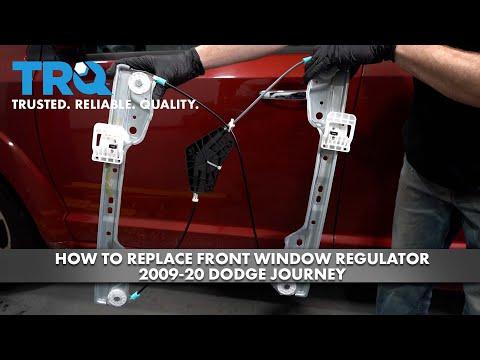







How to Replace Front Window Regulator on a 2016 Dodge Journey (Power Windows)
Step-by-step door panel removal, tools/parts list, and torque specs to restore smooth window operation
How to Replace Front Window Regulator on a 2016 Dodge Journey (Power Windows)
Step-by-step door panel removal, tools/parts list, and torque specs to restore smooth window operation


🔧 Journey - Front Window Regulator Replacement
The front window regulator is the metal track/cable assembly that raises and lowers your window glass. When it fails, the window may move crooked, make grinding noises, or drop into the door. You’ll remove the door panel, support the glass, swap the regulator (often sold as regulator + motor), then reassemble and test.
Difficulty Level: Intermediate | Estimated Time: 1.5-3.0 hours (per front door)
Assumption: your Journey uses a power regulator assembly with cable-style lift.
⚠️ Safety & Precautions
- ⚠️ Keep hands clear of the regulator while powered; the scissor/cable drive can pinch.
- ⚠️ Support the window glass before unbolting it, or it can drop and shatter.
- ⚠️ Disconnect the negative battery cable before unplugging door wiring to reduce short/canbus issues.
- ⚠️ Use trim tools (plastic pry tools) to avoid breaking clips and scratching paint.
🔧 Required Tools
You'll need the following tools for this repair:
- Safety glasses
- Mechanic gloves
- Floor jack (rated 3-ton minimum)
- Jack stands (rated 3-ton minimum)
- Wheel chocks
- Plastic trim removal tool set
- Small flat screwdriver
- Phillips screwdriver
- 7mm socket
- 8mm socket
- 10mm socket
- Ratchet
- 6-inch socket extension
- Torx T20 driver
- Torx T30 driver
- Torque wrench (inch-pound or small Nm range)
- Painter’s tape (1.5-inch wide)
- Pick tool
- Work light
🔩 Required Parts
HowToo sells all the parts you need for this repair:
- Front window regulator assembly - Qty: 1
- Front window regulator motor - Qty: 1 (only if not included with regulator)
- Door trim panel retainer clips - Qty: 6-12 (handy to have extras)
- Vapor barrier butyl seal tape - Qty: 1
📋 Before You Begin
- Park on level ground, shift to Park, and set the parking brake.
- Lower the window to about halfway if it still moves; this usually exposes the glass-to-regulator fasteners through access holes.
- Disconnect the battery: use a 10mm socket to remove the negative cable and isolate it so it can’t touch the terminal.
- Get your painter’s tape ready; you’ll use it to hold the glass up once it’s unbolted.
🔨 Step-by-Step Instructions
Follow these steps in order:
Step 1: Remove the front door trim panel
- Use a plastic trim removal tool set to pry up the window/lock switch panel (start at the rear edge).
- Unplug the switch connectors using a small flat screwdriver to release the locking tabs. Locking tab = small clip that holds the plug.
- Remove any visible screws in the armrest/handle area using a 7mm socket or Phillips screwdriver (varies by panel).
- Pop the door panel clips free: slide a plastic trim removal tool set along the bottom/side edges and pry outward.
- Lift the panel straight up and off the window sill (it hooks at the top).
- Unplug remaining connectors and unclip the door handle cable using a pick tool if needed. Cable retainer = plastic bracket holding the cable.
Step 2: Remove the vapor barrier (water shield)
- Use a plastic trim removal tool set to carefully peel back the vapor barrier.
- If the sticky butyl stretches, use a pick tool to help separate it slowly.
- Don’t tear it if possible; it prevents water leaks into the cabin.
Step 3: Support the window glass
- Reconnect the window switch temporarily if the glass needs positioning, then disconnect again when positioned.
- Use painter’s tape (1.5-inch wide) to tape the glass to the door frame from the outside, using 2–4 long strips.
- If the glass is already down and not moving, gently lift it by hand to the fully-up position and tape it securely.
Step 4: Unbolt the glass from the regulator
- Look through the door’s access openings and locate the glass clamp/fasteners.
- Use an 8mm socket or 10mm socket (varies by build) to loosen/remove the fasteners.
- Torque to 10 Nm (89 in-lbs) on reassembly (glass clamp/fasteners).
Step 5: Remove the regulator and motor assembly
- Unplug the window motor connector.
- Remove the regulator mounting bolts using a 10mm socket with a ratchet and 6-inch socket extension.
- If the motor is separate from the regulator, remove motor screws using a Torx T30 driver.
- Carefully maneuver the regulator out through the large access opening. Rotate and angle it out slowly.
- Torque to 9 Nm (80 in-lbs) on reassembly (regulator-to-door bolts).
- Torque to 6 Nm (53 in-lbs) on reassembly (motor fasteners, if applicable).
Step 6: Install the new regulator (and motor if needed)
- Slide the new regulator into the door the same way the old one came out.
- Hand-start all bolts first to avoid cross-threading, then tighten with a 10mm socket.
- Torque to 9 Nm (80 in-lbs) (regulator-to-door bolts).
- If transferring the motor, install it with a Torx T30 driver and Torque to 6 Nm (53 in-lbs).
- Plug in the window motor connector.
Step 7: Reattach the glass to the regulator
- Remove some tape so the glass can slide down carefully into the regulator clamps.
- Align the glass in the clamps and start the fasteners by hand.
- Tighten using an 8mm socket or 10mm socket.
- Torque to 10 Nm (89 in-lbs).
- Remove the remaining painter’s tape (1.5-inch wide) from the outside of the glass.
Step 8: Function test before reassembly
- Reconnect the negative battery cable using a 10mm socket.
- Turn the ignition on and run the window up/down while watching for tilting, binding, or popping noises.
- If it binds, loosen the regulator bolts slightly with a 10mm socket, align the tracks, then re-torque.
Step 9: Reinstall the vapor barrier and door panel
- Press the vapor barrier back into place; add vapor barrier butyl seal tape where the seal is weak.
- Reconnect all electrical plugs and the interior handle cable.
- Hang the door panel on the top edge first, then press clips in around the perimeter.
- Reinstall screws using a 7mm socket / Phillips screwdriver and snug them (do not over-tighten).
- Reinstall the switch panel using a plastic trim removal tool set and press it into place.
✅ After Repair
- Test the window from both the driver switch and the door’s own switch.
- Confirm the glass seals evenly against the weatherstrip and doesn’t whistle on a short road test.
- If the window has one-touch/express behavior and acts “confused,” cycle it fully down and fully up once with the switch held at the end.
- Check for water leaks later: after a wash/rain, verify the carpet near the door is dry.
💰 DIY vs Shop Cost
Shop Cost: $350-$750 (parts + labor)
DIY Cost: $90-$250 (parts only)
You Save: $260-$500 by doing it yourself!
Shop labor rates vary but typically run $100-$150/hour. This repair takes a shop approximately 1.5-3.0 hours.
🎯 Ready to get started?
HowToo makes it easy: same-day/2-day shipping on every part, plus all the tools and specialty tools you need! Check out the parts and tools sections below to add everything to your cart.