








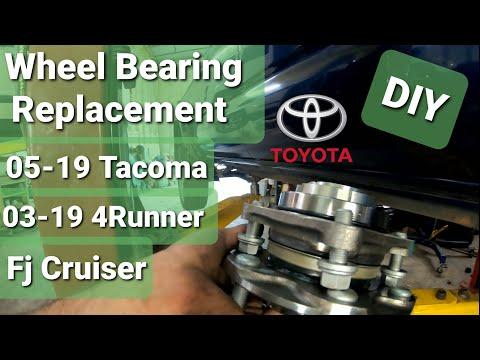






How to Replace Front Wheel Bearings on a 2022 Toyota Tacoma
Step-by-step DIY Tacoma wheel bearing replacement with tools, parts list, torque specs, safety tips, and cost savings for 2005, 2006, 2007, 2008, 2009, 2010, 2011, 2012, 2013, 2014, 2015, 2016, 2017, 2018, 2019, 2020, 2021, 2022, 2023
How to Replace Front Wheel Bearings on a 2022 Toyota Tacoma
Step-by-step DIY Tacoma wheel bearing replacement with tools, parts list, torque specs, safety tips, and cost savings for 2005, 2006, 2007, 2008, 2009, 2010, 2011, 2012, 2013, 2014, 2015, 2016, 2017, 2018, 2019, 2020, 2021, 2022, 2023


🔧 Tacoma - Wheel Bearing Replacement
On your Tacoma, replacing wheel bearings is a big job because the bearings are pressed into the knuckle (front) and onto the axle shaft (rear). It’s absolutely doable, but it’s not a beginner-friendly “driveway” job unless you’re careful and have access to a press or a machine shop.
Difficulty Level: Advanced | Estimated Time: 4–6 hours per axle (not including machine shop time)
⚠️ Safety & Precautions
- ⚠️ Always support the truck with jack stands; never rely on a jack alone.
- ⚠️ You will be working near suspension, brakes, and the axle; loose fasteners here can cause loss of control.
- ⚠️ Wheel bearings are pressed in; high force is involved. A shop press or machine shop is strongly recommended.
- ⚠️ The ABS wheel speed sensor and wiring are fragile; damaging them will turn on warning lights and disable some safety systems.
- ⚠️ Brake parts may contain dust—avoid blowing with compressed air; use brake cleaner spray instead.
- ⚠️ Disconnect the negative battery terminal if you’ll be working around ABS wiring for a long time.
🔧 Required Tools
You'll need the following tools for this repair:
- 🛠️ Floor jack (rated 3-ton minimum)
- 🛠️ Jack stands (rated 3-ton, Qty: 2–4)
- 🛠️ Wheel chocks
- 🛠️ Lug wrench or 21mm socket
- 🛠️ Socket set (8mm–22mm)
- 🛠️ 1/2" drive breaker bar
- 🛠️ Torque wrench (10–250 ft-lbs range)
- 🛠️ Combination wrench set (10mm–22mm)
- 🛠️ Hex/Allen socket set (metric)
- 🛠️ Torx bit set (metric)
- 🛠️ Pry bar (12"–18")
- 🛠️ Ball joint separator or pickle fork (specialty)
- 🛠️ Hammer (2–3 lb)
- 🛠️ Needle-nose pliers
- 🛠️ Side cutters
- 🛠️ Shop press (12-ton or larger) (specialty)
- 🛠️ Hub/bearing press adapter kit (specialty)
- 🛠️ Punch set and drift (hardened)
- 🛠️ Torque angle gauge (specialty)
- 🛠️ Rubber mallet
- 🛠️ Brake caliper hanger hooks
- 🛠️ Flat-head screwdriver (medium)
- 🛠️ Shop rags
- 🛠️ Brake cleaner spray
- 🛠️ Anti-seize compound
- 🛠️ Penetrating oil
- 🛠️ Safety glasses
- 🛠️ Mechanic gloves
🔩 Required Parts
HowToo sells all the parts you need for this repair:
- 🔩 Front wheel bearing - Qty: 1 per side
- 🔩 Front wheel hub - Qty: 1 per side
- 🔩 Front wheel bearing snap ring - Qty: 1 per side
- 🔩 New front axle nut - Qty: 1 per side
- 🔩 New cotter pins - Qty: 2–4
- 🔩 Front dust cap (if damaged) - Qty: 1 per side
- 🔩 ABS sensor O-ring (if damaged) - Qty: 1 per side
- 🔩 Brake caliper bracket bolts (optional one-time-use) - Qty: 2 per side
- 🔩 Brake rotor set screw (if equipped and damaged) - Qty: 1 per side
- 🔩 High-temperature wheel bearing grease - Qty: enough for light coating
📋 Before You Begin
- Park the Tacoma on level ground, set the parking brake, and chock the rear wheels.
- Loosen (do not remove) the front wheel lug nuts with a 21mm socket before lifting the truck.
- Disconnect the negative battery cable with a 10mm wrench if you’ll be unplugging ABS sensors for a while.
- Plan ahead for the press work: either have a shop press ready or arrange for a local machine shop to press the old bearing out and the new one in once you remove the steering knuckle.
🔨 Step-by-Step Instructions
Follow these steps in order:
This guide is for a front wheel bearing on your Tacoma.
Step 1: Lift and support the Tacoma
- Use the floor jack under the front frame crossmember to raise the front of the truck.
- Place jack stands under the frame rails on both sides and lower the truck onto them.
- Finish removing the front wheel lug nuts with a 21mm socket and take off the wheel.
- Give the truck a shake to confirm it’s stable.
Step 2: Remove brake caliper and rotor
- Turn the steering so you can access the caliper bolts.
- Use a 17mm socket on a breaker bar to loosen the caliper bracket bolts.
- Remove the bolts fully with the 17mm socket and lift the caliper and bracket off as one piece.
- Hang the caliper from the suspension with a caliper hanger hook so it doesn’t pull on the brake hose.
- If the rotor has a set screw, remove it with the correct Torx bit or Phillips screwdriver.
- Pull the rotor off. If stuck, tap around the hat with a rubber mallet.
Step 3: Remove the axle nut and dust cap
- Pry off the center dust cap carefully with a flat-head screwdriver.
- Remove the cotter pin from the axle nut using needle-nose pliers and discard the pin.
- Use the correct large axle nut socket (usually 30–36mm; check your new nut) and a breaker bar to loosen the axle nut.
- Remove the axle nut and washer and set them aside (you’ll install a new nut later).
Step 4: Disconnect ABS sensor and brackets
- Locate the ABS wheel speed sensor on the knuckle.
- Use a 10mm socket to remove the sensor bolt.
- Gently twist and pull the sensor out of the knuckle. If it’s stuck, spray penetrating oil and work it slowly—do not force it.
- Unclip any ABS wire brackets along the knuckle with a flat-head screwdriver or needle-nose pliers.
- Keep the sensor clean; avoid touching the tip.
Step 5: Separate tie-rod end from knuckle
- Find the outer tie-rod end where it connects to the knuckle.
- Remove the cotter pin with needle-nose pliers.
- Use a 19mm socket to remove the tie-rod nut.
- Insert a ball joint separator between the knuckle and the tie-rod stud and tap it with a hammer until the stud pops free.
- Do not hit the threaded stud directly.
Step 6: Separate lower ball joint from knuckle
- Support the lower control arm lightly with the floor jack so it doesn’t drop suddenly.
- Remove the cotter pin from the lower ball joint nut with needle-nose pliers.
- Use the correct socket (usually 22mm) and breaker bar to loosen and remove the ball joint nut.
- Use the ball joint separator and hammer to separate the lower ball joint stud from the knuckle.
Step 7: Separate upper ball joint and free the knuckle
- Remove the cotter pin from the upper ball joint nut with needle-nose pliers.
- Use the correct socket (commonly 19mm–21mm) and breaker bar to remove the nut.
- Use the ball joint separator again, tapping with a hammer until the upper joint pops free.
- Now carefully pull the knuckle outward while pushing the CV axle spline out of the hub with your hand or light taps on a drift and hammer.
- Remove the steering knuckle with the hub still attached.
Step 8: Press out the hub from the bearing
- At your workbench or machine shop, support the knuckle in the shop press using appropriate press adapters.
- Use the press to push the wheel hub out from the back side of the knuckle.
- When the hub comes out, the inner race of the bearing will often stay on the hub.
- Use a puller or carefully cut and chisel the inner race off the hub using a cutting tool and hammer (machine shop can do this safely).
Step 9: Remove the bearing from the knuckle
- Use a snap-ring pliers (if needed, part of a separate kit) to remove the bearing snap ring from the knuckle groove.
- Support the knuckle again in the shop press and press the old bearing out from the opposite side using the correct bearing press adapter.
- Clean the bearing bore in the knuckle with brake cleaner and a shop rag.
- Make sure the snap ring groove is completely clean.
Step 10: Press in the new bearing
- Lightly coat the outer surface of the new bearing with a thin layer of high-temperature bearing grease or clean engine oil.
- Position the new bearing squarely in the knuckle bore.
- Use the shop press and an adapter that pushes only on the outer race of the bearing to slowly press it in until it seats fully.
- Reinstall the new bearing snap ring with snap-ring pliers and confirm it’s fully seated in its groove.
Step 11: Press the hub into the new bearing
- Support the inner race of the bearing with the correct press adapter to avoid damaging it.
- Align the hub splines and use the shop press to press the hub into the new bearing, pressing only on the hub center.
- Verify that the hub spins smoothly with no roughness.
Step 12: Reinstall the knuckle onto the Tacoma
- Slide the knuckle back over the CV axle splines.
- Install the lower ball joint stud into the knuckle and start the new nut by hand.
- Install the upper ball joint stud into the knuckle and start its nut by hand.
- Reconnect the tie-rod end into the knuckle and start its nut.
- Torque the lower ball joint nut with a torque wrench and correct socket to 118 Nm (87 ft-lbs) and install a new cotter pin.
- Torque the upper ball joint nut to 98 Nm (72 ft-lbs) and install a new cotter pin.
- Torque the tie-rod end nut to 74 Nm (55 ft-lbs) and install a new cotter pin.
Step 13: Install axle nut and brakes
- Install the new axle nut and washer, then snug it down with the correct axle nut socket.
- Have a helper hold the brake pedal, or temporarily install the wheel and lower the truck slightly to prevent the hub from turning.
- Torque the axle nut with a torque wrench to 235 Nm (173 ft-lbs) or per spec for your exact axle nut; then align for the cotter pin if required.
- Install a new cotter pin and stake or bend it securely, then tap the dust cap back on with a rubber mallet.
- Reinstall the brake rotor.
- Reinstall the caliper and bracket assembly and torque the caliper bracket bolts with a 17mm socket to 123 Nm (91 ft-lbs).
Step 14: Reconnect ABS sensor and wiring
- Lightly clean the ABS sensor hole with brake cleaner.
- Install the ABS sensor with a new O-ring if needed and tighten the bolt with a 10mm socket to 8 Nm (71 in-lbs).
- Clip all ABS wire brackets back to their original locations using your hands or needle-nose pliers.
Step 15: Reinstall wheel and lower truck
- Reinstall the wheel and hand-tighten the lug nuts.
- Raise the truck slightly with the floor jack, remove the jack stands, and lower the truck fully to the ground.
- Torque the lug nuts in a star pattern with a 21mm socket to 113 Nm (83 ft-lbs).
- Reconnect the negative battery cable with a 10mm wrench.
✅ After Repair
- Start the engine and gently turn the steering wheel lock-to-lock while stationary to confirm no binding or noises.
- Check that the ABS light and other warning lights go out after a short drive.
- Drive slowly at first (20–40 km/h) and listen for any grinding, humming, or clicking from the repaired wheel.
- After a short test drive, recheck lug nut torque and look for any fluid leaks or loose wiring/brackets.
- It’s a good idea to schedule a front alignment any time the knuckle and ball joints are removed.
💰 DIY vs Shop Cost
Shop Cost: $650–$1,000 per front side (parts + labor, including press work and likely alignment)
DIY Cost: $180–$320 per front side (parts only, assuming you already have access to a press or a local machine shop does the pressing for a small fee)
You Save: $330–$800 by doing it yourself!
Shop labor rates vary but typically run $100–$150/hour. This repair takes a shop approximately 2.5–3.5 hours per side, plus press time.
🎯 Ready to get started?
HowToo makes it easier: we can bundle your wheel bearing, hub, axle nut, snap ring, and any needed hardware, plus the tools and specialty press adapters you’ll need. Check out the parts and tools sections below to add everything to your cart and tackle your Tacoma’s wheel bearing like a pro.