









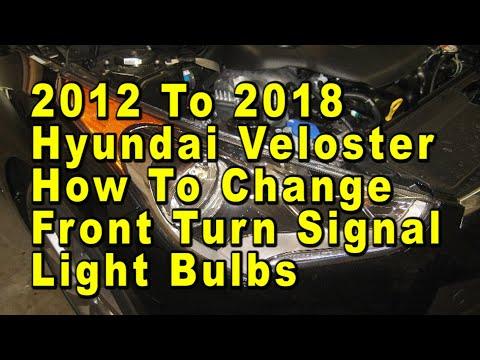






How to Replace Front Turn Signal Bulbs on a 2016 Hyundai Veloster (DIY Guide)
Step-by-step wheel-well access instructions, required tools/parts, safety tips, and lug nut torque specs
How to Replace Front Turn Signal Bulbs on a 2016 Hyundai Veloster (DIY Guide)
Step-by-step wheel-well access instructions, required tools/parts, safety tips, and lug nut torque specs


🔧 Veloster - Front Turn Signal Bulb Replacement
You’ll be accessing the back of the headlamp and swapping the front turn signal bulb. On your Veloster, the easiest access is typically through the front wheel-well liner, so you don’t have to remove the headlamp.
Difficulty Level: Beginner | Estimated Time: 0.5-1.0 hours
Assumption: front turn signal bulb is an amber single-filament type (commonly 1156A/7506A); match the new bulb to the old bulb you remove.
⚠️ Safety & Precautions
- ⚠️ Work on level ground and use jack stands—never rely on a jack alone.
- ⚠️ Turn the ignition OFF and remove the key before working near the fan/belts.
- ⚠️ Let the headlamp area cool if the lights were recently on.
- ⚠️ Do not touch the glass part of the new bulb with bare fingers; skin oil can shorten bulb life.
🔧 Required Tools
You'll need the following tools for this repair:
- Floor jack (rated 2-ton minimum)
- Jack stands (rated 2-ton minimum)
- Wheel chocks
- 21mm socket
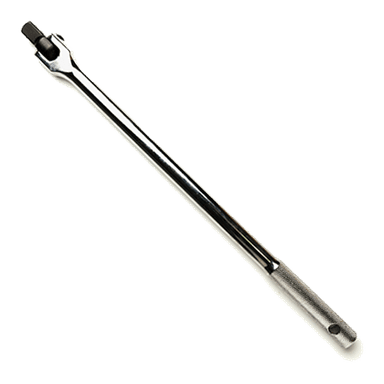
- Breaker bar
- Ratchet
- 10mm socket
- 6-inch extension
- Phillips #2 screwdriver
- Trim clip removal tool
- Torque wrench
- Flashlight
- Nitrile gloves
- Safety glasses
🔩 Required Parts
HowToo sells all the parts you need for this repair:
- Front turn signal bulb (amber) - Qty: 2
- Plastic push clips (fender liner) - Qty: 2-6
📋 Before You Begin
- Park on level ground, set the parking brake, and place wheel chocks behind the rear wheels.
- Turn the steering wheel toward the side you’re working on (this opens up space at the liner).
- Have your flashlight ready—working inside the fender is dark.
🔨 Step-by-Step Instructions
Follow these steps in order:
Step 1: Loosen the front wheel lug nuts
- Use a 21mm socket and breaker bar to loosen the lug nuts about 1/2 turn while the tire is still on the ground.
- Loosen first; it’s much safer.
Step 2: Lift and support the front corner
- Use a floor jack to lift the front corner you’re working on.
- Set the vehicle down onto jack stands.
Step 3: Remove the front wheel
- Finish removing the lug nuts using a 21mm socket and ratchet, then remove the wheel.
Step 4: Pull back the front fender liner
- Remove the plastic push-clips/screws at the front of the liner using a trim clip removal tool and Phillips #2 screwdriver.
- On any small bolts you find, remove them using a 10mm socket, ratchet, and 6-inch extension.
- Gently pull the liner back enough to reach behind the headlamp.
- Don’t crease the liner; bend it slowly.
Step 5: Locate the turn signal bulb socket
- Use a flashlight and look at the back of the headlamp assembly.
- Find the turn signal socket (usually an easy-to-grab twist socket with two wires).
- A “socket” is the plastic holder the bulb locks into.
Step 6: Remove the socket and bulb
- Twist the socket counterclockwise by hand to unlock it, then pull it straight out.
- Pull the old bulb straight out of the socket (no twisting for most wedge/straight-pull types).
Step 7: Install the new bulb
- Put on nitrile gloves before handling the new bulb.
- Push the new bulb into the socket firmly until fully seated.
- If you accidentally touch the glass, wipe it clean and dry (use a clean, lint-free cloth).
Step 8: Reinstall the socket
- Insert the socket back into the headlamp and twist clockwise until it locks.
- Give it a gentle tug to confirm it’s secured.
Step 9: Quick function test
- Turn the ignition to ON and switch on the turn signal and hazards.
- Verify the front turn signal flashes normally (not fast).
- Fast flashing usually means a bulb isn’t working.
Step 10: Reinstall fender liner and wheel
- Reposition the liner and reinstall clips/screws using a trim clip removal tool and Phillips #2 screwdriver.
- Reinstall any bolts using a 10mm socket and ratchet.
- Reinstall the wheel and hand-thread lug nuts.
- Lower the vehicle, then tighten lug nuts in a star pattern using a torque wrench: Torque to 88-108 Nm (65-80 ft-lbs).
✅ After Repair
- Test left and right turn signals and hazards again.
- Walk around the car to confirm all exterior lighting works.
- If the signal still flashes fast, re-check bulb seating and the socket lock.
💰 DIY vs Shop Cost
Shop Cost: $70-$150 (parts + labor)
DIY Cost: $8-$30 (parts only)
You Save: $60-$120 by doing it yourself!
Shop labor rates vary but typically run $100-$150/hour. This repair takes a shop approximately 0.5-1.0 hours.
🎯 Ready to get started?
HowToo makes it easy: same-day/2-day shipping on every part, plus all the tools and specialty tools you need! Check out the parts and tools sections below to add everything to your cart.