









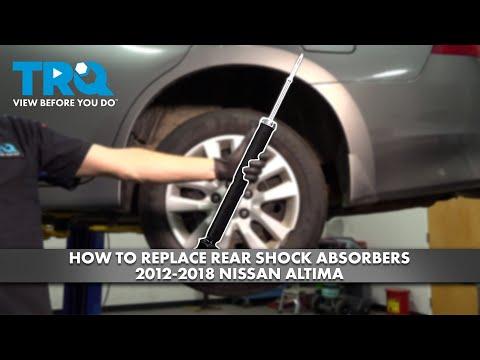







How to Replace Front Struts & Rear Shock Absorbers on a 2013-2018 Nissan Altima (Body: Sedan)
Step-by-step DIY instructions with required tools/parts, safety tips, and alignment reminders
How to Replace Front Struts & Rear Shock Absorbers on a 2013-2018 Nissan Altima (Body: Sedan)
Step-by-step DIY instructions with required tools/parts, safety tips, and alignment reminders for 2013, 2014, 2015, 2016, 2017, 2018


🔧 Altima - Shock Absorber Replacement
On your Altima, the rear uses separate shock absorbers, while the front uses strut assemblies (a strut is a shock built into a structural suspension unit). The steps, tools, and safety needs are different front vs rear—especially because front struts may require compressing a coil spring.
Difficulty Level: Intermediate | Estimated Time: 1.5-4.0 hours
⚠️ Safety & Precautions
- ⚠️ Support your Altima on jack stands on a flat surface; never rely on a jack alone.
- ⚠️ If you’re doing front struts and reusing the coil spring, a coil spring compressor is required (it squeezes the spring so it can’t “release” violently).
- ⚠️ Keep fingers clear of pinch points in the suspension.
- ⚠️ After any strut/shock work, get a 4-wheel alignment as soon as possible.
🔧 Required Tools
You'll need the following tools for this repair:
- Floor jack (rated 3-ton minimum)
- Jack stands (rated 3-ton minimum)
- Wheel chocks
- Safety glasses
- Mechanic gloves
- Breaker bar 1/2"
- Torque wrench 1/2"
- Torque wrench 3/8"
- Socket set 3/8" drive (8mm-19mm)
- Socket set 1/2" drive (14mm-22mm)
- Wrench set (10mm-22mm)
- Ratchet 3/8"
- Ratchet 1/2"
- Needle-nose pliers
- Trim clip remover
- Flathead screwdriver
- Penetrating oil
- Paint marker
- Pry bar
- Coil spring compressor (specialty)
- Pass-through strut nut socket set (specialty)
🔩 Required Parts
HowToo sells all the parts you need for this repair:
- Rear shock absorbers - Replace in pairs - Qty: 2
- Front strut assemblies - Replace in pairs - Qty: 2
- Front strut mount and bearing kit - If reusing springs - Qty: 2
- Front bump stop and dust boot kit - If worn - Qty: 2
- New self-locking strut/shock nuts and bolts - If required - Qty: 1 set
📋 Before You Begin
- Park on level ground, set the parking brake, and chock the rear wheels (for front work) or front wheels (for rear work).
- Loosen lug nuts slightly with the car on the ground using a 21mm socket and breaker bar.
- Spray suspension fasteners with penetrating oil and wait 5–10 minutes.
- If doing front struts and not using complete assemblies: plan to use a coil spring compressor. Never remove the top nut on an uncompressed spring.
🔨 Step-by-Step Instructions
Follow these steps in order:
Step 1: Confirm which end you’re replacing
- Are you replacing the rear shocks (easier), the front struts (more involved), or all four?
- Are you installing complete front strut assemblies (quick-struts) or reusing your coil springs with a coil spring compressor?
Step 2: Lift and remove the wheels
- Lift the correct end using a floor jack (rated 3-ton minimum) and support with jack stands (rated 3-ton minimum).
- Remove the wheels using a 21mm socket and ratchet 1/2".
Step 3 (Rear shocks): Support the rear suspension arm
- Place the floor jack (rated 3-ton minimum) lightly under the rear suspension arm to hold it up.
- This prevents the arm from dropping when the shock bolt is removed.
Step 4 (Rear shocks): Remove the lower shock bolt
- Remove the lower shock fastener using a socket set 1/2" drive (14mm-22mm) and breaker bar 1/2".
- If the bolt is stuck, re-apply penetrating oil and use a pry bar gently for alignment.
- Torque: Nissan uses specific torque values by fastener; I’ll provide the exact specs once you confirm rear vs front and which parts you’re installing.
Step 5 (Rear shocks): Remove the upper shock mount nuts
- Access the upper shock mount area in the trunk/inside trim as needed using a trim clip remover and flathead screwdriver.
- Remove the upper nuts using a socket set 3/8" drive (8mm-19mm) and ratchet 3/8".
- Remove the shock.
Step 6 (Rear shocks): Install the new rear shock
- Position the new shock and hand-thread the upper nuts using a socket set 3/8" drive (8mm-19mm).
- Align the lower mount and install the lower bolt using a socket set 1/2" drive (14mm-22mm).
- Tighten fasteners with a torque wrench 1/2" and torque wrench 3/8" once I confirm your exact configuration.
Step 7 (Front struts): Disconnect brackets from the strut
- Remove the brake hose/ABS wire brackets from the strut using a socket set 3/8" drive (8mm-19mm) or wrench set (10mm-22mm) (varies by fastener).
- Do not let the brake hose hang or twist.
Step 8 (Front struts): Mark the strut-to-knuckle position
- Use a paint marker to mark the relationship between the strut and steering knuckle.
- This helps you get close before the alignment shop.
Step 9 (Front struts): Remove the strut-to-knuckle bolts
- Support the knuckle area lightly with a floor jack (rated 3-ton minimum).
- Remove the two large bolts/nuts using a socket set 1/2" drive (14mm-22mm) and breaker bar 1/2".
- Torque: These are critical fasteners; I’ll give the exact Nissan torque once you confirm quick-struts vs spring swap.
Step 10 (Front struts): Remove the upper strut mount nuts
- Open the hood.
- Remove the upper mount nuts using a socket set 3/8" drive (8mm-19mm) and ratchet 3/8".
- Lower and remove the strut assembly from the wheel well.
Step 11 (Front struts - if NOT quick-strut): Transfer the spring
- Install a coil spring compressor (specialty) on the spring and tighten evenly until the spring is loose on the mount.
- Remove the center top nut using a pass-through strut nut socket set (specialty) and ratchet 3/8".
- Move the spring, dust boot, and bump stop to the new strut in the same orientation.
Step 12 (Front struts): Install the strut
- Position the strut and hand-thread the upper mount nuts using a socket set 3/8" drive (8mm-19mm).
- Install the strut-to-knuckle bolts using a socket set 1/2" drive (14mm-22mm).
- Reinstall brake hose/ABS brackets using a wrench set (10mm-22mm) or socket set 3/8" drive (8mm-19mm).
Step 13: Reinstall wheels and lower the car
- Reinstall wheels using a 21mm socket and ratchet 1/2".
- Lower the vehicle from the jack stands (rated 3-ton minimum) using the floor jack (rated 3-ton minimum).
- Tighten lug nuts with a torque wrench 1/2" in a star pattern.
- Torque: I’ll provide the exact lug torque for your Altima once you confirm which axle you’re doing (front/rear/all four).
✅ After Repair
- Road test at low speed first. Listen for clunks and confirm straight braking.
- Recheck for any loose brackets or rubbing hoses/wires.
- Schedule a 4-wheel alignment, especially after front strut work.
💰 DIY vs Shop Cost
Shop Cost: $500-$1,600 (parts + labor)
DIY Cost: $180-$900 (parts only)
You Save: $320-$700+ by doing it yourself!
Shop labor rates vary but typically run $100-$150/hour. This repair takes a shop approximately 1.5-4.0 hours.
🎯 Ready to get started?
HowToo makes it easy: same-day/2-day shipping on every part, plus all the tools and specialty tools you need! Check out the parts and tools sections below to add everything to your cart.
Guide for Suspension Shock Absorber replace for these Nissan vehicles
| Year Make Model | Sub Model | Engine | Body Style |
|---|---|---|---|
| 2018 Nissan Altima | - | - | Sedan |
| 2017 Nissan Altima | - | - | Sedan |
| 2016 Nissan Altima | - | - | Sedan |
| 2015 Nissan Altima | - | - | Sedan |
| 2014 Nissan Altima | - | - | Sedan |
| 2013 Nissan Altima | - | - | Sedan |