









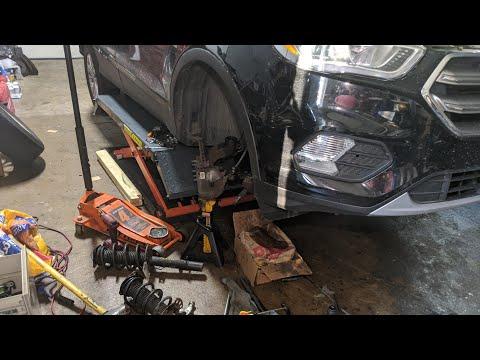






How to Replace Front Struts on a 2020 Ford Escape – Full DIY Guide
Step-by-step 2020 Escape strut replacement with tools, parts list, torque specs, safety tips, and cost-saving advice
How to Replace Front Struts on a 2020 Ford Escape – Full DIY Guide
Step-by-step 2020 Escape strut replacement with tools, parts list, torque specs, safety tips, and cost-saving advice


🔧 Escape - Strut Replacement
We’ll go through how to replace the strut assemblies on your Escape. The front suspension uses MacPherson struts (big shock units with a spring), while the rear uses separate shocks and springs.
Difficulty Level: Advanced (for a beginner) | Estimated Time: 4–6 hours for both fronts
⚠️ Safety & Precautions
- ⚠️ Strut springs are under very high tension. Only use a proper spring compressor; never try to remove the top nut without compressing the spring first.
- ⚠️ Always support the Escape with jack stands. Never rely only on a floor jack.
- ⚠️ Wear safety glasses and mechanic gloves; rust and debris can fall when loosening suspension bolts.
- ⚠️ Keep hands clear of the spring when it’s being compressed or released.
- ⚠️ After suspension work, an alignment is strongly recommended to avoid tire wear and pulling.
- Battery disconnect is not required for this job.
🔧 Required Tools
You'll need the following tools for this repair:
- Floor jack (rated 3-ton minimum)
- Jack stands (rated 3-ton minimum) - Qty: 2+
- Wheel chocks
- Lug wrench (19mm)
- Socket set (8mm–21mm)
- Ratchet (3/8" drive)
- Breaker bar (1/2" drive)
- Torque wrench (10–200 Nm range)
- Open-end/box-end wrench set (10mm–21mm)
- Spring compressor (external clamshell type) (specialty)
- Flathead screwdriver (medium)
- Trim clip removal tool
- Pry bar (medium)
- Hammer (small)
- Penetrating oil spray
- Paint marker or white marker
- Needle-nose pliers
- Safety glasses
- Mechanic gloves
- Shop light or work light
🔩 Required Parts
HowToo sells all the parts you need for this repair:
- Front strut assembly (left) - Qty: 1
- Front strut assembly (right) - Qty: 1
- Front coil spring (left) - Qty: 1
- Front coil spring (right) - Qty: 1
- Front strut mount with bearing (left) - Qty: 1
- Front strut mount with bearing (right) - Qty: 1
- Front upper strut mount nuts - Qty: 6
- Front strut-to-knuckle bolts and nuts - Qty: 4
- Front stabilizer (sway) bar link nuts - Qty: 2
- Brake hose bracket bolt (if corroded) - Qty: 2
- Penetrating oil - Qty: 1 can
- Anti-seize compound - Qty: 1 small tube
📋 Before You Begin
- Park the Escape on level ground, engage the parking brake, and place wheel chocks behind the rear wheels.
- Loosen (but do not remove) the front wheel lug nuts with a 19mm lug wrench while the vehicle is still on the ground.
- Spray penetrating oil on the lower strut bolts, sway bar link nut, and brake hose bracket bolts; let it soak for at least 10–15 minutes.
- Plan to replace both front struts as a pair for even ride and handling.
- Arrange an alignment appointment after finishing; new struts change steering angles.
🔨 Step-by-Step Instructions
Follow these steps in order:
Step 1: Lift and Support the Front
- Use the floor jack at the front center jacking point (behind the front bumper, on the subframe) to raise the front of the Escape.
- Place jack stands under the left and right front pinch welds or frame jacking points, then slowly lower the vehicle onto the stands.
- Shake the Escape slightly by hand to confirm it is stable on the stands.
- Remove the front wheels with the 19mm lug wrench.
Step 2: Identify Strut and Attachments
- Use your shop light to look at the strut: it runs from the steering knuckle (hub area) up into the body.
- Locate the brake hose bracket on the strut, and the sway bar end link bolted to the strut.
- Find the two large bolts holding the bottom of the strut to the steering knuckle.
- Take a picture for reassembly reference.
Step 3: Mark the Strut-to-Knuckle Position
- Use a paint marker to mark around the strut where it meets the steering knuckle, both front and back.
- This will help you install the new strut in roughly the same position to keep alignment closer.
Step 4: Disconnect Brake Hose Bracket and Sensor Wires
- Use a 10mm socket and ratchet to remove the bolt holding the brake hose bracket to the strut.
- If there is an ABS sensor wire clipped to the strut, use a trim clip removal tool or needle-nose pliers to carefully pop the clips out of their holes.
- Move the hose and wire aside so they won’t be pulled tight.
Step 5: Disconnect the Sway Bar End Link from the Strut
- Spray more penetrating oil on the sway bar link nut where it attaches to the strut.
- Use a 18mm socket and ratchet or breaker bar to loosen the nut.
- If the stud spins, hold the stud with a wrench on the back (often 8–10mm or Torx, depending) while turning the nut with the 18mm wrench or socket.
- Move the sway bar link away from the strut once freed.
Step 6: Loosen Lower Strut-to-Knuckle Bolts
- Support the steering knuckle/hub area with the floor jack lightly so that it does not drop when you remove the bolts.
- Use a 21mm socket and breaker bar on the nuts, and a 21mm wrench on the bolt heads if needed, to loosen the two large strut-to-knuckle bolts.
- Remove the nuts completely, then tap the bolts out gently using a hammer if they are stuck.
- Leave the knuckle supported by the jack so it doesn’t strain the axle or brake hose.
Step 7: Loosen Upper Strut Mount Nuts (Under Hood)
- Open the hood. At the top of the strut tower (above each front wheel) you’ll see three small nuts around a center area.
- Use a 13mm socket and ratchet to loosen the three nuts, but leave them threaded on by a few turns for now.
- Do not remove the center top nut yet; that holds the spring.
Step 8: Remove the Strut from the Vehicle
- Back under the wheel well, double-check that the brake hose and sensor wires are free from the strut.
- Hold the strut body with one hand while you remove the three upper nuts fully with the 13mm socket.
- Carefully lower the strut assembly and guide it out from the wheel well.
- Set the strut on a clean, flat work surface.
Step 9: Set Up the Spring Compressor
- Place the strut horizontally on the ground or on a sturdy bench.
- Attach the spring compressor to opposite sides of the coil spring, making sure the hooks fully engage the coils.
- Tighten each side alternately with a ratchet or wrench until the spring is compressed enough to move slightly away from the upper and lower seats.
- Stand to the side, not over the spring.
Step 10: Remove the Top Strut Nut and Disassemble
- Use a socket (usually 18–21mm) and ratchet or breaker bar on the top nut of the strut.
- If the strut shaft spins, hold the shaft with the correct wrench or internal hex while turning the nut with the socket.
- Remove the top nut and lift off the upper mount, bearing, and any rubber isolators.
- Carefully slide the compressed spring off the strut body and set it aside.
Step 11: Transfer Spring to New Strut (or Use New Spring)
- If you’re reusing the spring, keep it compressed in the spring compressor.
- Position the new strut so the lower spring seat is aligned like the old one (note the end of the spring coil location).
- Slide the compressed spring onto the new strut, making sure the bottom coil sits correctly in the pocket.
- Install the new upper mount, bearing, and rubber parts in the correct order.
Step 12: Install Top Nut and Release Spring Tension
- Install the new top nut by hand, then tighten with the correct socket and ratchet.
- Torque the top nut to 74 Nm (55 ft-lbs) while holding the shaft if needed.
- Slowly and evenly loosen the spring compressor on both sides until the spring is fully seated and no longer under compressor tension.
- Remove the compressor from the spring.
Step 13: Reinstall Strut into the Escape
- Guide the new strut up into the strut tower from the wheel well.
- From under the hood, install the three new upper mount nuts by hand to hold the strut in place.
- Snug them lightly with a 13mm socket but do not fully torque yet.
Step 14: Attach Strut to Steering Knuckle
- Align the lower strut with the steering knuckle. You may need to raise or lower the knuckle slightly with the floor jack.
- Insert the two new lower bolts through the strut and knuckle.
- Install new nuts and tighten loosely with a 21mm socket and wrench.
- Align the strut with your paint marks as close as possible.
- Tighten and torque the lower bolts to 180 Nm (133 ft-lbs) with a torque wrench.
Step 15: Reconnect Sway Bar Link and Brake Hose Bracket
- Reattach the sway bar link stud to the strut and start the nut by hand.
- Use an 18mm socket and appropriate wrench or bit to hold the stud if it spins.
- Torque the sway bar link nut to 65 Nm (48 ft-lbs).
- Reinstall the brake hose bracket bolt with a 10mm socket and torque to 10 Nm (89 in-lbs).
- Reclip any ABS sensor wires into their holders.
Step 16: Torque Upper Mount Nuts
- Under the hood, torque the three upper strut mount nuts to 35 Nm (26 ft-lbs) using a 13mm socket and torque wrench.
- Repeat Steps 2–16 on the other front side.
Step 17: Reinstall Wheels and Lower the Vehicle
- Install the front wheels and hand-tighten the lug nuts with the 19mm lug wrench.
- Raise the Escape slightly with the floor jack to remove the jack stands, then lower the vehicle fully to the ground.
- Torque the wheel lug nuts in a star pattern to 135 Nm (100 ft-lbs) using a torque wrench and 19mm socket.
✅ After Repair
- Start the Escape and turn the steering wheel lock-to-lock; listen for clunks or grinding from the front suspension.
- Take a short, gentle test drive on a smooth road, checking for noises, pulling, or vibration.
- Schedule a four-wheel alignment as soon as possible; new struts change alignment settings.
- After 50–100 km of driving, recheck the front lug nut torque.
💰 DIY vs Shop Cost
Shop Cost: $800–$1,100 (parts + labor for both front struts)
DIY Cost: $250–$450 (parts only, depending on brands and whether you reuse springs)
You Save: $350–$750 by doing it yourself!
Shop labor rates typically run $100–$150/hour. This repair takes a shop approximately 2–3 hours.
🎯 Ready to get started?
HowToo makes it easy: same-day/2-day shipping on every part, plus all the tools and specialty tools you need! Check out the parts and tools sections above to add everything to your cart.