









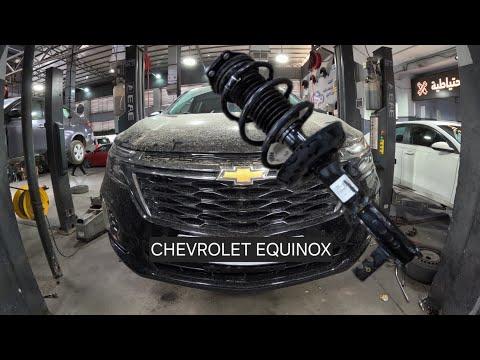






How to Replace Front Struts on a 2020 Chevrolet Equinox
Step-by-step DIY strut replacement with tools, parts list, torque specs, safety tips, and cost savings
How to Replace Front Struts on a 2020 Chevrolet Equinox
Step-by-step DIY strut replacement with tools, parts list, torque specs, safety tips, and cost savings


🔧 Equinox - Strut Replacement Overview
On your Equinox, the front suspension uses MacPherson struts (big shock + spring assemblies), and the rear uses separate shocks and springs. Replacing worn front struts restores ride comfort, reduces clunks, and improves braking and handling.
Difficulty Level: Advanced | Estimated Time: 3–4 hours (both fronts)
⚠️ Safety & Precautions
- ⚠️ Coil springs store a lot of energy. Always use a proper coil spring compressor; never loosen the top nut with the spring uncompressed.
- ⚠️ Support the vehicle only with jack stands, never with just a jack.
- ⚠️ Wheel alignment is required after strut replacement to prevent tire wear and pulling.
- ⚠️ Keep hands clear of the spring when compressing or releasing.
- ⚠️ Turn ignition off and remove the key when working near the steering knuckle and ABS wiring.
- Battery disconnect is not required for this job.
🔧 Required Tools
You'll need the following tools for this repair:
- 🧰 Floor jack (rated 3-ton minimum)
- 🧰 Jack stands (rated 3-ton minimum) - Qty: 2
- 🧰 Wheel chocks
- 🧰 Lug wrench 19mm
- 🧰 Socket set 10–21mm
- 🧰 Combination wrench set 10–21mm
- 🧰 Breaker bar 1/2" drive
- 🧰 Torque wrench 1/2" drive (10–200 Nm range)
- 🧰 Torque wrench 3/8" drive (5–80 Nm range)
- 🧰 Coil spring compressor (external clamp type) (specialty)
- 🧰 Pry bar 18–24"
- 🧰 Flathead screwdriver medium
- 🧰 Needle-nose pliers
- 🧰 Rubber mallet
- 🧰 Paint marker or permanent marker
- 🧰 Penetrating oil spray
- 🧰 Wire brush small
- 🧰 Safety glasses
- 🧰 Mechanic gloves
- 🧰 Fender cover or old towel
🔩 Required Parts
HowToo sells all the parts you need for this repair:
- 🔩 Front complete loaded strut assemblies (left and right) - Qty: 2
These include spring, mount, bearing, and boot already assembled. - 🔩 New front strut nuts and bolts - Qty: 1 kit
GM recommends replacing suspension fasteners if specified in kit. - 🔩 Front stabilizer link nuts - Qty: 2 (if not included with links)
- 🔩 Anti-seize compound - Qty: small tube
- 🔩 Rust penetrant / light oil - Qty: 1 can
📋 Before You Begin
- Park the Equinox on level ground, engage the parking brake, and place the transmission in Park.
- Chock the rear wheels so the vehicle cannot roll.
- Loosen the front wheel lug nuts 1/2 turn with the lug wrench before lifting the vehicle.
- If using bare struts (without springs) instead of loaded assemblies, you must safely transfer the springs with a spring compressor—this is more dangerous and time-consuming.
- Plan for a professional 4-wheel alignment immediately after this repair.
🔨 Step-by-Step Instructions
Follow these steps in order:
Step 1: Lift and Support the Front of the Vehicle
- Apply the parking brake and place wheel chocks behind both rear wheels.
- Use the 19mm lug wrench to loosen (do not remove) the front wheel lug nuts about half a turn.
- Position the floor jack under the front center jacking point (crossmember) and raise the front until both wheels are off the ground.
- Place jack stands under the reinforced pinch welds or frame points on each side and slowly lower the vehicle onto them.
- Remove both front wheels using the 19mm lug wrench.
Step 2: Inspect and Prepare the Strut Area
- Turn the steering wheel to expose the back of the strut (engine off, key in ACC if needed, then remove key).
- Use penetrating oil spray on the lower strut-to-knuckle bolts and stabilizer link nut; let it soak a few minutes.
- Clean threads and contact areas with a wire brush where you’ll remove nuts and bolts.
- Soaking bolts early makes removal much easier.
Step 3: Disconnect the Stabilizer (Sway Bar) Link from the Strut
- Locate the stabilizer link where it bolts to the strut body.
- Use the correct size socket (usually 18mm) and ratchet on the nut, and a wrench or Torx/Allen key (size varies) to hold the link stud if it spins.
- Remove the nut and push the link stud out of the strut tab. Use a rubber mallet gently if it’s stuck.
- Set the link aside without twisting or stretching the rubber boots.
Step 4: Disconnect Brake Hose and ABS Wire from Strut
- On the strut body, locate the brackets holding the brake hose and ABS sensor wire.
- Use a flathead screwdriver or needle-nose pliers to gently release plastic clips from the strut.
- If there is a small retaining bolt, use the correct socket (10mm) to remove it.
- Move the hose and wire aside so they are free from the strut but still attached to the vehicle.
- Do not pull hard on any wires or hoses.
Step 5: Loosen the Top Strut Mount Nuts (Do Not Remove)
- Open the hood and locate the three strut mount nuts for each side at the top of the strut tower.
- Use a socket (usually 15–18mm) and ratchet to loosen the three nuts on one side, but leave a few threads engaged so the strut does not fall later.
- Do not remove the large center nut if you are using loaded assemblies.
- Loosening now makes removal easier later.
Step 6: Remove the Lower Strut-to-Knuckle Bolts
- At the bottom of the strut, find the two large bolts that clamp it to the steering knuckle.
- Use a breaker bar with correct socket (typically 21mm) on the bolt head and a wrench (21mm) on the nut.
- Break loose and remove both nuts and bolts. You may need a rubber mallet to tap the bolts out.
- Support the knuckle/hub assembly with a jack or small jack stand so it does not strain the CV axle or brake hose.
Step 7: Separate the Strut from the Knuckle
- Once the bolts are out, the knuckle will still be snug in the strut clamp.
- Use a pry bar gently between the strut and knuckle to open the clamp slightly if needed.
- Carefully push the knuckle down while pulling the strut up and out of the knuckle.
- Move slowly so you do not pull on brake lines.
Step 8: Remove the Strut Assembly from the Vehicle
- Go back under the hood and support the strut from below with one hand.
- Use the correct size socket and ratchet to fully remove the three top mount nuts.
- Lower the strut assembly out through the wheel well and set it on the ground.
- Repeat Steps 3–8 on the other side.
Step 9: Prepare the New Loaded Strut Assembly
- Compare the new loaded strut with the old one on the ground: spring orientation, bracket locations, and top mount studs must match left/right.
- Use a paint marker to mark the orientation of the top mount relative to the lower bracket on both old and new assemblies.
- If using complete loaded assemblies, you do not need a spring compressor—the spring is already safely installed.
- Loaded assemblies are safer and faster for beginners.
Step 10: Install the New Strut into the Body
- Guide the new strut up through the wheel well and insert the top studs into the holes in the strut tower from below.
- From under the hood, start the three new top mount nuts by hand using the correct size socket. Do not fully tighten yet.
- Rotate the strut so the lower bracket lines up with the steering knuckle.
Step 11: Attach the Strut to the Steering Knuckle
- Raise or adjust the knuckle with the floor jack until the lower strut bracket aligns with the knuckle clamp.
- Slide the two lower bolts through the strut and knuckle by hand. You may need to wiggle the assembly slightly.
- Install the nuts by hand, then tighten them snug using a socket (21mm), wrench, and ratchet.
- Use the torque wrench and 21mm socket to torque the lower strut bolts to 140 Nm (103 ft-lbs).
Step 12: Reconnect Stabilizer Link, Brake Hose, and ABS Wire
- Insert the stabilizer link stud into the new strut tab.
- Install the new link nut and tighten with the correct size socket (about 18mm) and wrench. Then torque to 65 Nm (48 ft-lbs).
- Clip the brake hose bracket and ABS wire bracket back into the strut body using your hands or a flathead screwdriver if needed.
- If there was a small retaining bolt for a bracket, torque it with a 10mm socket to 10 Nm (89 in-lbs).
Step 13: Torque the Top Strut Mount Nuts
- Under the hood, use the appropriate size socket and torque wrench to tighten the three top mount nuts.
- Torque each top mount nut to 50 Nm (37 ft-lbs) in a crisscross pattern.
- Repeat Steps 10–13 for the other side.
Step 14: Reinstall Wheels and Lower the Vehicle
- Reinstall the wheels and hand-tighten the lug nuts using the 19mm lug wrench.
- Raise the vehicle slightly with the floor jack, remove the jack stands, and lower the vehicle fully to the ground.
- With the vehicle on the ground, torque the lug nuts with a torque wrench and 19mm socket to 140 Nm (103 ft-lbs) in a star pattern.
Step 15: Final Checks
- Visually check that all brake hoses and ABS wires are properly routed and not twisted or stretched.
- Check that all nuts and bolts you touched are tightened and torqued.
- Clean up tools and remove wheel chocks.
✅ After Repair
- Start the engine and turn the steering wheel lock-to-lock while stationary to ensure there are no clunks or binding.
- Take a short, slow test drive on a smooth road. Listen for new noises and check that the steering wheel is centered.
- Schedule a professional 4-wheel alignment as soon as possible to prevent uneven tire wear and pulling.
- After 50–100 km, recheck lug nut torque with a torque wrench.
💰 DIY vs Shop Cost
Shop Cost: $600–$900 (parts + labor) for both front struts
DIY Cost: $250–$450 (parts only, using loaded struts)
You Save: $350–$450 by doing it yourself!
Shop labor rates vary but typically run $100–$150/hour. This repair takes a shop approximately 2–3 hours.
🎯 Ready to get started?
HowToo makes it easy: same-day/2-day shipping on every part, plus all the tools and specialty tools you need! Check out the parts and tools sections above to add everything to your cart.