









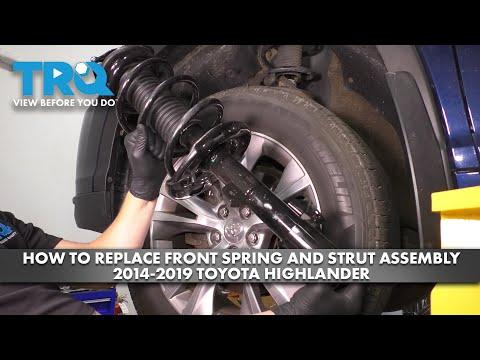







How to Replace Front Struts on a 2019 Toyota Highlander
Step-by-step DIY guide with tools, parts, torque specs, safety tips, and alignment advice for 2014, 2015, 2016, 2017, 2018, 2019
How to Replace Front Struts on a 2019 Toyota Highlander
Step-by-step DIY guide with tools, parts, torque specs, safety tips, and alignment advice for 2014, 2015, 2016, 2017, 2018, 2019


🔧 Highlander - Front Strut Replacement
This repair replaces the front suspension struts on your Highlander. The strut supports vehicle weight, controls bouncing, and keeps the tire planted on the road, so worn struts can cause clunking, uneven tire wear, nose-diving, and poor handling.
Difficulty Level: Advanced | Estimated Time: 3-5 hours
Assumption: This guide covers the front struts; rear suspension on your Highlander uses separate shock absorbers, not front-style strut assemblies.
⚠️ Safety & Precautions
- ⚠️ Replace front struts in pairs so the suspension stays balanced.
- ⚠️ Use a complete loaded strut assembly if possible. A loaded strut includes the spring, strut, mount, and bearing already assembled.
- ⚠️ Do not remove the center strut shaft nut unless the coil spring is properly compressed with a spring compressor. The spring is under very high force.
- ⚠️ Always support your Highlander with jack stands. Never work under a vehicle held only by a floor jack.
- ⚠️ Keep the front wheel speed sensor wire and brake hose from stretching or twisting.
- ⚠️ An alignment is required after strut replacement because the front suspension geometry is disturbed.
- ⚠️ Battery disconnect is not normally required for this repair.
🔧 Required Tools
You'll need the following tools for this repair:
- Floor jack rated 3-ton minimum
- Jack stands rated 3-ton minimum
- Wheel chocks
- 21mm lug nut socket
- 1/2-inch drive breaker bar
- 1/2-inch drive ratchet
- 3/8-inch drive ratchet
- 10mm socket
- 12mm socket
- 14mm socket
- 17mm socket
- 19mm socket
- 22mm socket
- 22mm wrench
- 6mm Allen key socket
- Torque wrench rated 10-150 ft-lbs
- Torque wrench rated 50-250 ft-lbs
- Trim clip removal tool
- Paint marker
- Pry bar 18-inch
- Rubber mallet
- Needle-nose pliers
- Penetrating oil
- Spring compressor set (specialty)
- Safety glasses
- Mechanic gloves
🔩 Required Parts
HowToo sells all the parts you need for this repair:
- Front complete loaded strut assembly - Left: 1, Right: 1
- Front stabilizer bar link nuts - Qty: 2
- Front strut-to-knuckle bolts and nuts - Qty: 4
- Front strut upper mount nuts - Qty: 6
- Replacement cowl clips - Qty: As needed
📋 Before You Begin
- 🚗 Park your Highlander on a flat, solid surface.
- 🅿️ Shift to Park and set the parking brake.
- 🧱 Place wheel chocks behind the rear wheels.
- 🔧 Loosen the front lug nuts slightly before lifting the vehicle.
- 🧭 Mark the position of the strut bolts before removal. This helps keep the alignment close enough to drive carefully to an alignment shop.
- 💡 A spring compressor squeezes the coil spring so it cannot expand while the strut mount is removed.
- ✅ For a beginner, complete loaded strut assemblies are strongly recommended because they avoid spring disassembly.
🔨 Step-by-Step Instructions
Follow these steps in order:
Step 1: Loosen the Front Wheel Lug Nuts
- Use the 21mm lug nut socket and 1/2-inch drive breaker bar to loosen each front lug nut about 1/2 turn.
- Do not remove the lug nuts yet.
- Loosen before lifting for stability.
Step 2: Lift and Support Your Highlander
- Use the floor jack rated 3-ton minimum at the front center jacking point.
- Place jack stands rated 3-ton minimum under the front side support points.
- Lower the vehicle gently onto the jack stands.
- Use the floor jack rated 3-ton minimum to lightly support the lower control arm on the side you are working on.
Step 3: Remove the Front Wheel
- Use the 21mm lug nut socket and 1/2-inch drive ratchet to remove the lug nuts.
- Remove the wheel and place it flat under the vehicle as an extra safety backup.
Step 4: Remove the Wiper Arms and Cowl Panel
- Use a paint marker to mark each wiper arm position on the windshield.
- Use a 14mm socket and 3/8-inch drive ratchet to remove the wiper arm nuts.
- Lift the wiper arms off the pivots. Wiggle gently if they are stuck.
- Use the trim clip removal tool to remove the plastic cowl clips.
- Remove the cowl panel to access the upper strut mount nuts.
- Take photos before removing panels.
Step 5: Remove Brake Hose and Sensor Wire Brackets
- Use a 12mm socket and 3/8-inch drive ratchet to remove the brake hose bracket bolt from the strut.
- Use a 10mm socket and 3/8-inch drive ratchet to remove the wheel speed sensor wire bracket from the strut.
- Move the hose and wire aside carefully. Do not pull on them.
Step 6: Disconnect the Stabilizer Bar Link
- The stabilizer bar link connects the strut to the sway bar and helps reduce body roll in turns.
- Spray the stabilizer link nut with penetrating oil.
- Use a 17mm socket and 3/8-inch drive ratchet to remove the nut from the strut bracket.
- If the stud spins, hold the center with a 6mm Allen key socket while turning the nut with a 17mm wrench.
Step 7: Mark the Strut-to-Knuckle Position
- The steering knuckle is the metal part that holds the wheel hub and connects to the strut.
- Use a paint marker to trace around the lower strut bracket where it meets the steering knuckle.
- This mark helps you install the new strut close to the original position before alignment.
Step 8: Remove the Lower Strut Bolts
- Use the floor jack rated 3-ton minimum to lightly support the steering knuckle and lower control arm.
- Use a 22mm socket, 22mm wrench, and 1/2-inch drive breaker bar to loosen the two lower strut-to-knuckle nuts and bolts.
- Remove the nuts, then tap the bolts out using a rubber mallet.
- If needed, use a pry bar 18-inch to gently separate the strut bracket from the knuckle.
- Do not let the knuckle fall outward because it can pull on the axle, brake hose, or sensor wire.
Step 9: Remove the Upper Strut Mount Nuts
- Support the strut with one hand from the wheel well.
- Use a 14mm socket and 3/8-inch drive ratchet to remove the three upper strut mount nuts.
- Do not remove the center shaft nut.
- Lower the strut assembly out through the wheel well.
Step 10: Transfer Parts Only If Needed
- If using a complete loaded strut assembly, no spring transfer is needed.
- If using a bare strut cartridge, use the spring compressor set (specialty) to compress the coil spring evenly before removing the center nut.
- For a first-time DIYer, do not disassemble the spring unless you are trained and have a high-quality compressor.
Step 11: Install the New Strut Assembly
- Guide the new strut into place through the wheel well.
- Install the three upper mount nuts by hand first.
- Use a 14mm socket and torque wrench rated 10-150 ft-lbs to tighten the upper mount nuts to Torque to 80 Nm (59 ft-lbs).
Step 12: Reconnect the Strut to the Steering Knuckle
- Align the lower strut bracket with the steering knuckle using the floor jack rated 3-ton minimum to raise or lower the knuckle slightly.
- Install the two lower strut bolts and nuts by hand.
- Use the 22mm socket, 22mm wrench, and torque wrench rated 50-250 ft-lbs to tighten the strut-to-knuckle nuts to Torque to 240 Nm (177 ft-lbs).
Step 13: Reconnect the Stabilizer Bar Link
- Insert the stabilizer bar link stud into the strut bracket.
- Install a new link nut by hand.
- Use a 17mm socket and torque wrench rated 10-150 ft-lbs to tighten the nut to Torque to 74 Nm (55 ft-lbs).
- If the stud spins, hold it with the 6mm Allen key socket while tightening with a 17mm wrench.
Step 14: Reinstall Brake Hose and Sensor Wire Brackets
- Use the 12mm socket and torque wrench rated 10-150 ft-lbs to tighten the brake hose bracket bolt to Torque to 29 Nm (21 ft-lbs).
- Use the 10mm socket and torque wrench rated 10-150 ft-lbs to tighten the wheel speed sensor bracket bolt to Torque to 8 Nm (71 in-lbs).
- Make sure the hose and wire are routed exactly like before.
Step 15: Repeat on the Other Side
- Use the same tools and steps to replace the opposite front strut.
- Always replace both front struts together.
Step 16: Reinstall the Cowl Panel and Wiper Arms
- Use the trim clip removal tool and needle-nose pliers to reinstall or replace cowl clips as needed.
- Set the wiper arms back on the marks you made earlier.
- Use the 14mm socket and torque wrench rated 10-150 ft-lbs to tighten the wiper arm nuts to Torque to 26 Nm (19 ft-lbs).
Step 17: Reinstall the Wheels
- Place each wheel back onto the hub.
- Thread the lug nuts by hand first to avoid cross-threading.
- Use the 21mm lug nut socket and 1/2-inch drive ratchet to snug the lug nuts in a star pattern.
Step 18: Lower and Torque the Wheels
- Use the floor jack rated 3-ton minimum to raise your Highlander slightly and remove the jack stands rated 3-ton minimum.
- Lower the vehicle until the tires touch the ground.
- Use the 21mm lug nut socket and torque wrench rated 50-250 ft-lbs to tighten the lug nuts in a star pattern to Torque to 103 Nm (76 ft-lbs).
✅ After Repair
- ✅ Bounce each front corner by hand. The body should settle quickly without repeated bouncing.
- ✅ Turn the steering wheel lock-to-lock while parked and listen for rubbing, popping, or wire/hose contact.
- ✅ Test drive slowly first. Listen for clunks and verify the steering wheel returns smoothly.
- ✅ Recheck lug nut torque after the first short drive using the 21mm lug nut socket and torque wrench.
- ✅ Schedule a four-wheel alignment immediately. Your Highlander AWD needs proper alignment to protect tires and handling.
- ✅ If ABS, traction control, or steering warning lights appear, inspect the front wheel speed sensor wire routing before driving further.
💰 DIY vs Shop Cost
Shop Cost: $850-$1,400 (parts + labor + alignment)
DIY Cost: $350-$750 (parts only, alignment not included)
You Save: $400-$650 by doing it yourself!
Shop labor rates vary but typically run $100-$150/hour. This repair takes a shop approximately 2.5-4.0 hours.
🎯 Ready to get started?
HowToo makes it easy: same-day/2-day shipping on every part, plus all the tools and specialty tools you need! Check out the parts and tools sections below to add everything to your cart.