









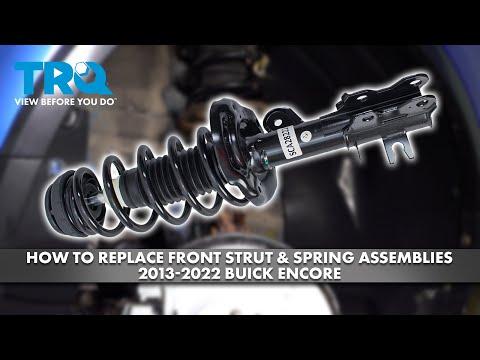







How to Replace Front Struts on a 2016 Buick Encore (MacPherson Strut Guide)
Step-by-step instructions with required tools, parts list, safety tips, and torque specs plus alignment notes for 2013, 2014, 2015, 2016, 2017, 2018, 2019, 2020, 2021, 2022
How to Replace Front Struts on a 2016 Buick Encore (MacPherson Strut Guide)
Step-by-step instructions with required tools, parts list, safety tips, and torque specs plus alignment notes for 2013, 2014, 2015, 2016, 2017, 2018, 2019, 2020, 2021, 2022


🔧 Encore - Front Strut Replacement
On your Encore, the front suspension uses MacPherson struts (a shock + spring in one assembly). Replacing worn struts restores ride control, braking stability, and reduces clunks or bouncing.
Difficulty Level: Advanced | Estimated Time: 3-6 hours
Assumption: You’re replacing the front struts; rear uses shocks + separate springs.
⚠️ Safety & Precautions
- ⚠️ The coil spring is under high tension; a slip can cause serious injury.
- ⚠️ If you are not using a pre-assembled “quick strut,” you must use a proper spring compressor (never use straps).
- ⚠️ Support the vehicle with jack stands; never rely on a floor jack alone.
- ⚠️ Do not let the steering knuckle hang by the brake hose/ABS wire; support it.
- ⚠️ An alignment is required after strut replacement to prevent tire wear and pulling.
- Battery disconnect is not required for this job.
🔧 Required Tools
You'll need the following tools for this repair:
- Floor jack (rated 3-ton minimum)
- Jack stands (rated 3-ton minimum)
- Wheel chocks
- Safety glasses
- Mechanic gloves
- Breaker bar (1/2")
- Torque wrench (30–200 ft-lbs range)
- Socket set (8mm–21mm)
- Wrench set (8mm–21mm)
- Torx bit set
- Pry bar
- Needle-nose pliers
- Paint marker
- Penetrating oil
- Spring compressor (specialty)
- Strut spreader tool (specialty)
🔩 Required Parts
HowToo sells all the parts you need for this repair:
- Front strut assemblies - Replace in pairs - Qty: 2
- Front strut mount/bearing set - If not included with struts - Qty: 2
- Front bump stops and dust boots - If not included - Qty: 2
- Front sway bar end links - Optional if worn/clunking - Qty: 2
- Strut-to-knuckle bolts and nuts - Recommended if specified as one-time-use - Qty: 4
📋 Before You Begin
- Park on level ground, set the parking brake, and chock the rear wheels.
- Loosen the front wheel lug nuts slightly using a breaker bar before lifting.
- Spray penetrating oil on the strut-to-knuckle bolts and sway bar end link nuts.
- If you’re not using “quick struts”: a spring compressor is a tool that safely compresses the coil spring so the top nut can be removed.
🔨 Step-by-Step Instructions
Follow these steps in order:
Step 1: Lift and remove the front wheels
- Use a floor jack to lift the front of the vehicle at the front jacking point.
- Place jack stands under the proper support points and lower the vehicle onto them.
- Remove lug nuts with a 19mm socket and remove both front wheels.
Step 2: Disconnect brackets and the sway bar end link
- Locate the brake hose/ABS wire brackets attached to the strut body.
- Remove bracket bolts using a 10mm socket (sizes may vary slightly by build).
- Remove the sway bar end link nut from the strut using an 18mm socket and a Torx bit to hold the stud if it spins.
- Tip: Hold the link stud steady to avoid rounding.
Step 3: Mark alignment position (helps get to the alignment shop)
- Use a paint marker to mark the strut-to-knuckle relationship (outline the bolt head/washer area).
- This does not replace a professional alignment, but helps keep it close.
Step 4: Remove the strut-to-knuckle bolts
- Support the steering knuckle with the floor jack lightly so it doesn’t drop.
- Remove the 2 large bolts/nuts connecting the strut to the knuckle using a breaker bar with 18mm–21mm sockets.
- If the knuckle clamps tightly to the strut, use a strut spreader tool (specialty) to slightly open the clamp. (This tool gently spreads the knuckle clamp so the strut can slide out.)
- Carefully separate the knuckle from the strut. Use a pry bar only as needed.
Step 5: Remove the strut from the strut tower
- Open the hood.
- Locate the strut mount nuts at the top of the strut tower.
- While holding the strut from below, remove the mount nuts using a 13mm socket.
- Lower and remove the strut assembly from the wheel well.
Step 6: Swap springs (skip if using “quick struts”)
- Install the spring compressor (specialty) on opposite sides of the spring.
- Evenly compress the spring using a ratchet until it no longer pushes on the top mount.
- Remove the center top nut using the correct socket and a Torx bit (or pass-through strut socket set if required).
- Move the spring, isolators, dust boot, bump stop, and mount to the new strut in the same order.
- Install the top nut, then slowly release the spring compressors evenly.
- Tip: Match spring end to the pocket stop.
Step 7: Install the new strut assembly
- Position the strut into the strut tower and hand-start the top mount nuts using a 13mm socket.
- Guide the knuckle onto the strut and install the lower bolts/nuts by hand first.
- Tighten the strut-to-knuckle bolts using a torque wrench to Torque to 155 Nm (114 ft-lbs).
- Tighten the top mount nuts using a torque wrench to Torque to 25 Nm (18 ft-lbs).
- Tip: Tighten evenly so the mount seats flat.
Step 8: Reconnect the sway bar end link and brackets
- Install the sway bar end link nut using an 18mm socket and hold the stud with the correct Torx bit if needed.
- Tighten the end link nut to Torque to 65 Nm (48 ft-lbs).
- Reinstall brake hose/ABS brackets using a 10mm socket and snug them securely.
Step 9: Reinstall wheels and lower the vehicle
- Reinstall wheels and hand-start lug nuts using a 19mm socket.
- Lower the vehicle off the jack stands using the floor jack.
- Torque lug nuts in a star pattern using a torque wrench to Torque to 140 Nm (103 ft-lbs).
Note on torque specs: If your replacement hardware or service info specifies different values (or torque-to-yield bolts), follow that guidance.
✅ After Repair
- Road-test at low speed first. Listen for clunks and verify steering feels normal.
- Recheck that the brake hose and ABS wire are not stretched or rubbing.
- Get a 4-wheel alignment as soon as possible (same day is best).
- After 50–100 miles, recheck lug nut torque using a torque wrench.
💰 DIY vs Shop Cost
Shop Cost: $900-$1,600 (parts + labor + alignment)
DIY Cost: $300-$900 (parts only; more if buying specialty tools)
You Save: $600-$700 by doing it yourself!
Shop labor rates vary but typically run $100-$150/hour. This repair takes a shop approximately 3-5 hours.
🎯 Ready to get started?
HowToo makes it easy: same-day/2-day shipping on every part, plus all the tools and specialty tools you need! Check out the parts and tools sections below to add everything to your cart.