









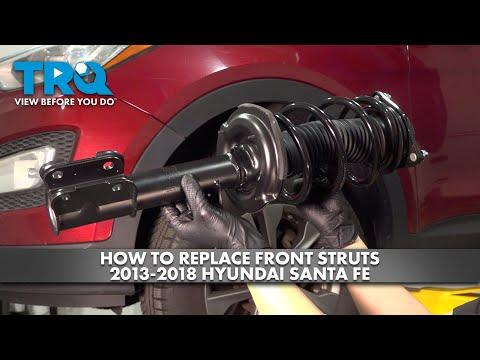







How to Replace Front Struts on a 2016-2018 Hyundai Santa Fe (MacPherson Strut Guide) (Trim: Limited)
Step-by-step DIY instructions with required tools/parts, safety tips, torque specs, and alignment notes
How to Replace Front Struts on a 2016-2018 Hyundai Santa Fe (MacPherson Strut Guide) (Trim: Limited)
Step-by-step DIY instructions with required tools/parts, safety tips, torque specs, and alignment notes for 2016, 2017, 2018


🔧 Santa Fe - Strut Replacement
On your Santa Fe, the front suspension uses MacPherson struts (a shock + coil spring in one unit). Replacing worn struts restores ride control, braking stability, and reduces clunks/bouncing.
Assumption: You’re replacing the front struts; rear uses separate shocks (procedure included below in case you meant rear).
Difficulty Level: Advanced | Estimated Time: 4-7 hours
⚠️ Safety & Precautions
- ⚠️ Coil springs store huge energy—use a coil spring compressor (specialty) correctly or choose complete strut assemblies to avoid spring transfer.
- ⚠️ Support the vehicle with jack stands on solid ground—never rely on a jack.
- ⚠️ Keep the steering knuckle supported so you don’t over-stretch the CV axle (front drive axle) or damage the ABS wire (wheel speed sensor wiring).
- ⚠️ If your Santa Fe has HID/LED leveling or ride-height sensor links, don’t pry on them.
- ⚠️ Battery disconnect is not required, but keep the key away from the vehicle so the steering doesn’t move unexpectedly.
🔧 Required Tools
You'll need the following tools for this repair:
- Floor jack (rated 3-ton minimum)
- Jack stands (rated 3-ton minimum)
- Wheel chocks
- Safety glasses
- Mechanic gloves
- Breaker bar 1/2"
- Torque wrench 1/2" (20–200 ft-lbs)
- Torque wrench 3/8" (10–80 ft-lbs)
- Socket set 3/8" + 1/2"
- Wrench set (metric)
- 17mm socket
- 19mm socket
- 21mm socket
- 22mm socket
- 14mm socket
- 12mm socket
- 6mm Allen key
- Pry bar
- Needle-nose pliers
- Trim clip tool
- Hammer
- Punch set
- Penetrating oil
- Paint marker
- Coil spring compressor (specialty)
- Strut nut pass-through socket set (specialty)
🔩 Required Parts
HowToo sells all the parts you need for this repair:
- Front complete strut assemblies (quick struts) - Replace in pairs - Qty: 2
- Front strut mounting nuts - Qty: 6
- Front strut-to-knuckle bolts and nuts - Replace in pairs - Qty: 4
- Front sway bar end links - Optional if worn - Qty: 2
- Rear shock absorbers - If doing rear - Replace in pairs - Qty: 2
- Rear upper shock mount hardware - If doing rear - Qty: 2
📋 Before You Begin
- Park on level ground, straighten the steering wheel, and chock the rear wheels.
- Loosen the front lug nuts with a 21mm socket before lifting.
- Spray penetrating oil on the strut-to-knuckle bolts and sway bar end link nuts.
- If you are not using complete strut assemblies: set up the coil spring compressor (a clamp tool that safely squeezes the spring) on a bench—not on the car.
🔨 Step-by-Step Instructions
Follow these steps in order:
Step 1: Lift and secure the front of the Santa Fe
- Use a floor jack (rated 3-ton minimum) to lift at the front center jacking point.
- Place jack stands (rated 3-ton minimum) under the front pinch welds or subframe points.
- Remove the wheels using a 21mm socket.
Step 2: Unclip ABS wire and brake hose brackets from the strut
- Use a trim clip tool and needle-nose pliers to remove clips and free the ABS wire from the strut.
- Remove any small bracket bolts using a 12mm socket.
- Don’t pull on the wire—unclip it.
Step 3: Disconnect the sway bar end link from the strut
- Hold the end link stud with a 6mm Allen key (if equipped) and remove the nut with a 17mm socket or wrench set (metric).
- If the nut is stuck, re-spray penetrating oil and use a breaker bar 1/2".
Step 4: Mark camber position (if your Santa Fe uses camber bolts)
- Use a paint marker to mark the relationship between the strut and the steering knuckle.
- This helps keep alignment close enough to drive to the shop.
Step 5: Remove strut-to-knuckle bolts
- Support the lower control arm/knuckle with a floor jack (rated 3-ton minimum) so it doesn’t drop.
- Remove the two large bolts/nuts using a 21mm socket and 22mm socket with a breaker bar 1/2".
- If the bolts are stuck, use a hammer and punch set to drive them out carefully.
- Torque to factory specification on reassembly (these are high-torque fasteners).
Step 6: Remove the strut top mount nuts
- Open the hood and locate the strut tower.
- Remove the three top mount nuts using a 14mm socket.
- Leave the center strut nut alone unless you are swapping springs.
Step 7: Remove the strut assembly
- Pull the strut outward and down from the knuckle area.
- Use a pry bar only as needed, and keep the knuckle supported so the CV axle doesn’t over-extend.
Step 8: If using complete strut assemblies (recommended), install the new strut
- Guide the new strut into the strut tower and start the three top nuts by hand using a 14mm socket (do not fully tighten yet).
- Align the strut with the knuckle and insert the two large bolts. Use a hammer lightly if needed.
- Tighten the strut-to-knuckle nuts using a torque wrench 1/2": Torque to factory specification.
- Tighten the top mount nuts using a torque wrench 3/8": Torque to factory specification.
Step 9: If transferring springs (only if you are NOT using complete assemblies)
- Install the coil spring compressor (specialty) on opposite sides of the spring and compress evenly until the spring is loose in the seat.
- Remove the center strut nut using a strut nut pass-through socket set (specialty) while holding the shaft with the appropriate bit.
- Move the spring, upper mount, bearing, dust boot, and bump stop to the new strut in the same order.
- Install the center nut and Torque to factory specification, then slowly release the spring compressors evenly.
- If anything binds, stop and reset the compressors.
Step 10: Reconnect sway bar end link, ABS wire, and brake hose bracket
- Reconnect the sway bar end link nut using a 17mm socket and hold the stud with a 6mm Allen key if needed.
- Torque to factory specification.
- Reinstall all brackets using a 12mm socket and re-clip wiring with needle-nose pliers.
Step 11: Reinstall wheels and lower the vehicle
- Install wheels and hand-tighten lug nuts using a 21mm socket.
- Lower the vehicle using a floor jack (rated 3-ton minimum).
- Tighten lug nuts in a star pattern using a torque wrench 1/2": Torque to 132 Nm (97 ft-lbs).
Step 12: Rear note (if you meant “rear struts”)
- Your Santa Fe typically uses rear shocks (not struts). Replacement is similar but easier: support the rear suspension with a floor jack, remove lower shock bolt with a 17mm socket/19mm socket, then remove upper mount nuts/bolt(s) with a 14mm socket.
- Torque to factory specification for upper and lower shock fasteners.
✅ After Repair
- Double-check that ABS wires and brake hoses are clipped and not twisted.
- Road test at low speed first. Listen for clunks over bumps.
- Get a 4-wheel alignment as soon as possible (front strut removal can change camber/toe).
- Recheck lug nut torque with a torque wrench 1/2" after 25–50 miles.
💰 DIY vs Shop Cost
Shop Cost: ₹35,000-₹80,000 (parts + labor, varies by brand and alignment)
DIY Cost: ₹18,000-₹55,000 (parts only)
You Save: ₹17,000-₹25,000 by doing it yourself!
Shop labor rates vary but typically run $100-$150/hour. This repair takes a shop approximately 4-6 hours.
🎯 Ready to get started?
HowToo makes it easy: same-day/2-day shipping on every part, plus all the tools and specialty tools you need! Check out the parts and tools sections below to add everything to your cart.