









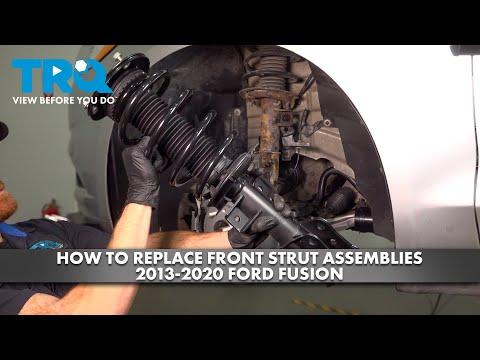







How to Replace Front Struts and Rear Shocks on a 2014 Ford Fusion (DIY Guide)
Step-by-step instructions with required tools/parts, safety tips, key torque specs, and alignment notes
How to Replace Front Struts and Rear Shocks on a 2014 Ford Fusion (DIY Guide)
Step-by-step instructions with required tools/parts, safety tips, key torque specs, and alignment notes


🔧 Fusion - Strut Replacement
On your Fusion, the front suspension uses MacPherson struts (a strut is a shock + coil spring assembly that also supports the steering knuckle). The rear uses shocks (not struts), but people often say “struts” for both—so below covers front struts and rear shocks.
Difficulty Level: Advanced | Estimated Time: 4-7 hours (all corners)
Assumption: replacing both front struts and both rear shocks.
⚠️ Safety & Precautions
- ⚠️ Support the car with jack stands on solid points; never rely on a jack.
- ⚠️ Your Fusion is a plug-in hybrid: do not touch or probe orange high-voltage cables or connectors.
- ⚠️ Use a coil spring compressor correctly; a compressed spring stores extreme energy.
- ⚠️ Keep the steering knuckle supported so you don’t over-stretch the axle or brake hose.
- ⚠️ Plan on a professional alignment after front strut replacement.
🔧 Required Tools
You'll need the following tools for this repair:
- Floor jack (rated 3-ton minimum)
- Jack stands (rated 3-ton minimum)
- Wheel chocks
- Safety glasses
- Mechanic gloves
- Lug nut socket 19mm
- Ratchet 3/8"
- Ratchet 1/2"
- Socket set 10mm-24mm
- Wrench set 10mm-24mm
- Breaker bar 1/2"
- Torque wrench 10-200 ft-lbs
- Torx bit set
- Pry bar 18"
- Needle-nose pliers
- Paint marker
- Penetrating oil
- Coil spring compressor (specialty)
- Strut nut pass-through socket set (specialty)
- Trim removal tool
🔩 Required Parts
HowToo sells all the parts you need for this repair:
- Front strut assemblies - Replace in pairs - Qty: 2
- Front strut mounts with bearing - Replace in pairs - Qty: 2
- Front strut dust boots & bump stops - Qty: 2
- Front sway bar end links - Replace in pairs - Qty: 2
- Front strut-to-knuckle bolts and nuts - Replace in pairs - Qty: 4
- Rear shock absorbers - Replace in pairs - Qty: 2
- Rear shock upper mounts - Replace in pairs - Qty: 2
📋 Before You Begin
- Park on level ground, set the parking brake, and chock the rear wheels (for front work).
- Loosen wheel lug nuts 1/2 turn using a 19mm socket before lifting.
- Spray penetrating oil on the front strut-to-knuckle bolts and sway bar end link nuts.
- If you’re reusing springs: inspect for cracks and heavy rust before compressing.
🔨 Step-by-Step Instructions
Follow these steps in order:
Step 1: Lift and remove the front wheels
- Use a floor jack to lift the front and place jack stands under proper support points.
- Remove both front wheels using a 19mm socket.
Step 2: Detach brackets from the front strut
- Remove the brake hose/ABS wire brackets from the strut using the appropriate socket or Torx bit.
- Tip: Don’t let wiring hang by tension.
Step 3: Disconnect the front sway bar end link from the strut
- Hold the stud with the correct Torx bit (if equipped) and remove the nut using a wrench.
- If the nut spins, use a breaker bar carefully while holding the stud.
Step 4: Mark the strut-to-knuckle position (for reference only)
- Use a paint marker to mark the knuckle/strut relationship.
- Tip: Alignment is still required afterward.
Step 5: Separate the strut from the steering knuckle
- Support the knuckle with a floor jack under the lower control arm area.
- Remove the strut-to-knuckle bolts/nuts using a breaker bar and correct-size sockets.
- Use a pry bar to gently work the knuckle away from the strut.
- Torque to OEM specification (these fasteners are critical; many are one-time-use).
Step 6: Remove the strut assembly from the car
- Under the hood, remove the upper strut mount nuts using the correct-size socket.
- Hold the strut so it doesn’t drop, then pull the complete strut out of the wheel well.
- Torque to OEM specification for the upper mount nuts during reassembly.
Step 7: Transfer the spring (only if you are NOT using quick-struts)
- Install a coil spring compressor (specialty) on opposite sides of the spring. (A spring compressor squeezes the spring shorter so the top nut can be removed safely.)
- Evenly tighten both sides with a ratchet until the spring is loose in the perch.
- Remove the center strut shaft nut using a strut nut pass-through socket set (specialty).
- Transfer the spring, dust boot, bump stop, and mount/bearing to the new strut in the same order.
- Install the new shaft nut and torque to OEM specification, then slowly release the spring compressor.
Step 8: Install the front strut assembly
- Position the strut into the strut tower and start the upper mount nuts by hand using a socket.
- Guide the knuckle onto the strut and install the strut-to-knuckle bolts/nuts using the correct sockets.
- Reconnect the sway bar end link using a wrench and Torx bit as needed.
- Reinstall brake hose/ABS brackets using the correct socket or Torx bit.
- Torque to OEM specification for all fasteners removed.
Step 9: Repeat on the other front side
- Repeat Steps 2–8 for the other front strut.
Step 10: Rear shock replacement (rear wheels off)
- Chock the front wheels, lift the rear with a floor jack, and support with jack stands.
- Remove rear wheels using a 19mm socket.
- Support the rear suspension arm with a floor jack so it doesn’t drop.
- Remove the lower shock bolt using the correct-size socket and breaker bar, then torque to OEM specification during reassembly.
- Access the upper shock mount from inside the trunk (pull back trim) using a trim removal tool.
- Remove the upper mount nuts using the correct-size socket, remove the shock, and install the new shock/mount.
- Torque to OEM specification for the upper mount nuts and lower bolt.
Step 11: Reinstall wheels and lower the car
- Reinstall wheels and snug lug nuts using a 19mm socket.
- Lower the car and final-tighten lug nuts in a star pattern using a torque wrench: Torque to 135 Nm (100 ft-lbs).
✅ After Repair
- Start the car and turn the steering wheel lock-to-lock to confirm nothing binds or rubs.
- Test drive slowly. Listen for clunks over small bumps (often a loose end link or mount nut).
- Get a 4-wheel alignment as soon as possible after front struts.
- Recheck lug nut torque using a torque wrench after 25–50 miles.
💰 DIY vs Shop Cost
Shop Cost: $900-$1,900 (parts + labor)
DIY Cost: $350-$1,050 (parts only)
You Save: $550-$850 by doing it yourself!
Shop labor rates vary but typically run $100-$150/hour. This repair takes a shop approximately 4-7 hours.
🎯 Ready to get started?
HowToo makes it easy: same-day/2-day shipping on every part, plus all the tools and specialty tools you need! Check out the parts and tools sections below to add everything to your cart.