









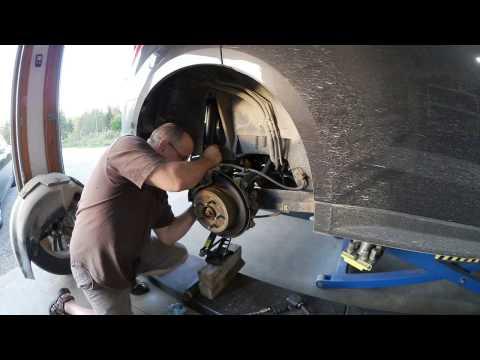






How to Replace Front Struts and Rear Shocks on a 2010-2017 Chevy Equinox
Step-by-step DIY suspension guide with tools, parts list, torque specs, safety tips, and cost comparison
How to Replace Front Struts and Rear Shocks on a 2010-2017 Chevy Equinox
Step-by-step DIY suspension guide with tools, parts list, torque specs, safety tips, and cost comparison for 2010, 2011, 2012, 2013, 2014, 2015, 2016, 2017


🔧 Equinox - Shock Absorber Replacement
You can replace the shocks at home with basic tools, but you must work safely because the suspension supports the vehicle’s weight. On your Equinox, the rear uses simple shock absorbers and the front uses complete struts (shock + spring together).
Difficulty Level: Intermediate | Estimated Time: 2–3 hours for all rear shocks, 3–4 hours for both front struts
⚠️ Safety & Precautions
- ⚠️ Always support the Equinox with jack stands; never rely on the floor jack alone.
- ⚠️ Loosen wheel lug nuts only when the vehicle is still on the ground; remove them after it is on stands.
- ⚠️ Suspension parts are heavy; support the control arm or axle with a jack to prevent sudden drop.
- ⚠️ Wear safety glasses and mechanic gloves to protect from dirt and pinched fingers.
- ⚠️ Do not put any part of your body under the Equinox unless it is solidly on jack stands on level ground.
- ⚠️ For front struts, you do not need to compress springs if you install complete loaded strut assemblies (recommended for beginners).
🔧 Required Tools
You'll need the following tools for this repair:
- 🛠️ Floor jack (rated 3-ton minimum)
- 🛠️ Jack stands (rated 3-ton, Qty: 2–4)
- 🛠️ Wheel chocks
- 🛠️ Lug wrench 19mm
- 🛠️ Socket set metric 10–21mm
- 🛠️ Ratchet 3/8"
- 🛠️ Breaker bar 1/2"
- 🛠️ Torque wrench 10–150 ft-lbs
- 🛠️ Combination wrenches metric 13–21mm
- 🛠️ Allen key set metric
- 🛠️ Pry bar 18–24"
- 🛠️ Flathead screwdriver medium
- 🛠️ Needle nose pliers
- 🛠️ Hammer small
- 🛠️ Penetrating oil spray
- 🛠️ Wire brush small
- 🛠️ Paint marker or white correction pen
- 🛠️ Spring compressor (external type) (specialty) — only if reusing front springs
- 🛠️ Mechanic gloves
- 🛠️ Safety glasses
- 🛠️ Shop rags
🔩 Required Parts
HowToo sells all the parts you need for this repair:
- 🔩 Front loaded strut assembly (left) - Qty: 1
- 🔩 Front loaded strut assembly (right) - Qty: 1
- 🔩 Rear shock absorber (left) - Qty: 1
- 🔩 Rear shock absorber (right) - Qty: 1
- 🔩 New front strut mounting nuts and bolts - Qty: 1 set
- 🔩 New rear shock mounting bolts (upper and lower) - Qty: 1 set
- 🔩 Anti-seize compound - Qty: 1 small tube
- 🔩 Rust penetrant spray - Qty: 1 can
📋 Before You Begin
- 📝 Park the Equinox on a level, solid surface, set the parking brake, and place wheel chocks at the wheels that stay on the ground.
- 📝 Loosen (do not remove) the wheel lug nuts with the 19mm lug wrench before jacking the vehicle.
- 📝 Plan to replace shocks and struts in pairs: both fronts together, both rears together for best ride and safety.
- 📝 You do not need to disconnect the battery for this job.
- 📝 Have all parts and tools laid out so you are not searching mid-job.
🔨 Step-by-Step Instructions
Follow these steps in order:
Step 1: Lift and Support the Equinox
- Use the floor jack on the front center jacking point (under the subframe crossmember) to lift the front if you are doing front struts, or the rear center jacking point (rear subframe) for rear shocks.
- Place jack stands under the reinforced pinch welds or frame points on both sides; lower the vehicle gently onto the stands using the floor jack.
- Remove the lug nuts completely with the 19mm lug wrench and take off the wheels.
- Give the car a light shake to confirm it is stable.
Step 2: Rear Shock – Access and Support Suspension
- If you are doing the rear shocks, position the floor jack under the rear lower control arm or the lower part of the trailing arm near the shock to slightly support the suspension.
- Spray the upper and lower shock bolts with penetrating oil spray and let it soak for a few minutes.
Step 3: Rear Shock – Remove Lower Bolt
- Use a 18mm socket and ratchet (or breaker bar if tight) to remove the lower shock bolt at the control arm. Hold the nut on the opposite side with an 18mm combination wrench if present.
- Once the bolt is out, the shock bottom may swing; the suspension is supported by the jack, so it should not drop far.
Step 4: Rear Shock – Remove Upper Bolt
- Use a 15mm socket and ratchet to remove the upper shock mounting bolt at the body.
- Pull the shock absorber down and out of the wheel well by hand; use the pry bar gently if rusted tight.
Step 5: Rear Shock – Install New Shock
- Compare the new shock to the old one to confirm length and mounting points match.
- Lightly coat the new bolts with anti-seize compound using a shop rag.
- Position the new shock in place and start the upper bolt by hand. Use the 15mm socket and ratchet to snug it, but do not fully tighten yet.
- Align the lower end of the shock with the control arm; you may need to raise or lower the control arm slightly using the floor jack.
- Install the lower bolt and nut by hand and then snug with the 18mm socket and wrench.
- With the suspension still slightly compressed (vehicle weight partly on the jack), tighten bolts with the torque wrench:
- Upper rear shock bolt: Torque to 70 Nm (52 ft-lbs)
- Lower rear shock bolt: Torque to 100 Nm (74 ft-lbs)
- Torque with suspension in normal ride position to avoid bushing twist.
Step 6: Repeat Rear Shock on Other Side
- Repeat Steps 2–5 for the other rear shock using the same tools and torque specs.
Step 7: Front Struts – Remove Brake Line/ABS Clips
- Move to the front if you are replacing the front struts.
- Support the steering knuckle (the part the wheel bolts to) with the floor jack or a small stand so it does not pull on brake hoses.
- Use a flathead screwdriver and needle nose pliers to gently remove any brake hose clips or ABS sensor wire clips from the strut body.
Step 8: Front Struts – Mark Camber Bolt Position
- On the lower strut-to-knuckle bolts, use a paint marker to mark the outline of the bolt head and washer on the strut and knuckle. This helps keep wheel alignment close.
- Proper alignment after the job is still recommended.
Step 9: Front Struts – Remove Lower Strut Bolts
- Spray the large lower bolts and nuts with penetrating oil spray.
- Use a 21mm socket on a breaker bar for the nut and a 21mm combination wrench for the bolt head to loosen the two lower strut bolts.
- Tap the bolts out with a hammer if needed while supporting the knuckle with the floor jack.
- Once the bolts are out, the knuckle will be free from the strut; make sure it is supported by the jack or a small stand.
Step 10: Front Struts – Remove Upper Mount Nuts
- Open the hood and locate the three small nuts at the top of the strut tower (inside the engine bay).
- Use a 15mm socket and ratchet to remove the three upper mount nuts while holding the strut from below with your other hand.
- Carefully lower and remove the complete strut assembly from the wheel well.
Step 11: Front Struts – Install New Loaded Strut
- Position the new loaded strut (spring and mount already assembled) into the strut tower from below.
- Start the three upper mount nuts by hand to hold it in place, then snug them using the 15mm socket and ratchet (do not fully torque yet).
- Align the bottom of the strut with the steering knuckle and insert the two large lower bolts by hand.
- Use the 21mm combination wrench and 21mm socket with ratchet to snug the lower bolts, aligning them with your paint marks.
Step 12: Front Struts – Torque Bolts and Nuts
- With the knuckle supported at approximate ride height by the floor jack, torque the lower bolts:
- Lower strut-to-knuckle bolts: Torque to 150 Nm (111 ft-lbs)
- In the engine bay, torque the upper mount nuts:
- Upper strut mount nuts: Torque to 50 Nm (37 ft-lbs)
- Reattach the brake hose and ABS wire clips to the new strut using the flathead screwdriver and needle nose pliers as needed.
Step 13: Repeat Front Strut on Other Side
- Repeat Steps 7–12 for the other front strut.
Step 14: Reinstall Wheels and Lower Vehicle
- Install the wheels and start the lug nuts by hand.
- Use the floor jack to lift each end slightly, remove the jack stands, and lower the Equinox to the ground.
- Use the torque wrench and 19mm socket to tighten the wheel lug nuts in a star pattern:
- Lug nuts: Torque to 140 Nm (103 ft-lbs)
✅ After Repair
- ✅ Take a slow test drive on a smooth, quiet road. Listen for clunks, rattles, or metal noises over bumps. If you hear anything, recheck all bolts and torque.
- ✅ Check that the Equinox sits level front-to-rear and side-to-side.
- ✅ After a short drive, recheck wheel lug nut torque with the torque wrench.
- ✅ Schedule a wheel alignment. New front struts almost always require alignment to prevent uneven tire wear and pulling.
💰 DIY vs Shop Cost
Shop Cost: $700–$1,000 (parts + labor) for all four corners
DIY Cost: $250–$450 (parts only, using loaded struts)
You Save: $250–$550 by doing it yourself!
Shop labor rates vary but typically run $100–$150/hour. This repair takes a shop approximately 2–3 hours.
🎯 Ready to get started?
HowToo makes it easy: same-day/2-day shipping on every part, plus all the tools and specialty tools you need! Check out the parts and tools sections above to add everything to your cart.
Guide for Suspension Strut and Coil Spring Assembly replace for these Chevrolet vehicles
| Year Make Model | Sub Model | Engine | Body Style |
|---|---|---|---|
| 2017 Chevrolet Equinox | - | - | - |
| 2016 Chevrolet Equinox | - | - | - |
| 2015 Chevrolet Equinox | - | - | - |
| 2014 Chevrolet Equinox | - | - | - |
| 2013 Chevrolet Equinox | - | - | - |
| 2012 Chevrolet Equinox | - | - | - |
| 2011 Chevrolet Equinox | - | - | - |
| 2010 Chevrolet Equinox | - | - | - |