









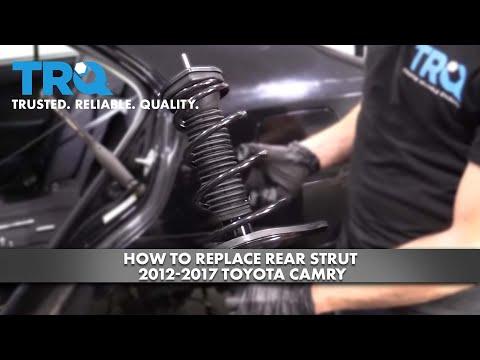






How to Replace Front Struts and Rear Shock Absorbers on a 2016 Toyota Camry
Step-by-step suspension replacement with tools, parts list, safety tips, and key torque specs
How to Replace Front Struts and Rear Shock Absorbers on a 2016 Toyota Camry
Step-by-step suspension replacement with tools, parts list, safety tips, and key torque specs


🔧 Camry - Shock Absorber/Strut Replacement
On your Camry, the rear uses separate shock absorbers, while the front uses strut assemblies (a strut is a shock with a spring and mount built around it). Replacing worn units restores ride control, braking stability, and reduces bouncing or clunking.
Difficulty Level: Intermediate | Estimated Time: 3-6 hours (rear shocks: 1-2 hours, front struts: 2-4 hours)
Assumption: Steps cover both rear shocks and front struts (most common “shock” request on this Camry).
⚠️ Safety & Precautions
- ⚠️ Support the car with jack stands; never rely on a floor jack.
- ⚠️ If doing front struts, the coil spring stores serious energy—only use a spring compressor correctly, or replace complete “quick-strut” assemblies to avoid spring transfer.
- ⚠️ Keep hands/face out of the spring’s path while compressed.
- ⚠️ Chock wheels and work on level ground.
- 🔋 Battery disconnect is not required for this job.
🔧 Required Tools
You'll need the following tools for this repair:
- Floor jack (rated 2.5-ton minimum)
- Jack stands (pair, rated 2-ton minimum)
- Wheel chocks
- Lug wrench (21mm)
- Socket set (10mm, 12mm, 14mm, 17mm, 19mm, 21mm)
- Wrench set (14mm, 17mm, 19mm)
- Breaker bar (1/2")
- Torque wrench (20–250 Nm range)
- Pry bar
- Needle-nose pliers
- Trim clip remover
- Rubber mallet
- Penetrating oil
- Paint marker
- Spring compressor (specialty)
- Safety glasses
- Mechanic gloves
🔩 Required Parts
HowToo sells all the parts you need for this repair:
- Rear shock absorbers - Replace in pairs - Qty: 2
- Front strut assemblies - Replace in pairs - Qty: 2
- Front strut mount/bearing kit - If not using complete assemblies - Qty: 2
- Front coil spring isolators - If damaged - Qty: 2
- Front sway bar end links - Optional if worn - Qty: 2
- New self-locking nuts/bolts - If supplied/required by parts kit - Qty: As needed
📋 Before You Begin
- Park on level ground, set the parking brake, and place wheel chocks at the tires staying on the ground.
- Use a lug wrench (21mm) to loosen lug nuts 1/2 turn before lifting.
- Lift one end of the car with a floor jack and support with jack stands at the proper jack points.
- Spray mounting bolts/nuts with penetrating oil and let it soak 5–10 minutes.
- Tip: Replace left/right as a pair.
🔨 Step-by-Step Instructions
Follow these steps in order:
Step 1: Remove the wheel
- Use a lug wrench (21mm) to remove the lug nuts, then remove the wheel.
Step 2 (Rear): Support the rear suspension
- Place the floor jack lightly under the rear lower control arm near the shock area to support it.
- This keeps the suspension from dropping suddenly when the shock bolt comes out.
Step 3 (Rear): Remove the rear shock lower bolt
- Use a breaker bar (1/2") with a 17mm or 19mm socket (varies by hardware) to remove the lower shock bolt/nut.
- If the bolt is tight, tap it out with a rubber mallet.
Step 4 (Rear): Access and remove the rear shock upper nuts
- Open the trunk and pull back trunk trim near the shock tower using a trim clip remover.
- Use a 14mm socket to remove the upper shock mount nuts.
- Remove the shock downward and out of the wheel well.
- Torque (install): Upper mount nuts Torque to 20 Nm (15 ft-lbs) (typical)
Step 5 (Rear): Install the new rear shock
- Position the new shock and hand-thread the upper nuts using a 14mm socket.
- Line up the lower mount, raise/lower the control arm slightly with the floor jack until the bolt slides through.
- Install the lower bolt/nut using a 17mm or 19mm socket and wrench.
- Torque (install): Lower shock bolt Torque to 137 Nm (101 ft-lbs) (typical)
Step 6 (Front): Remove brackets and sway bar link (if attached to strut)
- Remove brake hose/ABS wire brackets from the strut using a 10mm socket or 12mm socket (varies by bracket).
- If the sway bar end link attaches to the strut, remove the link nut using a 17mm socket and wrench.
- A sway bar end link is the short rod connecting the sway bar to the strut.
Step 7 (Front): Remove strut-to-knuckle bolts
- Mark the bolt/knuckle position with a paint marker for a reference line.
- Use a breaker bar (1/2") with a 19mm or 21mm socket to remove the two large bolts/nuts connecting the strut to the steering knuckle.
- Use a pry bar only as needed to separate the knuckle from the strut.
- Torque (install): Strut-to-knuckle bolts Torque to 212 Nm (156 ft-lbs) (typical)
Step 8 (Front): Remove the strut top nuts
- Open the hood.
- Use a 14mm socket to remove the top mount nuts.
- Hold the strut with one hand as you remove the last nut, then lower it out.
- Torque (install): Strut top nuts Torque to 64 Nm (47 ft-lbs) (typical)
Step 9 (Front option A): Install complete strut assembly (recommended)
- Slide the new complete strut into the tower and start the top nuts by hand using a 14mm socket.
- Align the bottom with the knuckle and install the two large bolts using a 19mm or 21mm socket and wrench.
- Reinstall sway bar link and brackets using the correct 10mm/12mm/17mm tools.
Step 10 (Front option B): Swap spring onto new strut (only if not using complete assembly)
- Install the spring compressor (specialty) onto the coil spring and compress evenly until the spring is loose in the mount.
- Remove the top nut using the appropriate socket and wrench setup for your strut hardware.
- Transfer spring and mounts to the new strut in the same orientation, then slowly release the compressor evenly.
- Tip: Compress both sides evenly, small turns.
Step 11: Reinstall wheels and lower the car
- Install wheels and hand-thread lug nuts.
- Lower the car off the jack stands using the floor jack.
- Tighten lug nuts in a star pattern using a torque wrench.
- Torque: Wheel lug nuts Torque to 103 Nm (76 ft-lbs)
Step 12: Repeat on the other side
- Repeat the same procedure for the opposite side so damping is matched left-to-right.
✅ After Repair
- Drive slowly at first and listen for clunks or rattles over bumps.
- Re-check all visible fasteners for tightness after a short test drive.
- If you replaced front struts, get a 4-wheel alignment soon (within a day or two) to prevent tire wear.
- If the steering wheel is off-center after the repair, do not ignore it—alignment is needed.
💰 DIY vs Shop Cost
Shop Cost: $900-$1,800 (parts + labor, front + rear)
DIY Cost: $350-$900 (parts only, depending on brand and whether you choose complete strut assemblies)
You Save: $550-$900 by doing it yourself!
Shop labor rates vary but typically run $100-$150/hour. This repair takes a shop approximately 3-6 hours.
🎯 Ready to get started?
HowToo makes it easy: same-day/2-day shipping on every part, plus all the tools and specialty tools you need! Check out the parts and tools sections below to add everything to your cart.