









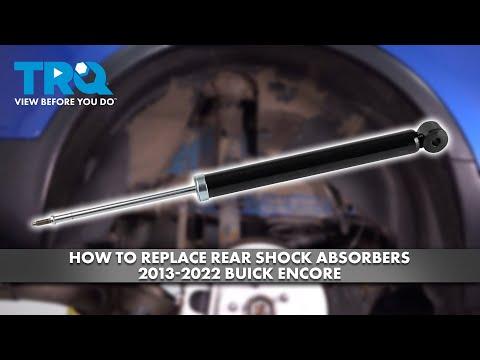







How to Replace Front Struts and Rear Shock Absorbers on a 2016 Buick Encore
Step-by-step suspension replacement guide with tools, parts list, torque specs, safety tips, and alignment notes for 2013, 2014, 2015, 2016, 2017, 2018, 2019, 2020, 2021, 2022
How to Replace Front Struts and Rear Shock Absorbers on a 2016 Buick Encore
Step-by-step suspension replacement guide with tools, parts list, torque specs, safety tips, and alignment notes for 2013, 2014, 2015, 2016, 2017, 2018, 2019, 2020, 2021, 2022


🔧 Encore - Shock Absorber/Strut Replacement
On your Encore, the rear uses separate shock absorbers, and the front uses strut assemblies (a shock + coil spring + mount). Replacing worn shocks/struts restores ride control, braking stability, and reduces bouncing and uneven tire wear.
Difficulty Level: Advanced | Estimated Time: 3-6 hours
Assumption: Stock suspension; torque specs shown are for the Encore/Trax platform.
⚠️ Safety & Precautions
- ⚠️ Never work under a vehicle supported only by a jack—use jack stands on solid ground.
- ⚠️ If you disassemble a front strut (swap spring), the coil spring is stored energy—use a coil spring compressor (specialty) and keep hands/face out of the spring’s path.
- ⚠️ Support the rear axle/suspension arm with a jack before removing shock bolts to prevent sudden drop.
- ⚠️ Do not let the brake hose or ABS wire hang or stretch—support the knuckle if needed.
- ⚠️ No battery disconnect is typically required for this job.
🔧 Required Tools
You'll need the following tools for this repair:
- Floor jack (rated 3-ton minimum)
- Jack stands (rated 3-ton minimum)
- Wheel chocks
- Safety glasses
- Mechanic gloves
- Breaker bar 1/2"
- Torque wrench 1/2" (20-200 ft-lbs range)
- Torque wrench 3/8" (10-80 ft-lbs range)
- Socket set metric 8mm-21mm
- Wrench set metric 8mm-21mm
- Torx bit set
- Trim panel tool set
- Needle-nose pliers
- Penetrating oil
- Pry bar
- Paint marker
- Coil spring compressor (specialty)
- Pass-through strut nut socket set (specialty)
🔩 Required Parts
HowToo sells all the parts you need for this repair:
- Front complete strut assemblies (Quick-Struts) - Replace in pairs - Qty: 2
- Rear shock absorbers - Replace in pairs - Qty: 2
- Front strut-to-knuckle bolts and nuts - Replace if corroded/damaged - Qty: 4
- Rear shock mounting hardware - Replace if corroded/damaged - Qty: 1 kit
📋 Before You Begin
- Park on level ground, set the parking brake, and place wheel chocks at the wheels staying on the ground.
- Loosen the lug nuts 1/2 turn using a 19mm socket and breaker bar before lifting.
- Spray stubborn fasteners (rear lower shock bolt, front strut bolts) with penetrating oil and wait 5–10 minutes.
- If you’re not using complete strut assemblies: a coil spring compressor is a tool that clamps the spring so it can be safely removed.
🔨 Step-by-Step Instructions
Follow these steps in order:
Step 1: Lift and secure the vehicle
- Use a floor jack to lift the rear (center jacking point), then set the rear on jack stands.
- Remove rear wheels using a 19mm socket.
Step 2: Access the rear upper shock mounts
- Open the rear hatch.
- Use a trim panel tool set to carefully pop off the side cargo trim panels enough to reach the shock top nuts.
- Locate the upper shock mount nuts (one per side).
Step 3: Remove the rear shocks
- Support the rear suspension arm/axle near the shock with the floor jack so it doesn’t drop.
- Remove the lower shock bolt using a 18mm socket and breaker bar.
- Remove the upper shock mount nuts using a 13mm socket.
- Pull the shock out. Use a pry bar gently if it’s stuck.
Step 4: Install the new rear shocks
- Position the new shock and start the upper nuts by hand using a 13mm socket (don’t fully tighten yet).
- Align the lower mount and install the lower bolt using an 18mm socket.
- With the suspension supported at normal ride height (jack lightly lifting the arm), torque fasteners:
- Torque rear lower shock bolt to 100 Nm (74 ft-lbs)
- Torque rear upper shock mount nuts to 25 Nm (18 ft-lbs)
Step 5: Reinstall rear trim and wheels
- Reinstall cargo trim panels using the trim panel tool set to seat clips.
- Reinstall wheels using a 19mm socket.
- Lower the vehicle and torque lug nuts in a star pattern: Torque to 140 Nm (103 ft-lbs) using a torque wrench 1/2".
Step 6: Lift and secure the front for strut replacement
- Chock the rear wheels with wheel chocks.
- Use a floor jack to lift the front, support with jack stands, then remove front wheels using a 19mm socket.
Step 7: Disconnect items attached to the front strut
- Remove the ABS/brake hose brackets from the strut using the correct socket (commonly 10mm socket).
- Remove the sway bar end link nut from the strut using an 18mm socket and matching wrench.
- Tip: Hold the link stud with a Torx bit if it spins.
Step 8: Separate the strut from the steering knuckle
- Use a paint marker to mark the strut-to-knuckle position for reference.
- Remove the two strut-to-knuckle bolts using a 18mm socket and breaker bar.
- Support the knuckle so it doesn’t pull on the axle or hoses.
Step 9: Remove the front strut assembly
- Open the hood.
- Remove the strut mount nuts at the strut tower using a 13mm socket (leave one nut loosely threaded until you’re ready to catch the strut).
- Remove the last nut and lower the strut out.
Step 10: Install the new front strut assembly
- Guide the new strut into the strut tower and start the top nuts by hand using a 13mm socket.
- Align the strut with the knuckle and install the two lower bolts using an 18mm socket.
- Reconnect the sway bar link using an 18mm socket and wrench.
- Reinstall brake hose/ABS brackets using a 10mm socket.
- Torque fasteners:
- Torque front strut upper mount nuts to 25 Nm (18 ft-lbs)
- Torque front strut-to-knuckle bolts to 140 Nm (103 ft-lbs)
- Torque front sway bar end link nut to 65 Nm (48 ft-lbs)
Step 11: Reinstall wheels and lower the vehicle
- Reinstall front wheels using a 19mm socket.
- Lower the vehicle and torque lug nuts in a star pattern: Torque to 140 Nm (103 ft-lbs) using a torque wrench 1/2".
✅ After Repair
- Do a slow test drive. Listen for clunks over bumps and confirm the steering feels normal.
- Recheck for any loose bracket bolts and look for stretched ABS/brake hoses.
- Get a 4-wheel alignment after replacing front struts (very important to prevent tire wear).
- After 50–100 miles, re-check lug nut torque with a torque wrench 1/2".
💰 DIY vs Shop Cost
Shop Cost: $900-$1,700 (parts + labor + alignment)
DIY Cost: $350-$850 (parts only)
You Save: $550-$850 by doing it yourself!
Shop labor rates vary but typically run $100-$150/hour. This repair takes a shop approximately 3-5 hours.
🎯 Ready to get started?
HowToo makes it easy: same-day/2-day shipping on every part, plus all the tools and specialty tools you need! Check out the parts and tools sections below to add everything to your cart.