









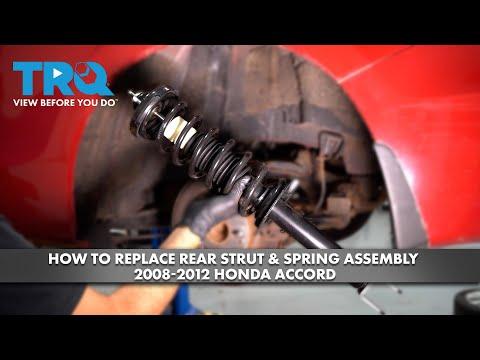







How to Replace Front Struts and Rear Shock Absorbers on a 2008-2012 Honda Accord (Engine: V6 3.5L)
Step-by-step DIY guide with required tools, parts list, safety tips, and torque specifications
How to Replace Front Struts and Rear Shock Absorbers on a 2008-2012 Honda Accord (Engine: V6 3.5L)
Step-by-step DIY guide with required tools, parts list, safety tips, and torque specifications for 2008, 2009, 2010, 2011, 2012


🔧 Accord - Shock Absorber/Strut Replacement
On your Accord, the front uses complete strut assemblies (shock + spring), and the rear uses separate shock absorbers. Replacing worn shocks/struts restores ride control, braking stability, and prevents uneven tire wear.
Difficulty Level: Intermediate | Estimated Time: 3-6 hours (pair) / 6-10 hours (all four)
⚠️ Safety & Precautions
- ⚠️ Never remove the strut center nut unless the spring is compressed; the spring can release with extreme force.
- ⚠️ Support the car with jack stands under the proper lift points; never rely on a floor jack alone.
- ⚠️ Keep hands clear of pinch points when lowering/raising the suspension.
- Disconnecting the battery is not required for this job.
- Plan on getting an alignment after front struts.
🔧 Required Tools
You'll need the following tools for this repair:
- Floor jack (rated 3-ton minimum)
- Jack stands (rated 3-ton minimum)
- Wheel chocks
- Safety glasses
- Mechanic gloves
- Breaker bar (1/2")
- Torque wrench (20–200 ft-lbs range)
- Ratchet (3/8")
- Ratchet (1/2")
- Socket set: 10mm, 12mm, 14mm, 17mm, 19mm, 22mm
- Wrench set: 10mm, 12mm, 14mm, 17mm, 19mm
- 19mm socket
- 6mm Allen key
- Extensions (3" and 6")
- Pry bar (12–18")
- Rubber mallet
- Needle-nose pliers
- Paint marker
- Penetrating oil
- Coil spring compressor (specialty)
- Pass-through strut nut socket set (specialty)
🔩 Required Parts
HowToo sells all the parts you need for this repair:
- Front struts - Replace in pairs - Qty: 2
- Front strut mount/bearing kit - Replace in pairs - Qty: 2
- Front bump stop & dust boot kit - Qty: 2
- Rear shock absorbers - Replace in pairs - Qty: 2
- Rear upper shock mounts - Recommended - Qty: 2
- New self-locking nuts/bolts for strut/shock mounting - As needed - Qty: 1 set
📋 Before You Begin
- Park on level ground, set the parking brake, and place wheel chocks at the tires staying on the ground.
- Spray mounting bolts/nuts with penetrating oil and let it soak 10–15 minutes.
- If you are not using “quick struts” (pre-assembled struts), you’ll need a coil spring compressor (a tool that safely squeezes the spring so it can’t expand).
🔨 Step-by-Step Instructions
Follow these steps in order:
Step 1: Loosen lug nuts and raise the car
- Use a 19mm socket and breaker bar to loosen lug nuts 1 turn.
- Lift with a floor jack and support with jack stands.
- Remove the wheels using a 19mm socket.
Step 2: Front strut removal (one side at a time)
- Remove the brake hose/ABS wire brackets from the strut using a 10mm socket and/or 12mm socket (depending on bracket).
- Disconnect the sway bar end link from the strut using a 17mm wrench; hold the stud with a 6mm Allen key if it spins.
- Support the lower control arm with a floor jack (light pressure).
- Remove the damper fork lower through-bolt using a 17mm socket and 19mm wrench.
- Remove the damper fork pinch bolt at the strut using a 14mm socket.
- Under the hood, remove the strut mount nuts using a 14mm socket.
- Work the strut assembly out of the wheel well; use a pry bar gently if needed.
Step 3: If installing “quick struts” (pre-assembled)
- Skip spring transfer and move to installation.
- Quick struts are safest for first-timers.
Step 4: If reusing your springs (spring transfer)
- Install the coil spring compressor (specialty) on opposite sides of the spring and tighten evenly with a ratchet until the spring is loose in the perch.
- Remove the strut center nut using a pass-through strut nut socket set (specialty) with a ratchet while holding the shaft from turning.
- Transfer spring, boot, bump stop, and mount to the new strut, matching orientation marks using a paint marker.
- Install the center nut and tighten with the pass-through strut nut socket set (specialty).
- Slowly release the spring compressor evenly and re-check that the spring ends sit in the pockets.
Step 5: Front strut installation
- Position the strut in the tower and start the top nuts by hand using a 14mm socket.
- Slide the damper fork onto the strut and install the pinch bolt using a 14mm socket.
- Install the damper fork lower through-bolt using a 17mm socket and 19mm wrench.
- Reconnect the sway bar end link using a 17mm wrench and 6mm Allen key if needed.
- Reinstall brake hose/ABS brackets using a 10mm socket and/or 12mm socket.
- Tighten fasteners to spec using a torque wrench:
- Upper strut mount nuts: Torque to 44 N·m (33 ft-lbs)
- Damper fork pinch bolt: Torque to 64 N·m (47 ft-lbs)
- Damper fork lower through-bolt: Torque to 116 N·m (86 ft-lbs)
- Sway bar end link nut (at strut): Torque to 44 N·m (33 ft-lbs)
Step 6: Rear shock removal (one side at a time)
- Open the trunk and pull back the side trim to access the upper shock mount nuts; use needle-nose pliers and a trim tool if clips are present.
- Support the rear lower control arm with a floor jack (light pressure).
- Remove the lower shock bolt using a 17mm socket and 17mm wrench.
- Remove the upper shock mount nuts in the trunk using a 14mm socket.
- Remove the shock assembly.
Step 7: Rear shock installation
- Install the new shock, start the upper nuts by hand using a 14mm socket.
- Install the lower bolt using a 17mm socket and 17mm wrench.
- Torque fasteners with a torque wrench:
- Upper shock mount nuts: Torque to 22 N·m (16 ft-lbs)
- Lower shock bolt: Torque to 59 N·m (44 ft-lbs)
- Reinstall trunk trim.
Step 8: Reinstall wheels and lower the car
- Install wheels and snug lug nuts using a 19mm socket.
- Lower the car off jack stands using a floor jack.
- Torque lug nuts in a star pattern using a torque wrench: Torque to 108 N·m (80 ft-lbs).
✅ After Repair
- Test drive at low speed first; listen for clunks over small bumps.
- Re-check lug nut torque with a torque wrench after 25–50 miles.
- Get a 4-wheel alignment, especially after replacing front struts.
- If the steering wheel is off-center or it pulls, stop and get alignment immediately.
💰 DIY vs Shop Cost
Shop Cost: $900-$1,800 (parts + labor, depends on front/rear/all four)
DIY Cost: $250-$900 (parts only, depends on quick struts vs. bare struts)
You Save: $650-$900 by doing it yourself!
Shop labor rates vary but typically run $100-$150/hour. This repair takes a shop approximately 3-6 hours.
🎯 Ready to get started?
HowToo makes it easy: same-day/2-day shipping on every part, plus all the tools and specialty tools you need! Check out the parts and tools sections below to add everything to your cart.
Guide for Suspension Strut replace for these Honda vehicles
| Year Make Model | Sub Model | Engine | Body Style |
|---|---|---|---|
| 2012 Honda Accord | - | Inline 4 2.4L | - |
| 2012 Honda Accord | - | V6 3.5L | - |
| 2011 Honda Accord | - | Inline 4 2.4L | - |
| 2011 Honda Accord | - | V6 3.5L | - |
| 2010 Honda Accord | - | Inline 4 2.4L | - |
| 2010 Honda Accord | - | V6 3.5L | - |
| 2009 Honda Accord | - | Inline 4 2.4L | - |
| 2009 Honda Accord | - | V6 3.5L | - |
| 2008 Honda Accord | - | Inline 4 2.4L | - |
| 2008 Honda Accord | - | V6 3.5L | - |